

Table of Contents
- What Commercial Smoking and Vaping Shelters Must Deliver
- Smoking Shelter Regulations You Need to Check Before Ordering
- Smoking Shelter Design: Size, Materials and Layout Choices
- Comparing Shelter Types and What Drives the Cost
- Smoking Shelter Installation: Site Prep and Fixing
- Workplace Smoking Shelters: Getting Staff and Visitors Onside
- Common Mistakes When Buying Smoking and Vaping Shelters
- Frequently Asked Questions
Last Updated: October 22, 2026
What Commercial Smoking and Vaping Shelters Must Deliver
Commercial smoking and vaping shelters in the UK are designated outdoor structures that give staff and visitors a covered place to smoke or vape while keeping entrances clear and protecting the building from smoke drift. At Store Fittings Direct, we have supplied site furniture and protection equipment for over 30 years. A shelter has four jobs. It must keep rain and wind off the people underneath. It must sit far enough from doors and windows to stop smoke entering the building. It must survive daily use without rusting, cracking or blowing loose. And it must be sited where staff can reach it on a break without walking half the car park. Get those four right and the specification almost writes itself.
Smoking Shelter Regulations You Need to Check Before Ordering
The single most important rule is that smoking is banned in enclosed and substantially enclosed public places and workplaces under the Health Act 2006, enforced by local authorities. A shelter counts as enclosed if it has a roof and walls that are more than half the perimeter, so most compliant designs are deliberately open-sided. That is why the open side is not a cost-saving shortcut, it is the legal point of the structure. Check the official smoke-free guidance on enclosed public places before you commit to a design, then confirm your plans with the local authority environmental health team, because they are the people who will assess the finished shelter. Separately, a shelter used for vaping only needs different thought, since vape policies are set by the employer rather than the smoke-free legislation.
Smoking Shelter Design: Size, Materials and Layout Choices
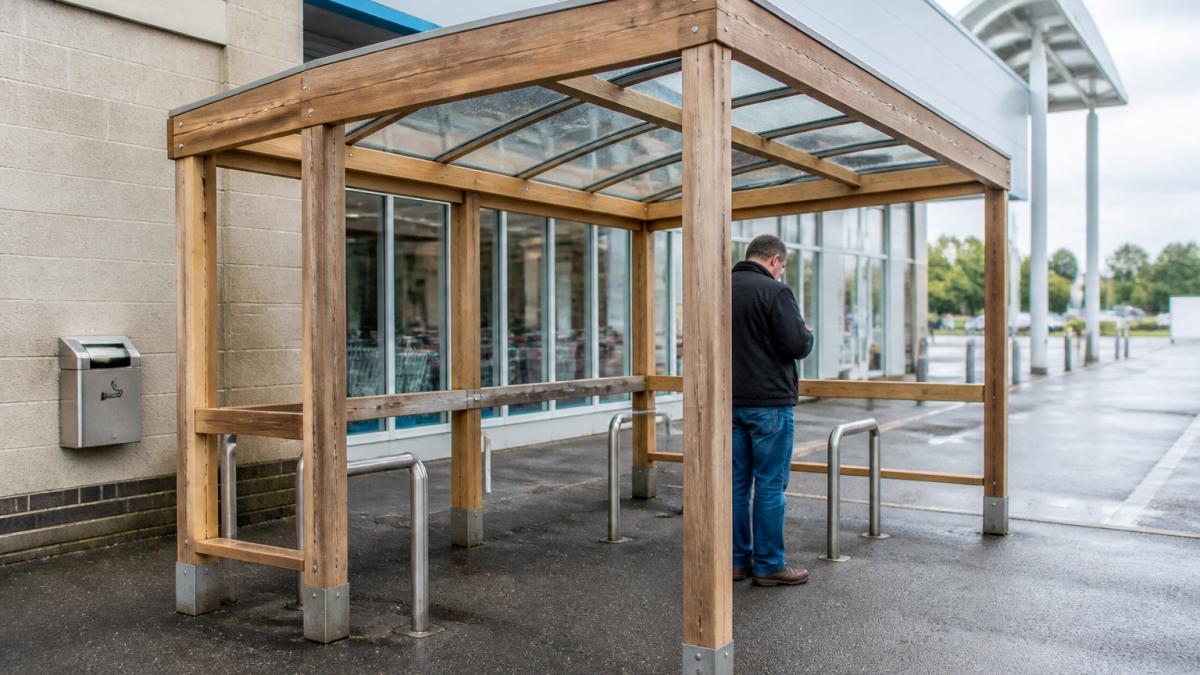
Size the shelter around the peak number of people on a break at once, not the total headcount. As a working rule, allow roughly 1 square metre of covered floor per person standing, and more if you are adding seating or a perch rail. A shelter for six people is a very different footprint from one for twenty. Layout matters as much as area: a single open long side with the back to the prevailing wind works better than a square box open on all four sides, and a shallow depth keeps people close to the roofline where the cover actually holds.
Open-Sided or Enclosed: What the Rules Require
Open-sided is the default for a reason. A roof plus one back panel and partial end panels keeps the weather out while staying comfortably under the half-perimeter threshold. Fully enclosed, glazed structures are only appropriate where you have taken specific advice and are not using the space for smoking at all.
Materials That Survive Daily Use
Powder-coated steel frames, galvanised posts, toughened glass, polycarbonate, and timber cladding are all material options. Match the material to the site.
Comparing Shelter Types and What Drives the Cost
Pricing for smoking shelters depends on size, materials, glazing, and delivery, so we quote each job rather than publish a single figure. What drives cost is predictable: floor area, roof material, how many sides are closed, whether you need ground fixings or ballast, and access for delivery. Here is how the main types compare on the things that actually matter.
| Shelter type | Best for | Weather protection | Maintenance | Relative cost |
|---|---|---|---|---|
| Open-sided steel with polycarbonate roof | Most retail and workplace sites | Good | Low | Lower |
| Open-sided with toughened glass roof | Front-of-store, visible locations | Good | Low | Mid |
| Timber-framed with pitched roof | Garden centres, hospitality | Good | Regular re-treatment | Mid to higher |
| Partly enclosed with end panels | Exposed, windy sites | Strong | Low | Higher |
| Freestanding canopy with seating | Larger staff numbers | Good | Low | Higher |
Decide the type first, then the size.
Smoking Shelter Installation: Site Prep and Fixing
Installation starts with the ground, not the frame. A smoking shelter installation needs a level, firm base, and the fixing method depends on what is underneath. Into concrete or paving, bolt-down feet are straightforward. On softer ground or where you cannot drill, weighted ballast boxes hold the shelter down without penetrating the surface. Check for underground services before drilling, and leave clear space around the open side so people are not stepping into a walkway or vehicle route. Delivery access is the detail that delays jobs: measure the gate and the path before the shelter arrives, not after.
Workplace Smoking Shelters: Getting Staff and Visitors Onside
A workplace smoking shelter only works if people actually use it. Put it where the smokers already gather, within a short walk of the staff entrance, and make it obviously more comfortable than standing by the bins. Add a cigarette bin at the edge so ends do not collect on the ground, and a perch rail for people who do not want to sit. Signage matters too: a clear sign at the shelter and at the door tells visitors where to go without staff having to explain. If you run a vape-friendly policy, state it at the shelter so the rules are visible rather than assumed.
Common Mistakes When Buying Smoking and Vaping Shelters
The recurring errors with commercial smoking and vaping shelters in the UK are all avoidable. These include not confirming the shelter stays under the half-perimeter enclosed threshold, not checking the design with the local authority before ordering, under-sizing for peak concurrent users, not specifying the wind-load fixing method for the site, not measuring delivery access to the final position, and not adding a cigarette bin and clear signage. Properly addressing these logistical oversights ensures that the infrastructure remains fit for purpose while simultaneously supporting staff who are managing workplace vaping.
- Confirm the shelter stays under the half-perimeter enclosed threshold
- Check the design with the local authority before ordering
- Size for peak concurrent users, not total headcount
- Specify the wind-load fixing method for the site
- Measure delivery access to the final position
- Add a cigarette bin and clear signage
Frequently Asked Questions
What should a commercial smoking and vaping shelter include?
A practical shelter needs an open front and sides so smoke can escape, a roof that keeps rain off, and a hard standing that stays clean. Add a wall-mounted cigarette bin, bench seating and clear signage. If vaping is allowed, confirm your policy covers it and choose materials that wipe clean easily, such as powder-coated steel or aluminium frames with polycarbonate or glass panels. Check the shelter sits away from doors and windows so smoke does not drift inside.
Do smoking shelters need to be open-sided?
In most cases, yes. Enclosed structures with walls on all sides can be treated as indoor premises under smoke-free rules, which would make smoking inside them an offence. A shelter with at least one open side, and ideally two, keeps it outdoor and lets smoke clear. Before ordering, check the exact requirements with your local authority, because conditions can vary between sites and planning consents.
Can a smoking shelter also be used for vaping?
Yes, many workplaces allow vaping in the same shelter, but you need a written policy that says so. Vaping does not produce the same smoke, yet some staff and visitors still find the vapour unpleasant, so signage should make the rules clear. If you want separate areas, a second smaller shelter or a marked zone within the same structure works well. Confirm your policy covers both smoking and vaping before installation.
How do you choose the right size smoking shelter for a workplace?
Count how many people use the shelter at peak times, such as shift changes or lunch breaks, then allow roughly one square metre of covered floor per person. A shelter that is too small pushes people outside the roof and defeats the purpose. Also check the space available, door clearance and any planning limits on the structure's height or footprint. If numbers are likely to grow, choose a modular design you can extend later.
Getting a smoking and vaping shelter right comes down to checking the rules, sizing for real use, and specifying fixings that suit the ground. At Store Fittings Direct we supply site protection and outdoor furniture backed by over 30 years of experience, a Price Match Promise, trade accounts with 30 days interest-free credit, and fast nationwide delivery. View the range and get your shelter specified correctly the first time.


