

Table of Contents
- Gondola Shelving vs Wall Shelving: The Quick Comparison
- The Pros and Cons of Gondola Shelving
- The Pros and Cons of Retail Wall Display Shelves
- How to Plan a Gondola Shelving Layout
- How to Choose Retail Shelving for Your Shop
- Can You Use Gondola and Wall Shelving Together?
- Frequently Asked Questions
Last Updated: October 22, 2026
Gondola Shelving vs Wall Shelving: The Quick Comparison
Gondola shelving is double-sided, free-standing retail shelving that merchandises stock from both sides, while wall shelving is single-sided and fixed against a perimeter wall. The pros differ sharply: gondolas maximise floor space and browsing, wall bays hold deeper stock and use vertical height.

Choosing between them is the first real layout decision most shopfits force on you. At Store Fittings Direct, we have supplied both formats for over 30 years, and the pattern is consistent: shops that get this call right need fewer bays overall and sell more per square metre of floor.
Here is the short version before we go deeper.
| Factor | Gondola Shelving | Wall Display Shelves |
|---|---|---|
| Position | Free-standing, shop floor centre | Fixed to perimeter walls |
| Sides merchandised | Two | One |
| Typical height | 1.4m to 2.1m | 2.1m to 2.4m |
| Base shelf depth | 300mm or 470mm | 570mm |
| Best for | Browsing, impulse buys, mid-floor aisles | Bulk stock, back-wall presence, heavy lines |
| Floor space used | Higher | Lower |
The Pros and Cons of Gondola Shelving
The core advantage of gondola shelving is that one bay sells from two sides. A single run down the middle of your floor gives you double the display face of a wall bay occupying the same footprint. That efficiency is why convenience stores, food halls and health and beauty retailers build their layouts around it.
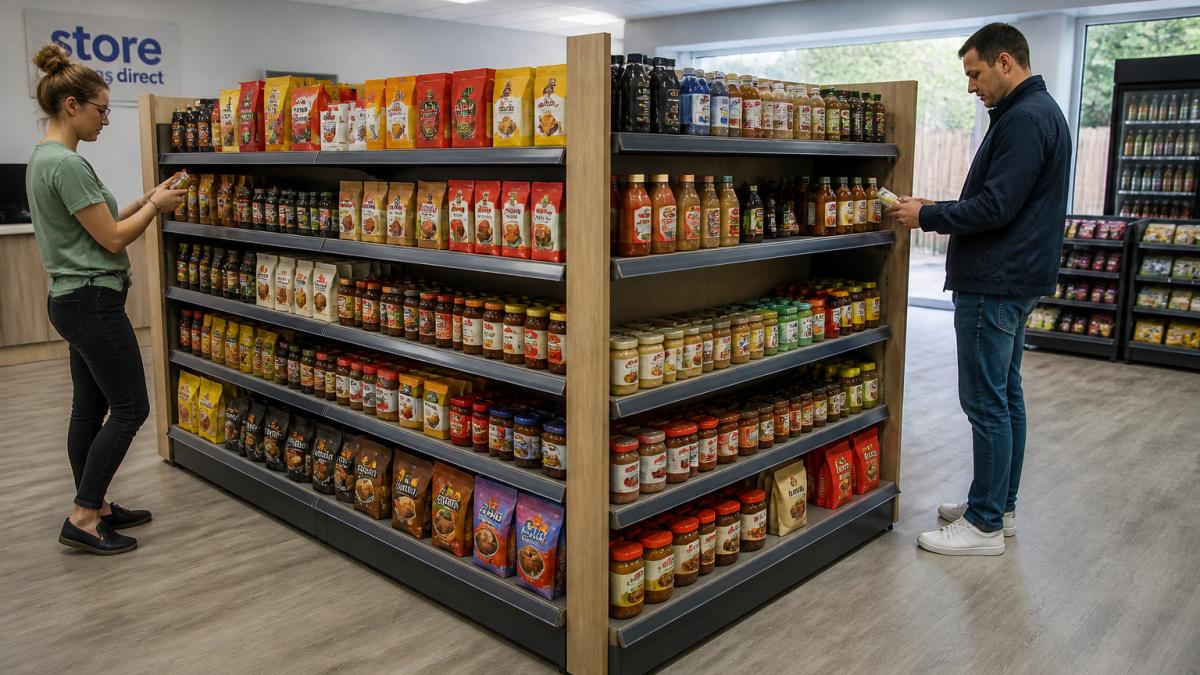
Pros:
- Double-sided display from one footprint
- Creates natural aisles and customer flow
- Adjustable upper shelves adapt as stock changes
- Free-standing, so layouts can be reworked without fixing to walls
Cons:
- Blocks sightlines if run too high or too densely
- Needs clear aisle widths either side to work
- Less suitable for very deep or bulky stock
Where Gondolas Work Best
Gondolas suit any shop where customers browse and compare. A 1.4m-high bay keeps the whole floor visible from the entrance, which matters in smaller stores. Our Wood Effect Gondola Shelving Bay, 1.4m high with a 300mm base shelf at £143.55 is the format we would start most small shops on: low enough to see over, deep enough for boxed and packaged lines.
Where Gondolas Fall Short
Run them too tall and you create a maze. A common mistake is packing a small floor with 2.1m gondolas, which kills the open feel and makes the shop feel cramped the moment two customers meet in an aisle. Keep centre runs lower than your perimeter, and leave genuine passing room.
The Pros and Cons of Retail Wall Display Shelves
Retail wall display shelves win on capacity and presence. Because they sit against a wall and merchandise one side, they can go taller and deeper without obstructing anything. A 570mm base shelf holds far more per bay than a 300mm gondola base, which suits bulkier or heavier lines.
Wood Effect Gondola Shelving Bay | 1.4m High × 300mm Base Shelf →

Pros:
- Deeper base shelves hold more stock per bay
- Taller runs use vertical space fully
- Strong back-wall presence frames the store
- Out of the way of customer circulation
Cons:
- Only one display face
- Fixed position limits layout changes
- Can feel sparse if not dressed properly
Where Wall Bays Work Best
Wall bays suit the perimeter of almost any shop, and they are the natural home for your anchor categories. Our Wood Effect Wall Bay Shelving, 2.1m high with a 570mm base shelf at £143.46 gives you that deep base and full-height display without eating floor space. For larger units, the 2.4m version at £145.88 adds another tier of selling height.

Where Wall Bays Fall Short
A wall bay only sells to customers who walk to it. Put your bestsellers on the back wall and you force people to cross the whole shop to find them. The fix is simple: use walls for destination and bulk categories, and let gondolas carry the impulse lines.
How to Plan a Gondola Shelving Layout
A workable gondola shelving layout starts with aisle width, not bay count. Work backwards from how customers move, then fit bays into the space that remains.
- Measure the floor and mark entrances. Note where customers naturally enter and turn.
- Set aisle widths first. Leave clear passing room either side of every run, wider on main routes.
- Place runs parallel to the entrance wall. This pulls customers deeper into the shop.
- Keep centre runs lower than perimeter runs. Sightlines stay open and the shop feels larger.
- Leave a clear decompression zone at the entrance. Do not start a gondola run at the door.
- Group categories along each run. Shoppers should find related lines on the same aisle.
- Test with tape on the floor before you buy. Walk the layout and adjust before committing.
HSE guidance on workplace safety and pedestrian routes is worth a read if your shop floor doubles as a stock route, since clear, unobstructed walkways matter for both customers and staff.
How to Choose Retail Shelving for Your Shop
Choosing retail shelving comes down to four tests: stock depth, sightlines, layout flexibility and finish. Answer these honestly and the format picks itself.
- Stock depth: Bulky or heavy lines point to wall bays with deep bases. Packaged, fast-moving lines suit shallower gondola bases.
- Sightlines: Small floors need low centre runs. Large floors can take taller gondolas.
- Flexibility: If you expect to rework the layout as ranges change, free-standing gondolas give you that freedom.
- Finish: Match the finish across both formats so the shop reads as one scheme. Our wood-effect ranges come in 19 frame and wood-colour combinations, so you can carry the same look from wall to floor.
One point most guides miss: buy both formats from the same range. Mismatched heights and finishes between wall and floor shelving is the single most common reason a new fit-out looks unfinished.
Can You Use Gondola and Wall Shelving Together?
Yes, and most well-planned shops do. The strongest layouts use wall bays for perimeter capacity and gondolas for mid-floor browsing, with heights stepping down from wall to centre. This combination gives you deep stock holding at the edges and open, shoppable aisles in the middle.
Wood Effect Gondola Shelving Bay | 1.4m High × 300mm Base Shelf →
The trick is proportion. In a smaller shop, expect more wall bays than gondolas. In a larger floor, the balance shifts toward centre runs. Either way, keep the finish consistent and the height hierarchy clear: tallest at the walls, lowest in the centre.
British Retail Consortium resources on retail operations covers wider store operating practice if you are planning a fuller refit alongside the shelving.
Getting the shelving mix right is the difference between a shop that feels open and one that feels cramped. At Store Fittings Direct, we supply wood-effect gondola and wall bay shelving built on powder-coated steel frames, made to order and delivered nationwide, with a Price Match Promise and trade accounts offering 30 days interest-free credit. Start with our Wood Effect Gondola Shelving Bay, 1.4m high with a 470mm base shelf at £155.61 for the mid-floor, and pair it with matching wall bays to complete the scheme.
Frequently Asked Questions
What is the difference between gondola shelving and wall shelving?
Gondola shelving is double-sided and free-standing, so it sits in the middle of the shop floor and displays stock from both sides. Wall shelving is single-sided and fixes against a wall, using the perimeter rather than the centre of the room. In practice, a gondola creates aisles and browsing routes, while wall bays use space that would otherwise be dead. Most shops benefit from both: wall bays around the edge and gondolas in the middle.
Is gondola shelving suitable for small shops?
Yes, provided you plan the layout carefully. A gondola shelving layout in a small shop should keep aisles wide enough for two people to pass and avoid blocking sightlines to the till. Shorter bays, such as a 1.4m high unit, keep the space feeling open while still doubling the display area compared with a single-sided bay. Measure your floor first and mark out the footprint with tape before ordering.
Can gondola shelving and wall shelving be used together?
They are designed to work as a pair. Retail wall display shelves line the perimeter and handle slower-moving or bulkier stock, while gondolas fill the centre and create browsing routes. Using matching finishes across both keeps the shop looking coherent. Choose the same frame and wood colour across wall bays and gondolas so the two systems read as one fitted scheme rather than a mix of odd units.
Which type of shelving is easier to rearrange?
Gondola shelving is easier to rearrange because it is free-standing and does not need to be fixed to a wall. You can move a bay to change the layout, widen an aisle, or create a promotional feature without touching the building. Wall bays are fixed in place, so their position is effectively permanent. If your range changes with the seasons, favour gondolas for the parts of the shop you reconfigure most often.
How do I choose retail shelving for a shop with limited space?
Start with the perimeter: wall bays give you display space without eating into the floor. Then add gondolas only where there is room for a comfortable aisle on both sides. Check the base shelf depth against your largest product, and pick a bay height that keeps the shop feeling open. A 300mm base gondola suits compact goods, while a 470mm base handles bulkier lines.


