

Table of Contents
- What Are the Main Shop Shelving Solutions?
- Gondola Shelving: Free-Standing Bays for the Shop Floor
- Modular Shop Shelving: Building a Bay That Fits Your Space
- Shop Shelving Prices and What Each Bay Delivers
- Retail Shelving Installation: What to Check Before You Fix Anything
- Retail Shelving Maintenance: Keeping Bays Safe and Presentable
- Conclusion
- Frequently Asked Questions
Last Updated: 22 October 2026
What Are the Main Shop Shelving Solutions?
Shop shelving solutions fall into three core families: free-standing gondola bays for the middle of the floor, single-sided wall bays for perimeter walls, and end bays that cap a run and turn aisle ends into selling space. Each is modular, so a bay can be built to suit the space rather than the space being built around the bay.
Get that structure right and everything downstream, from stock density to customer flow, follows. Get it wrong and you spend years working around a layout that fights you.
At Store Fittings Direct we have supplied shop shelving for over 30 years, across more than 1.3 million products sold, and the pattern is consistent: retailers who match bay type to position before they order get a better result.
Below, we break down each type, what it costs, and what to check before anything is fixed to a wall.
Gondola, Wall and End Bay Units Compared
The quickest way to choose is to start from where the bay will stand. A gondola is double-sided and free-standing, so it merchandises from both faces. A wall bay is single-sided and leans on a perimeter wall. An end bay is single-sided and caps a gondola run.

| Bay Type | Position | Sides | Typical Use |
|---|---|---|---|
| Gondola | Middle of floor | Double | Aisles, general merchandise |
| Display gondola | Middle of floor | Double, with back panels | Premium ranges, gifting, spirits |
| Wall bay | Perimeter wall | Single | Back-wall stock, bulk lines |
| End bay | End of a gondola run | Single | Promotions, impulse lines |
The trade-off is density against sightlines. Gondolas give you more selling face per square metre of floor, but they also block views across the store. Wall bays free up floor space but give you one face only.
Gondola Shelving: Free-Standing Bays for the Shop Floor
Gondola shelving is the workhorse of the shop floor: a free-standing, double-sided bay that holds stock on both faces and can be run end to end to form aisles. It needs no wall fixing, which makes it the most flexible option for a layout that may change.
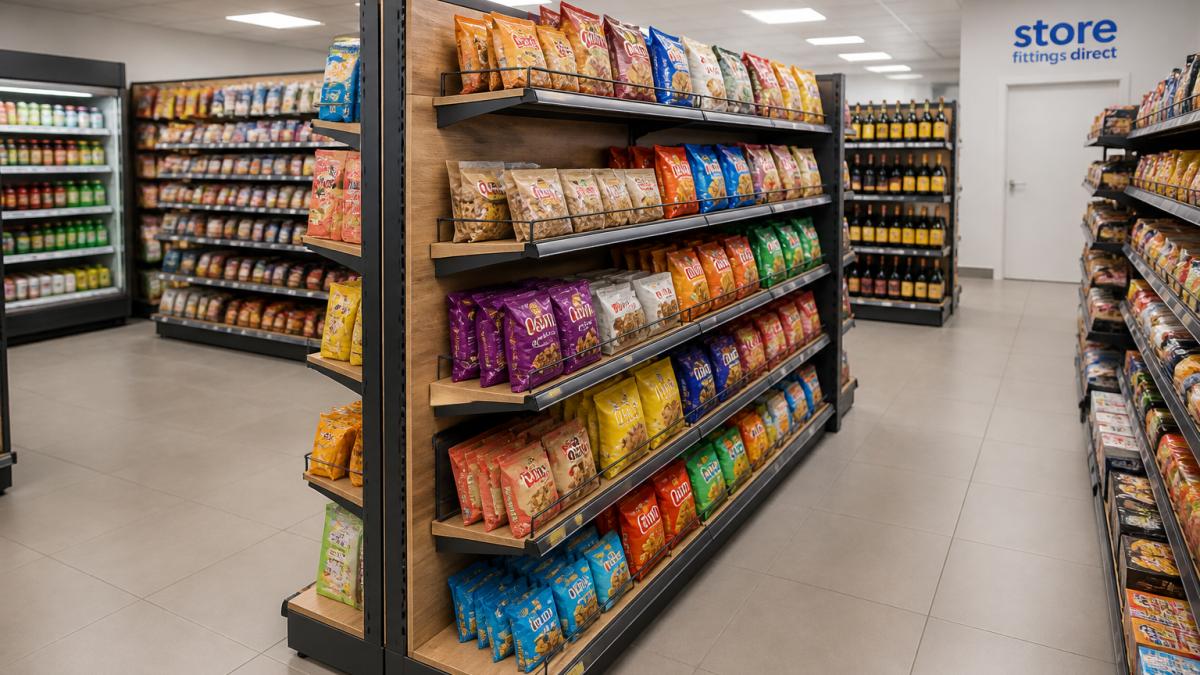
Our Wood Effect Gondola Shelving Bay stands 1.4m high with 300mm base shelves on both sides, and comes in bay widths of 500mm, 665mm, 800mm or 1000mm with one to four adjustable uppers. You choose from 19 frame and wood-colour combinations, from Rustic Oak and Walnut to Graphite and Concrete. It is £143.55.

The one drawback: at 1.4m it is a sightline-friendly height rather than a stock-maximising one.
Gondola vs Display Gondola: When Back Panels Matter
The difference is the back panel. A standard gondola leaves the rear of the bay open, so it reads as shelving. A display gondola adds full-height back-panel inserts on both sides, so it reads as a feature unit.
That distinction matters more than it sounds. Open backs suit fast-moving everyday stock where the priority is density and quick replenishment. Back panels suit categories where presentation drives the sale: beauty, vape, spirits, gifting, and anything where the packaging is part of the pitch.
The Wood Effect Gondola Display Bay is the same 1.4m height and 300mm base shelf as the standard bay, but with a coloured insert (black, blue, brown, cream, dark grey, green, light grey, red or white) or a mirror insert in the same range. It costs £126.88.
Wood Effect Gondola Shelving Bay | 1.4m High × 300mm Base Shelf →
Modular Shop Shelving: Building a Bay That Fits Your Space
Modular shop shelving is a bay system built from interchangeable components, so height, width, base depth and shelf count are chosen independently rather than fixed at purchase. That is what lets a small independent use the same system as a multiple, just in a smaller configuration.
The practical benefit is that you can phase a fit-out. Buy the bays you need now, add widths and uppers later.
Height is the decision that constrains everything else. A 1.4m bay keeps the store open and lets staff see across the floor, which suits convenience, pharmacy and boutique formats. A 2.4m bay uses the full wall height and holds considerably more, at the cost of needing a step or ladder for top shelves.
Base depth is the second lever. A 300mm base suits packaged goods and shallow lines. A 570mm base, as on our Wood Effect Wall Bay Shelving at £145.88, carries deeper or bulkier stock on a wall run.

- Height: 1.4m for open sightlines, 2.4m for wall capacity
- Base depth: 300mm for packaged goods, 470mm to 570mm for bulk
- Bay width: 500mm to 1000mm, chosen to fit the run without cutting
- Uppers: one to four adjustable shelves, set to your stock heights
Shop Shelving Prices and What Each Bay Delivers
Prices for shop shelving scale with height, base depth and whether the bay carries back panels. Understanding that lets you budget a run accurately before you commit.
| Product | Height | Base Depth | Price |
|---|---|---|---|
| Wood Effect Wall Bay Display | 1.4m | 300mm | £107.82 |
| Wood Effect Gondola Display Bay | 1.4m | 300mm | £126.88 |
| Wood Effect Gondola Shelving Bay | 1.4m | 300mm | £143.55 |
| Wood Effect Wall Bay Shelving | 2.4m | 570mm | £145.88 |
| Wood Effect End Bay Shelving | 1.4m | 470mm | £157.01 |
| Beers, Wines and Spirits Display | 1.94m wide | 420mm | £1,884.18 |
Two things stand out. First, the display versions cost less than the standard bays at the same height, because the back panel replaces open shelving structure. Second, the end bay is the most expensive 1.4m unit.
The Beers, Wines and Spirits Display is a different category of purchase entirely. At 1940mm wide by 420mm deep by 1888mm high, it is a three-tier modular feature unit built from metal, mesh and plywood, designed to be configured to your range and cross-sold with related products. It carries free delivery.
Retail Shelving Installation: What to Check Before You Fix Anything
Retail shelving installation starts with the floor and the wall, not the bay. Check both before anything is unpacked, because a bay that is level on a sloping floor will rack and a wall bay fixed into unsuitable substrate will not stay put.
Work through this before you fix anything:
- Check the floor is level across the full run, not just at the first bay
- Confirm the wall substrate will take the fixing, or plan a free-standing run instead
- Measure the total run and divide it into whole bay widths
- Check ceiling height clears the tallest bay plus the space needed to stand a shelf upright
- Plan aisle widths around your trolley or basket type before siting gondolas
- Assemble bays on the floor and level them before loading any stock
- Load base shelves first and distribute weight evenly across the bay
For wall bays, the fixing is the whole job. A single-sided 2.4m bay carries load on a wall, so the wall has to be sound and the fixings suited to the substrate. If you are unsure, run the bay free-standing instead.
A common mistake is assembling a bay against a wall and then discovering the run does not divide into whole widths. Measure first, order second.
Retail Shelving Maintenance: Keeping Bays Safe and Presentable
Retail shelving maintenance is a short monthly routine, not an annual project.
Wood Effect Gondola Shelving Bay | 1.4m High × 300mm Base Shelf →
What to check each month:
- Shelf clips and brackets seated fully at every corner
- Uprights plumb, with no lean along the run
- Base shelves free of damage and sitting flat
- Fixings on wall bays still tight, with no movement when the bay is nudged
- Back panels and inserts secure, with no lifting edges
- Powder-coated surfaces wiped down, with no chips left to spread
The thing nobody tells you about maintenance is that most failures start at the base. A base shelf that takes a knock and is left bent will pull the uprights out of line over months. Replace a damaged base shelf early.
Conclusion
The hard part of specifying shop shelving is not choosing a bay, it is matching bay type to position before you order, then checking the floor, the wall and the run length before anything is fixed.
At Store Fittings Direct we supply gondola, wall and end bays in a single modular system, so a small independent and a multiple can specify from the same range. Every bay is made to order with nationwide delivery, backed by our Price Match Promise, and trade accounts come with 30 days interest-free credit and bulk discounts on larger orders.
Get started with Store Fittings Direct and build a run that fits your space the first time.
Frequently Asked Questions
What are the different types of shelving used in retail stores?
Most shops run on three bay types. Gondola shelving is double-sided and free-standing, so it merchandises from both sides down the middle of the floor. Wall bays are single-sided and sit against a wall, typically taller at 2.4m to use the full height. End bays cap a gondola run and turn the aisle end into selling space. Within each type you choose bay width, base shelf depth and the number of adjustable upper shelves, so a single system covers most store formats.
What is gondola shelving used for?
Gondola shelving creates aisles. Because it is double-sided and free-standing, one unit displays stock to shoppers approaching from either direction, which makes it the standard choice for the middle of a sales floor in convenience stores, food halls, farm shops and health and beauty retailers. A 1.4m high bay with 300mm base shelves keeps sightlines open across the store, while the adjustable uppers let you change shelf heights as your range changes.
How do I choose shelving for a shop?
Start with the stock, not the catalogue. Measure your tallest and deepest products, then pick base shelf depth and bay width to suit them. Wall runs usually justify a taller 2.4m bay with a 570mm base, while floor-standing gondolas work better at 1.4m so staff and customers can see across the store. Then count how many adjustable uppers you need, and check the finish against your existing fit-out before ordering.
Can shop shelving be adjusted to fit different products?
Yes. Modular bays let you choose between one and four adjustable upper shelves at the point of order, and the uppers can be repositioned later as your range changes. Base shelf depth is fixed per bay, so decide that first: 300mm suits packaged and small goods, 470mm suits end-bay feature displays, and 570mm on a wall bay handles bulkier lines. Bay width is also fixed, available in 500mm, 665mm, 800mm and 1000mm options.
How do you install shop shelving?
Level the floor area first, then assemble each bay flat and stand it into position before loading any stock. Fix wall bays back to the wall and check that gondola runs are square to the aisle, because a run that drifts will show at the end bay. Load from the bottom up, keeping heavier stock on the base shelf. Made-to-order bays are built to your specification, so confirm the bay widths and upper shelf count against your floor plan before the order goes in.
How do you maintain retail shelving?
Check fixings and shelf clips monthly, and re-level any bay that rocks after a delivery or a floor clean. Wipe powder-coated steel frames with a damp cloth rather than abrasive cleaners, which dull the finish. Inspect base shelves for impact damage from trolleys and pallet trucks, since that is where wear shows first. Keep a note of which uppers were repositioned so shelf heights stay consistent along a run, and replace damaged clips rather than bending them back.


