

Table of Contents
- Wall Mounted vs Floor Bike Racks: The Core Trade-Off
- Wall Mounted Bike Racks: Pros and Cons
- Floor Bike Racks: Pros and Cons
- Commercial Bike Racks: Matching the Rack to the Site
- Vertical Bike Rack Options and When They Pay Off
- Bike Rack Installation: What to Check Before You Drill
- Cycle Parking Planning: Capacity, Access and Weather
- Frequently Asked Questions
Last Updated: 22 October 2026
Wall Mounted vs Floor Bike Racks: The Core Trade-Off
Wall mounted vs floor bike racks comes down to one question: are you buying floor space or buying simplicity? Wall mounted racks lift bicycles off the ground and free up walking routes, while floor racks trade footprint for easier lifting and fewer wall requirements. At Store Fittings Direct, we have supplied cycle storage and site protection equipment for over 30 years, and the pattern is consistent: sites with tight corridors choose wall mounted, sites with generous floor area choose floor standing.
A wall mounted bike rack is a storage fixture fixed to a wall or structural column that holds bicycles vertically or horizontally above floor level. A floor bike rack is a freestanding frame that holds bicycles upright at ground level, either by the front wheel or the frame.
The difference matters more than most buyers expect. Get it wrong and you either lose usable floor area or create a daily lifting task nobody wants to repeat.
Wall Mounted Bike Racks: Pros and Cons
The biggest advantage is reclaimed floor space. A wall mounted rack holds the bike against the wall, so the area beneath stays clear for walking, cleaning and fire escape routes. That single benefit decides the specification on most constrained sites.
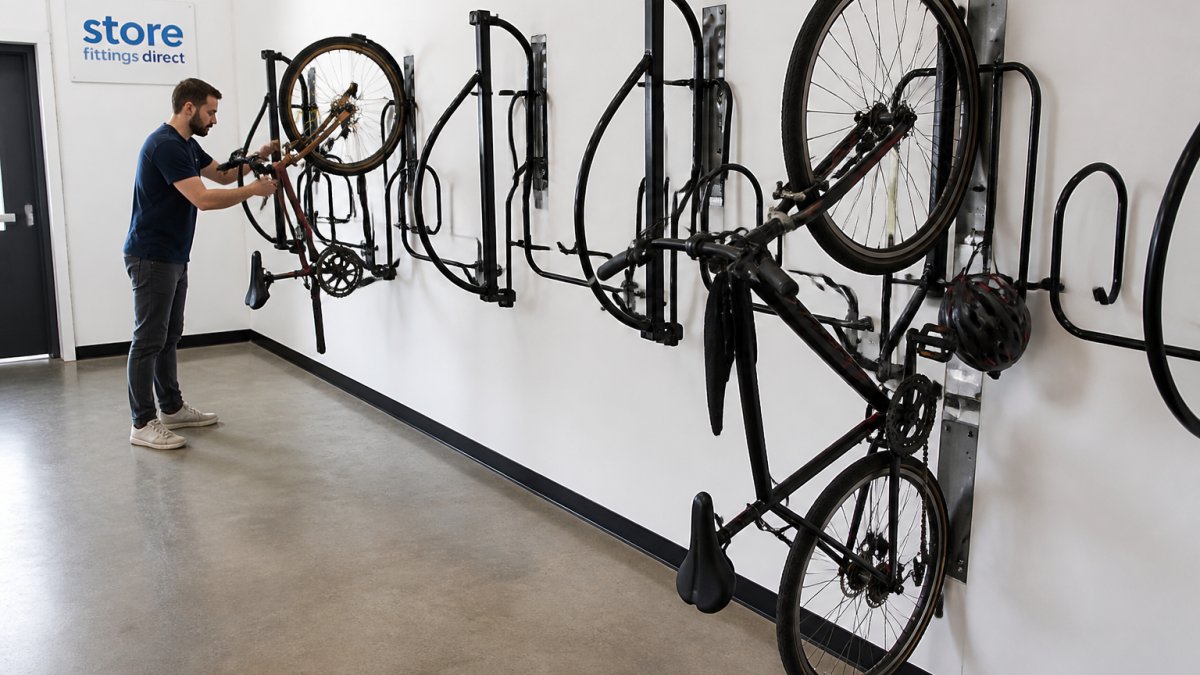
Pros:
- Frees floor area for circulation and cleaning
- Keeps bikes tidy and off walkways
- Deters casual theft by lifting bikes out of easy reach
- Suits corridors, alcoves and unused wall runs
Cons:
- Requires sound masonry or structural wall fixings
- Lifting a bike overhead is hard work for some users
- Less suitable for heavy e-bikes and cargo cycles
- Limited by wall length rather than room size
Where Wall Mounted Racks Work Best
Wall mounted racks suit sites with long, sound walls and short floor space: staff rooms, back-of-house corridors, garages and covered compounds. They work poorly where walls are stud partition, where bikes are heavy, or where users have limited mobility. Check the wall substrate before ordering anything.
Floor Bike Racks: Pros and Cons
Floor bike racks win on accessibility. A rider rolls the bike in, drops the front wheel into the cradle and walks away. No lifting, no wall fixings, no structural survey. For schools, leisure centres and public-facing sites, that ease of use drives far higher uptake than any space saving.
Pros:
- No wall fixings or structural assessment needed
- Easy for all ages and abilities
- Handles heavy e-bikes and cargo cycles
- Can be relocated or reconfigured
Cons:
- Consumes floor area permanently
- Needs a level, well-drained surface
- Freestanding units can be moved unless anchored
- Lower density per square metre than vertical storage
Where Floor Racks Make More Sense
Floor racks fit sites with spare ground and mixed users: school cycle shelters, leisure centre compounds, retail staff parking and visitor areas. They also suit temporary or leased buildings where drilling walls is not an option. If the surface is uneven or slopes, sort that first, because a rocking rack damages frames and puts users off.
Commercial Bike Racks: Matching the Rack to the Site
Commercial bike racks are specified by site, not by preference. We group the decision into three site types, which keeps the choice simple:
Site type |
Recommended rack |
Why |
Watch out for |
|---|---|---|---|
Tight corridor or alcove |
Wall mounted |
Frees floor area |
Wall must take load |
School or leisure compound |
Floor standing |
Easy for all users |
Needs level surface |
Mixed fleet with e-bikes |
Floor standing, anchored |
Handles weight |
Anchor into base |
Long wall, short floor |
Vertical wall mounted |
Highest density |
Lifting effort |
The pattern is clear. Where floor area is the constraint, go up the wall. Where user effort is the constraint, stay on the floor.
Vertical Bike Rack Options and When They Pay Off
A vertical bike rack stores bicycles nose-up or hung by the front wheel, stacking them closely along a wall. It delivers the highest number of bikes per metre of wall of any option here, which is why it appears in staff rooms and residential compounds with more bikes than floor.
Vertical storage pays off when three conditions hold: the wall is solid, the bikes are light enough to lift comfortably, and users are regulars who accept the routine. It stops paying off the moment heavy e-bikes arrive or a user cannot lift safely. Be honest about who will actually use the rack.
Bike Rack Installation: What to Check Before You Drill
Bike rack installation fails on preparation, not on the product. Before any fixing goes in, confirm four things:
- Wall or base construction identified and load capacity confirmed
- Fixings matched to the substrate, not the default ones in the box
- Rack height set so the bike clears the floor and any obstruction
- Spacing checked against handlebar width so bikes do not clash
- Route to the rack clear of fire exits and walkways
- Anchors sealed against water ingress on external walls
For floor units, anchoring into a concrete base stops the rack walking when bikes are pulled out. On external sites, position racks under cover where possible, because constant rain accelerates wear on frames, locks and fixings. Where cycle parking sits in a public area, check that it does not obstruct an escape route, in line with government fire safety guidance for premises.
Cycle Parking Planning: Capacity, Access and Weather
Cycle parking planning starts with a count, not a catalogue. Work out peak demand first: how many bikes arrive on the busiest day, then add headroom for growth. Density follows from the rack type, and access follows from the route riders take to reach it.
Three planning rules hold on almost every site:
- Capacity: plan for peak demand plus spare spaces, because a full rack pushes riders to improvise.
- Access: the route to the rack should be direct, lit and step-free where possible.
- Weather: covered parking increases use noticeably, and shelter protects the equipment itself.
Good cycle parking also needs signage and, on public sites, a clear policy on abandoned bikes. A rack full of rusting frames is worse than an empty one, because it tells riders the facility is not managed.
For sites that need barriers, bollards or protective fixtures alongside cycle parking, our range at Store Fittings Direct covers the wider site protection brief, and our team can advise on matching rack specification to the space you actually have.
Frequently Asked Questions
Are wall-mounted or floor bike racks better for a small space?
Wall-mounted racks usually win in tight spaces because they free up the floor. A vertical wall rack holds one bike in roughly the footprint of its handlebars, so a narrow corridor or a spare wall in a shop back area can become usable cycle parking. Floor racks need clear ground space in front of them for wheeling bikes in and out. If your site has a wide, empty floor but little wall, a floor rack is the simpler choice.
How much space do wall-mounted bike racks save?
A wall-mounted rack removes the need for a floor footprint per bike, so the saving is effectively the depth of a floor stand plus the manoeuvring room around it. In practice, a wall that would hold two floor racks can often take four or more hanging bikes. The trade-off is that you need clear wall height and enough space in front of the wall for a person to lift and hang the bike.
Can wall-mounted bike racks hold different types of bikes?
Many do, but check the hook spacing and weight rating before buying. Standard hooks suit road bikes, hybrids and children's bikes. Heavier e-bikes and cargo bikes need a rack rated for their weight and often a two-point fixing rather than a single hook. Folding bikes are usually easiest on a floor rack. Measure your longest wheelbase and confirm the rack's stated limits.
Which type of bike rack is easier to maintain?
Floor racks generally need less attention because there are no wall fixings to check and no lifting mechanism. Wall racks should have their fixings inspected periodically, especially in busy commercial bike racks where users may hang bikes carelessly. Both types benefit from a quick check of paint or coating and a clean of the contact points. Stainless or galvanised finishes cut maintenance in exposed cycle parking areas.
Choosing between wall mounted and floor bike racks is a site survey question dressed up as a product question. Get the wall construction, floor area and user profile right, and the specification writes itself. Store Fittings Direct supplies durable cycle storage and site protection equipment with fast nationwide delivery, trade accounts with 30 days interest-free credit, and a Price Match Promise. Get started with Store Fittings Direct and specify cycle parking that holds up to daily use.


