

Table of Contents
- Why Hardware Stores Are a Prime Target for Theft
- Asset Protection and Theft Prevention for Hardware Stores: The Core Framework
- Retail Loss Prevention Strategies That Work on the Shop Floor
- How to Install Retractable Barriers in Shops
- Observation Mirrors and Camera Systems: Seeing the Blind Spots
- Legal Considerations for Retail Security in the UK
- Frequently Asked Questions
Last Updated: September 25, 2026
Why Hardware Stores Are a Prime Target for Theft
Hardware stores lose stock to theft in ways most retailers never have to think about. The reason is simple: the same qualities that make a hardware store useful to a tradesperson make it attractive to a thief. Tools are compact, branded, easy to resell, and carry genuine value. Fixings, copper fittings, and power tool accessories vanish in pockets and bags without anyone noticing until stocktake.
This guide from Store Fittings Direct covers asset protection and theft prevention for hardware stores, drawn from more than 30 years supplying shop fixtures and site protection equipment to retailers across the country. The core problem is that hardware stores are laid out for browsing, not for surveillance. Long aisles, high shelving, and open displays create natural blind spots that a determined shoplifter learns to use within minutes of walking in. Mitigating these structural vulnerabilities requires a comprehensive approach to retail loss prevention strategies that adapts to evolving inventory management challenges.
Three factors make the sector unusually exposed:
- High resale value. Branded hand tools and copper components sell quickly online and at car boot sales, with no traceability.
- Small, dense stock. A single shelf can hold hundreds of pounds of merchandise that fits in a coat pocket.
- Self-service layout. Customers handle stock directly, so staff have fewer natural touchpoints to check what leaves the building.
Theft prevention in this environment is not about one dramatic measure.
Asset Protection and Theft Prevention for Hardware Stores: The Core Framework
Asset protection and theft prevention for hardware stores works best as a layered system rather than a single control. Each layer targets a different stage of the theft attempt, so a failure at one point is caught by the next.
Layered defence: deter, detect, delay, respond
| Layer | What It Does | Practical Example | Typical Cost Band |
|---|---|---|---|
| Deter | Stops the attempt before it starts | Ceiling and wall observation mirrors | Low |
| Detect | Spots activity in progress | Camera coverage on blind spots | Medium |
| Delay | Slows the theft down | Cable locks on power tools | Low to medium |
| Respond | Manages the incident safely | Written staff procedure | No equipment cost |
The mistake most independents make is spending heavily on one layer, usually cameras, while leaving the others thin. A camera records a theft beautifully and prevents almost nothing on its own.
Detective-X Convex Observation Mirror →
Retail Loss Prevention Strategies That Work on the Shop Floor
Retail loss prevention strategies succeed when they change the physical layout, not just the policy folder. The shop floor is where stock actually disappears, so that is where the effort belongs.
High-value stock: tools, fixings and copper
Move the most stealable lines into the most visible part of the store. Power tools, branded hand tools, copper fittings, and anything under roughly the size of a shoebox should sit where staff and mirrors can see them continuously.
A workable approach for a typical independent:
- Relocate high-value tools to a staffed or camera-covered zone
- Reduce the quantity on open display and keep backstock in a locked area
- Add cable locks or locked cases to the top ten most stolen lines
- Review the till area so it overlooks the highest-risk aisle
- Train staff to greet every customer within 30 seconds of entry
How to Install Retractable Barriers in Shops
Knowing how to install retractable barriers in shops comes down to three decisions: where the barrier goes, what height it needs to reach, and how it is fixed to the floor or wall. Get those right and installation is a straightforward job for one person with basic tools.
- Choose the mounting point. Position the unit so the tape or belt extends across the full opening at the height you need. Check that nothing obstructs the path when extended.
- Mark and check the fixings. Hold the unit in place, mark the fixing holes, and confirm the surface is sound. Hollow plasterboard needs appropriate anchors, not standard plugs.
- Drill and mount the housing. Drill to the marked depth, fit the anchors, and secure the housing. Keep the unit level so the retraction mechanism runs smoothly.
- Fit the receiving end. Install the wall clip or post that the belt or tape connects to, aligned with the housing.
- Test the full extension. Pull the barrier out fully, check the retraction, and confirm the belt does not sag or catch.
- Add signage if needed. Where a barrier restricts access, a clear sign avoids customers trying to step over it.
Observation Mirrors and Camera Systems: Seeing the Blind Spots
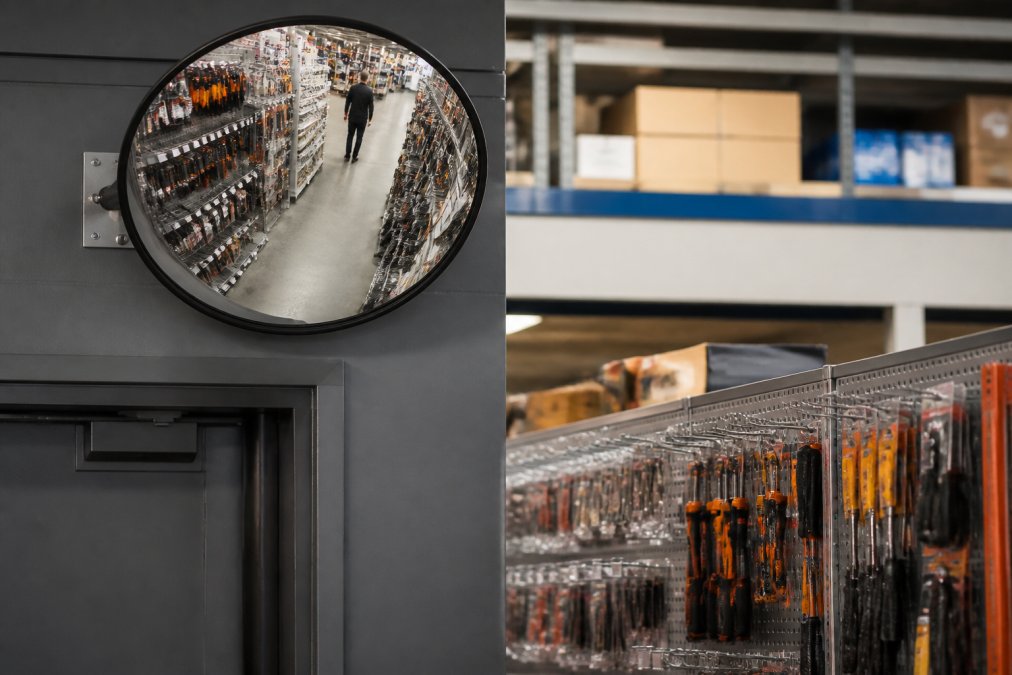
For hardware stores, the practical options are straightforward:
- Convex wall mirrors for covering a single aisle or a till approach. The Health and Safety Executive guidance on workplace safety notes that good visibility in circulation areas also reduces accident risk, which matters in a store where customers handle heavy stock.
- Domed mirrors for junctions, corners, and any point where two aisles meet and neither is visible from the other.
- Body-worn cameras for staff working the floor or a trade counter, giving a recorded account of an incident without a fixed installation.
Legal Considerations for Retail Security in the UK
Retail security in the UK sits inside a specific legal framework, and getting it wrong exposes a business to claims even when it was the victim of a crime. Two areas matter most for hardware stores: data protection and the powers available to staff.
Detective-X Convex Observation Mirror →

- What staff should do when they suspect theft
- Who reviews camera footage and how requests are handled
- How long footage is retained and how it is deleted
- When and how the police are contacted
Frequently Asked Questions
What are the most effective theft prevention measures for hardware stores?
A combination of visible deterrents and physical controls works best. Convex observation mirrors, such as the Detective-X range, remove blind spots, while body-worn cameras and clear signage signal that staff are alert. Keep high-value items like power tools and copper fittings in locked cages or behind counters, and use retractable barriers to control access to restricted aisles. Regular stock counts help you spot shrinkage early. No single measure stops theft on its own, but layering several makes your store a harder target than the one down the road.
How does retail asset protection differ from general loss prevention?
Asset protection covers the whole picture: your stock, fixtures, equipment, cash and premises. Loss prevention tends to focus on reducing shrinkage from theft, fraud and admin errors. In a hardware store, asset protection also means protecting expensive display fittings and tools from damage or removal. The two overlap heavily, but asset protection takes a broader view of what your business owns and what it would cost to replace. Think of loss prevention as one strand within a wider asset protection plan.
What role do physical barriers play in hardware store security?
Physical barriers control movement through your store. Retractable belt barriers can close off aisles outside trading hours or guide customers away from stockrooms. Fixed barriers protect high-value displays and create a clear boundary between public and staff areas. By making it harder to reach stock quickly, barriers buy your team time to respond. They also work as a visual deterrent: a would-be thief is less likely to attempt a grab-and-run when a barrier stands between them and the exit.
How can hardware stores reduce inventory shrinkage?
Start with accurate stock records and regular cycle counts so you notice discrepancies quickly. Secure high-risk lines such as drill bits, copper pipe and hand tools in locked display units or behind the counter. Use mirrors and cameras to cover blind spots, and train staff to greet every customer, which signals that they are being watched. Review your returns and refund process for weak points. Small changes, applied consistently, cut shrinkage more effectively than one expensive system.
What are the legal considerations for retail security in the UK?
If you use CCTV or body-worn cameras, you must comply with UK GDPR and the Data Protection Act 2018. That means telling people they are being recorded, storing footage securely and keeping it only as long as necessary. The Partner MK4 body-worn camera, for example, uses AES 256 encryption and password protection to meet these requirements. You also need a lawful basis for processing personal data and a clear retention policy. Displaying the right notices and training staff on data handling keeps you on the right side of the rules.
How often should I check my theft prevention measures?
Review your measures at least quarterly, and after any incident. Walk the shop floor as a customer would and look for new blind spots created by seasonal displays or moved shelving. Check that mirrors are clean and angled correctly, barriers retract smoothly and cameras are recording. Update your staff training when you change layouts or introduce new equipment. A quick monthly walk-through takes minutes but catches problems before they cost you stock.


