

Table of Contents
- How Full Height and Half Height Turnstiles Differ
- Full Height Turnstiles: Models, Sizes and Duty Ratings
- DDA Access Regulations and Accessible Entry Points
- The Technoport Automatic Gate as a Turnstile Alternative
- Choosing the Right Turnstile for Your Site
- Installation, Power and Fire Safety Checks
- Frequently Asked Questions
Last Updated: September 23, 2026
How Full Height and Half Height Turnstiles Differ
Turnstiles are access control gates that allow one person through at a time, using rotating arms or barriers to regulate pedestrian flow. The two main types, full height and half height, solve different problems. At Store Fittings Direct, we've supplied access gates to warehouses, construction sites and public venues for over 30 years, and the choice usually comes down to one question: what are you trying to stop?

Full height turnstiles enclose the user completely, with rotating arms that reach from floor to a canopy or frame above head height. Half height turnstiles use waist-high arms or glass barriers, so a person can see over and, if determined, climb over. That single physical difference drives every other decision, from security level to where each unit gets installed.
Below, we'll break down what each type actually stops, where each still makes sense, and how DDA access regulations shape the specification.
Full Height Turnstiles: Models, Sizes and Duty Ratings
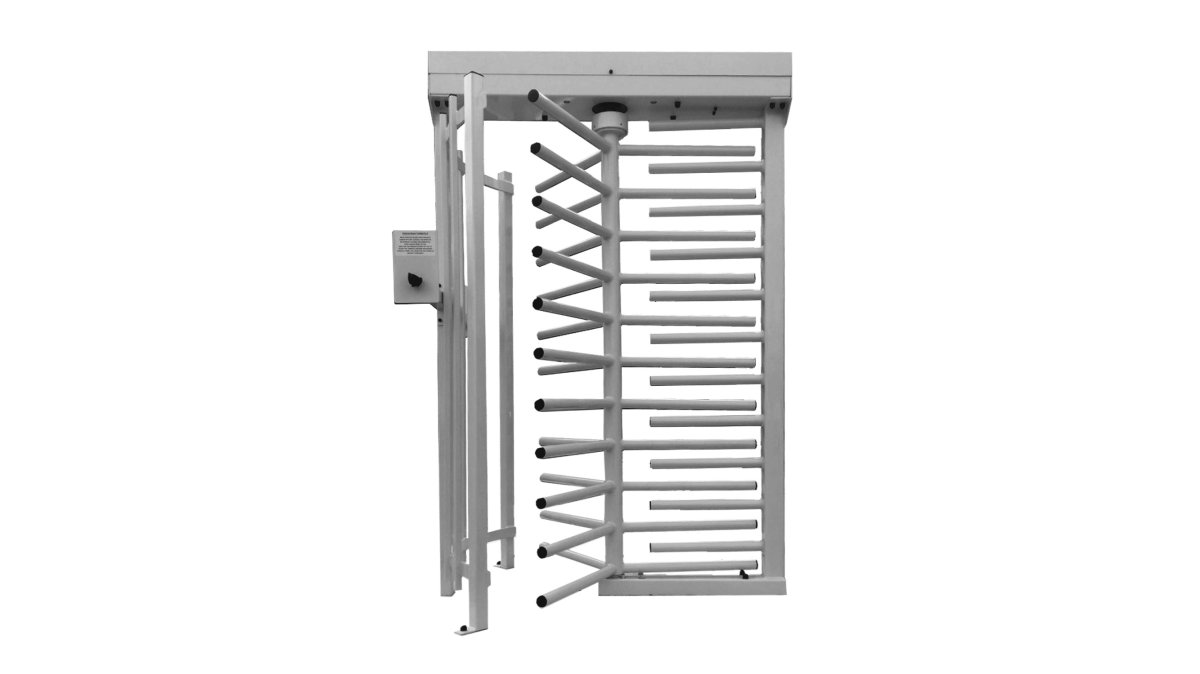
A full height turnstile is a floor-to-canopy rotating gate that physically encloses the user, making it the strongest pedestrian access control option short of a manned gatehouse. It's the specification you choose when unauthorised entry, not just crowd counting, is the risk.

The SFD 4000 range from Store Fittings Direct comes in single or double configuration across three models (4000P, 4000G, 4000GP), with a choice of 90-degree or 120-degree arms and trombone arms. Every unit is 100% duty cycle rated, meaning it handles continuous operation on heavy foot traffic without a cooldown period. The single Dalby Full Height Turnstile Pedestrian Gate is available now, and the double version suits sites where two lanes of traffic need to move simultaneously.
Single or Double Configuration
Single units control one lane of traffic and suit smaller sites or secondary entrances. Double units handle two lanes side by side, which keeps queues moving at shift change on construction sites and industrial premises. If your site sees concentrated arrival times, a double configuration usually pays for itself in reduced congestion.
DDA Access Regulations and Accessible Entry Points
DDA access regulations, formally the Equality Act 2010, require that access control doesn't create a barrier for disabled users. A turnstile alone rarely satisfies this. The practical answer is a parallel accessible gate, an automatic swing or sliding gate wide enough for a wheelchair, positioned alongside the turnstile lane and operated by the same access control system.
This matters most on public-facing sites: stadiums, transport hubs, council facilities and anywhere the public has a legal right of entry. Security and accessibility aren't in conflict here, but they do need designing together from the start. Retrofitting an accessible lane after a turnstile is installed costs considerably more than specifying both at once. Consistent procurement strategies allow organisations to standardise security hardware across multiple sites, ensuring that accessibility compliance remains uniform regardless of the specific location.
The Technoport Automatic Gate as a Turnstile Alternative
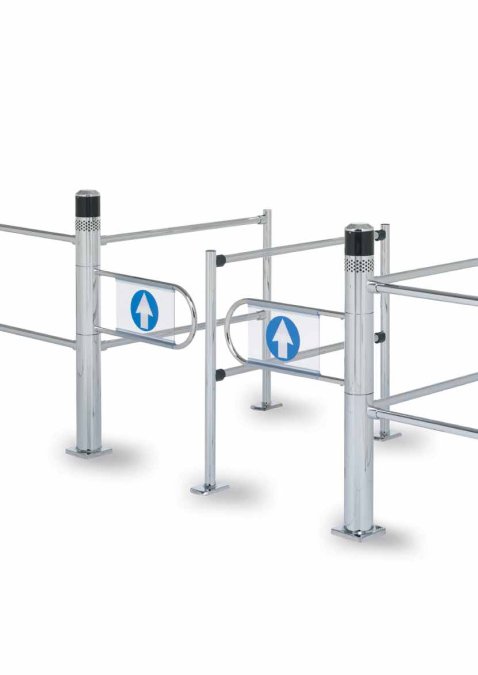
For sites that need both security and compliance, the strongest setup pairs a full height turnstile for general pedestrian flow with a Technoport automatic gate as the accessible lane. Both connect to the same access control reader, so you manage one credential system rather than two. The Technoport works particularly well where a turnstile would be overkill for the traffic volume but you still need controlled entry rather than an open doorway.
Choosing the Right Turnstile for Your Site
Match the turnstile to the threat, not the budget line. A construction site losing tools overnight needs a full height unit. A stadium managing entry flow needs turnstiles plus an accessible lane. A small office reception may only need a half height unit for direction, not security.
Use this to narrow the decision:
Site Type |
Recommended Solution |
Why |
|---|---|---|
Construction site, warehouse yard |
Full height single or double |
Stops climbing and tailgating |
Stadium, transport hub |
Full height + accessible gate |
High volume plus public access duty |
Office reception, gym |
Half height turnstile |
Direction and counting, not security |
Public facility with wheelchair access |
Technoport automatic gate |
Meets DDA access requirements |
The Harby Full Height Pedestrian Turnstile is the value option for construction and industrial sites, with a slimline single design that ships flat-packed or preassembled for rapid installation.
Installation, Power and Fire Safety Checks
Fire safety is the check most buyers leave too late. Turnstiles must release or free-rotate on a fire alarm so occupants can exit without obstruction. Both the Harby and SFD 4000 ranges can be configured to free rotate on alarm, but this has to be specified at order, not added later.
Power and mounting matter too. Full height units need a flat, level base and either mechanical or powered operation depending on your access control setup. Optional canopy heads and reader mounting plates let you fit third-party access control systems without custom fabrication.
- Confirm flat, level base is prepared before delivery
- Specify fire alarm free-rotation at order
- Confirm mechanical or powered operation
- Check reader mounting plate compatibility
- Plan the accessible lane alongside the turnstile
Frequently Asked Questions
What is the difference between full height and half height turnstiles?
Full height turnstiles stand roughly 2.1 metres tall with a rotating cage of arms, so they cannot be climbed over or ducked under. Half height models use waist-high barriers or tripod arms and control flow rather than block it. Full height units suit construction sites, warehouses and perimeter fencing where equipment theft is a risk. Half height units work better in lobbies and offices where you want direction without a fortress feel. Full height turnstiles are also the stronger choice where you need to monitor staff movement for time and attendance.
How do turnstiles meet DDA access regulations in public buildings?
The Equality Act 2010 requires reasonable adjustments so disabled people are not placed at a disadvantage, and the earlier DDA duties still shape how venues plan entrances. In practice this means every turnstile line needs an adjacent accessible route: a widened gate, a powered opening or a staffed side entrance at least 900mm clear. Turning circles, level thresholds and clear signage all matter. A turnstile alone is rarely enough; it has to sit within a wider access plan that a wheelchair user, a guide dog handler or someone with luggage can all use.
Are turnstiles effective for high-security environments?
Yes, when they are specified correctly. A full height turnstile with a 100% duty cycle rating runs continuously through heavy foot traffic, and the enclosed cage design prevents tailgating and climbing. The SFD 4000 range is built for airports, construction sites, lorry parks and industrial estates, and can be retrofitted into an existing fence line. Pairing a turnstile with access control readers, canopy heads and monitored CCTV gives you a layered perimeter rather than a single point of control. The weak link is usually the surrounding fence, not the turnstile itself.
How do I choose between a turnstile and an automatic gate?
Start with who needs to pass through and how often. A single full height turnstile handles one person at a time and costs £3,995, while a double unit at £6,995 moves two streams side by side. If you need to admit vehicles, deliveries or wheelchair users without staff assistance, a powered gate is the better fit because it opens on demand and can be tied into the same access control system. Many sites combine both: turnstiles for pedestrian staff entry, an automatic gate for accessible and vehicle access.
Specifying turnstiles correctly comes down to matching the unit to the actual threat and building accessibility in from the start, not bolting it on afterwards. Store Fittings Direct supplies full height turnstiles, double units and the Technoport automatic gate with free delivery, backed by over 30 years in the trade and a Price Match Promise. Get started with Store Fittings Direct and specify an access control setup that meets both your security and DDA access obligations.


