

Table of Contents
- Deposit Return Scheme UK: How It Will Change Retail
- Deposit Return Scheme Retailer Requirements
- Deposit Return Scheme Containers: What's Included
- Deposit Return Scheme Return Points: Setting Up In-Store
- Deposit Return Scheme Labelling: Getting It Right
- How to Prepare Your Store Before Launch
- Frequently Asked Questions
Last Updated: 16 October 2026
Deposit Return Scheme UK: How It Will Change Retail
A deposit return scheme, DRS in the UK adds a small refundable deposit to the price of a drink container, which the customer reclaims when they return the empty item to a collection point. For retailers, that turns the checkout and the back of store into a collection and handling operation, not just a sales space.
This guide from Store Fittings Direct covers what the scheme asks of shops, which containers it captures, how to lay out return points, and what to sort out before launch day. Below, we walk through each requirement in the order you will actually face it.
The direction of travel is clear. The Department for Environment, Food & Rural Affairs guidance on deposit return schemes sets out the framework for a scheme that covers single-use drinks containers, with collection infrastructure expected across retail and community settings. Scotland has been running its own parallel process, so operators with sites in more than one nation should track both.
Deposit Return Scheme Retailer Requirements
Retailers who sell drinks in containers covered by the scheme must act as return points, accept eligible empties, and pay back the deposit. The detail varies by nation and by the size of your operation, but the core obligations are consistent: take the container back, refund the deposit, and handle the material responsibly.
In practice, that means three things land on your plate:
- Collection: a place where customers can hand over empties, whether staffed or self-service
- Refund handling: a clear method for returning the deposit, in cash or as a voucher
- Storage and uplift: somewhere to hold collected containers before they are taken away
Most of the friction sits in the third item. A busy convenience store can accumulate a surprising volume of empties in a single day, and if there is no dedicated holding area, the collection point becomes a trip hazard within a week. The Scottish Environment Protection Agency guidance on deposit return underlines that returned containers must be stored and managed so they do not create environmental or safety problems on site.
Exemptions and Small Retailer Rules
Smaller shops often qualify for lighter-touch rules, and the thresholds differ between nations. Some schemes exempt very small retailers from acting as a return point, or allow them to opt out where a nearby alternative exists.
Because those thresholds are set in legislation and can change, we would not quote a figure here. Check the current rules for your nation on the official government pages before you assume you are exempt. If you sell drinks across several sites, treat each site on its own merits rather than applying one blanket decision.
Deposit Return Scheme Containers: What's Included
A deposit return scheme container is a single-use drinks container made of glass, plastic, or metal that falls within the size range the scheme specifies. The scheme does not cover every bottle or can on your shelves, so the first job is mapping which of your products are in scope.
Broadly, expect the scheme to capture:
- Plastic bottles, typically the smaller single-use format
- Metal cans
- Glass bottles in the relevant size band
Containers that fall outside the specified size range, and drinks formats such as cartons, generally sit outside the scheme. The exact size limits are set in the regulations and differ by nation, so verify against the official source rather than working from memory.
Deposit Return Scheme Return Points: Setting Up In-Store
A return point is the physical location where customers hand back empty containers and reclaim their deposit. Getting this right is mostly a space and flow problem, and it is where shop fittings do the heavy lifting. Efficient infrastructure for recycling beverage packaging must also account for the growing variety of small-format items that complicate standard collection processes.
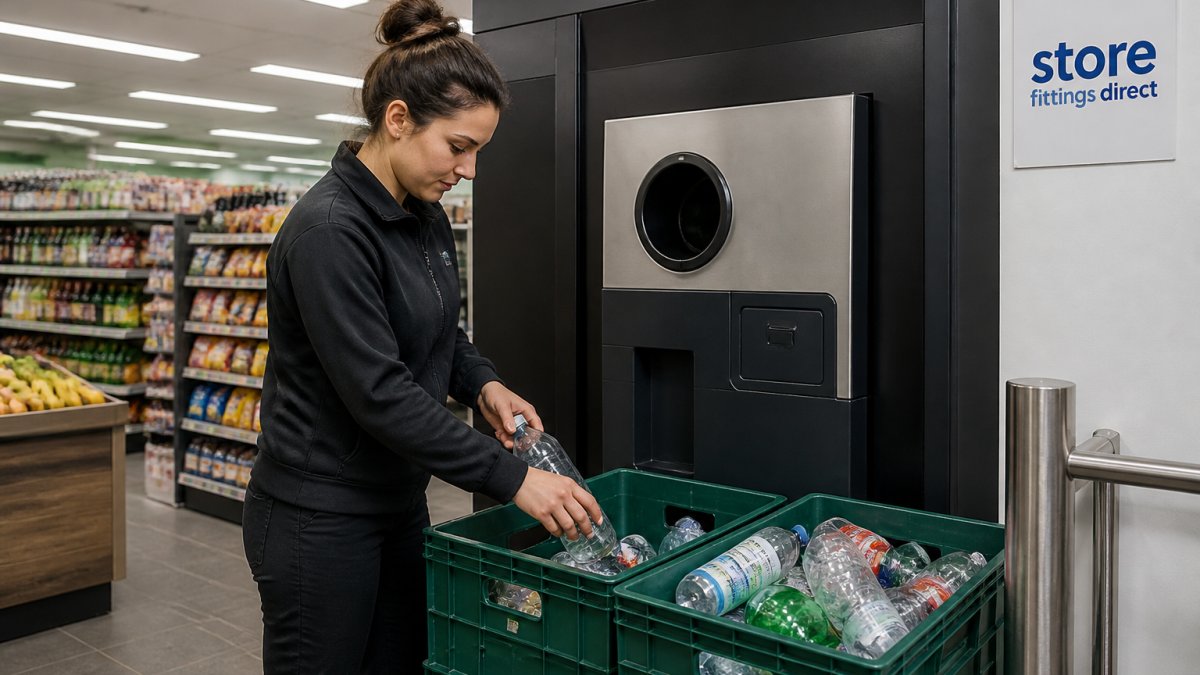
Place the return point where customers can reach it without crossing your busiest till queue, and where staff can see it. A spot near the entrance works well for high-footfall stores; a quieter corner suits smaller shops where space is tight. Whichever you choose, give it a defined footprint so the rest of the shop does not absorb the mess.
Manual and Automated Return Options
Manual return points rely on staff to accept containers, count them, and issue refunds. They cost less to set up and suit low volumes, but they pull staff away from the till at exactly the wrong moment.
Automated options, such as reverse vending machines, handle counting and refunds without staff involvement. They suit higher volumes and larger sites, but they need floor space, power, and a service arrangement.
| Option | Best for | Main trade-off |
|---|---|---|
| Manual counter return | Small shops, low volumes | Staff time at peak hours |
| Dedicated collection station | Medium stores, mixed volumes | Needs a defined footprint |
| Reverse vending machine | High-footfall sites | Space, power and servicing |
Deposit Return Scheme Labelling: Getting It Right
Deposit return scheme labelling tells the customer which containers carry a deposit and how much it is. The scheme requires clear marking on eligible containers and at the point of sale, so shoppers understand what they are paying and how to get it back.
Your role as a retailer is mostly about the point of sale and the return point. Make sure shelf-edge information and any in-store signage match the deposit shown at the till, and that the return point itself is clearly signed. If a customer cannot tell where to take an empty bottle, they will leave it on a shelf instead.
Check the official labelling requirements for your nation before printing anything. The wording, the deposit mark, and the placement rules are set in the regulations, and getting them wrong means reprinting signage at your own cost.
How to Prepare Your Store Before Launch
Preparation is a sequence, not a single task. Work through it in order and the launch becomes routine rather than a scramble.
- Map your products. List every drink line you sell and flag which containers fall in scope.
- Choose your return model. Decide between manual, dedicated station, or automated based on your volume and floor space.
- Design the footprint. Give the return point a fixed area with clear access and a holding space behind it for collected containers.
- Sort storage. Plan how empties are held before uplift, and how they are kept from blocking aisles or fire routes.
- Brief your team. Staff need to know the refund process, the deposit value, and what to do with damaged or contaminated containers.
- Sign it clearly. Match in-store signage to the official labelling rules and the deposit shown at the till.
- Test before launch. Run a dry run with a small number of containers to check flow, storage, and staff timing.
The deposit return scheme asks retailers to run a collection operation alongside a shop, and the businesses that struggle are usually the ones that treated it as a signage job rather than a space and flow problem. Store Fittings Direct has spent over 30 years helping retailers lay out their space, with shelving, barriers, and site protection products built for daily use, backed by fast nationwide delivery and a Price Match Promise. Get started with Store Fittings Direct and set up a return point that keeps your customers moving and your floor clear.
Frequently Asked Questions
What is a deposit return scheme?
A deposit return scheme adds a small refundable deposit to the price of drinks containers. When a customer buys a drink, they pay the deposit on top of the price. When they return the empty container to a return point, they get that deposit back. The scheme is designed to increase recycling rates and reduce litter by giving people a financial reason to return containers rather than bin or drop them.
Which drinks containers are included in the deposit return scheme?
The scheme covers single-use drinks containers, typically plastic bottles and metal cans. Glass containers may be included depending on the final scope confirmed by government. Deposit return scheme containers must fall within the specified size range, usually between 150ml and 3 litres. Retailers should check the latest guidance for the full list, as the exact container types and sizes are set out in the regulations.
What will retailers need to do under the deposit return scheme?
Retailers selling covered drinks will need to charge the deposit at the point of sale, accept returned containers, and refund the deposit to customers. This means setting up deposit return scheme return points, whether manual or automated, and ensuring staff are trained. Deposit return scheme labelling on products and shelves must clearly show the deposit amount and return instructions. Larger stores may face additional obligations.
When is the deposit return scheme expected to start?
The deposit return scheme is expected to launch in October 2027 across the UK, following repeated delays to allow retailers and producers more preparation time. The exact start date may vary by nation, as Scotland, England, Wales, and Northern Ireland are working towards aligned timelines. Retailers should monitor official government announcements for confirmed dates and any phased rollout plans.


