

Table of Contents
- Why Most Attempts to Increase Retail Sales Stall
- Retail Sales Techniques That Staff Can Use Today
- Retail Promotion Ideas That Protect Your Margin
- Retail Customer Loyalty Strategies That Bring People Back
- Retail Sales Performance Metrics Worth Tracking Weekly
- Where Shop Fittings Fit Into a Plan to Increase Retail Sales
- Conclusion
- Frequently Asked Questions
Last Updated: October 16, 2026
Why Most Attempts to Increase Retail Sales Stall
Most attempts to increase retail sales stall for one reason: they treat sales as a marketing problem when it is usually a shop-floor problem. At Store Fittings Direct, we have spent over 30 years supplying fixtures to retailers of every size, and the pattern is consistent. Teams chase new promotions, new signage, new ad spend, while the fundamentals of how customers move, browse and pay stay untouched.
The three levers behind every sales increase are traffic, conversion and basket value. Traffic is the most expensive to buy. Conversion and basket value are the cheapest to fix, because they depend on what happens inside the shop, not on how many people walk through the door. Yet they are the levers most retailers ignore.
Below, we break down the techniques, promotion ideas and metrics that actually move the needle, and where the physical environment fits into all of it.
The Three Levers Behind Every Sales Increase
Every pound of extra revenue comes from one of three places:
- More people through the door (traffic)
- More of those people buying (conversion)
- Each buyer spending more (basket value)
Traffic gets the attention because it is visible and easy to measure. Conversion and basket value are quieter, but they compound. A modest lift in both, applied across a full year, typically outperforms a single expensive advertising push.
Retail Sales Techniques That Staff Can Use Today
The fastest wins in retail sales techniques come from staff behaviour, not from systems or spend. These are the habits that separate stores that hit target from stores that miss it.
Greet within 30 seconds, then step back. A greeting signals availability. Hovering signals pressure. Staff should acknowledge every customer, then give them space to browse.
Ask open questions, not closed ones. "What are you looking for today?" opens a conversation. "Can I help?" invites a no.
Suggest, don't sell. A recommendation framed as helpful advice converts far better than a pitch. Train staff to mention one relevant item, then stop talking.
Know the top ten products. Staff who can explain the difference between two similar items, and who they suit, close more sales than staff who simply point.
A common mistake is training staff once at induction and never again. Product knowledge decays quickly as ranges change.
Add-Ons and Basket Builders at the Till Point
The till point is the most underused selling space in most shops. Customers are stationary, engaged and already in a buying mindset. A well-placed display here turns waiting time into incremental revenue.
The Barrier Merchandising Bowl is one of the simplest ways to do this. It clamps onto standard 2.5" queue barriers and holds impulse merchandise right where customers queue, with four sections of shelf edge strip for pricing. At £86.25, it is a low-cost addition to an existing barrier setup. British Retail Consortium guidance on the customer journey

Retail Promotion Ideas That Protect Your Margin
Discounting is the default retail promotion idea, and it is usually the worst one. A 10% cut on a product with a 40% margin wipes out a quarter of your profit on that line. Promotions should move stock or build baskets, not simply shave the top line. Strategic value is better captured by driving engagement through consistent social media management, which transforms casual interest into long-term customer loyalty without eroding your underlying margins.
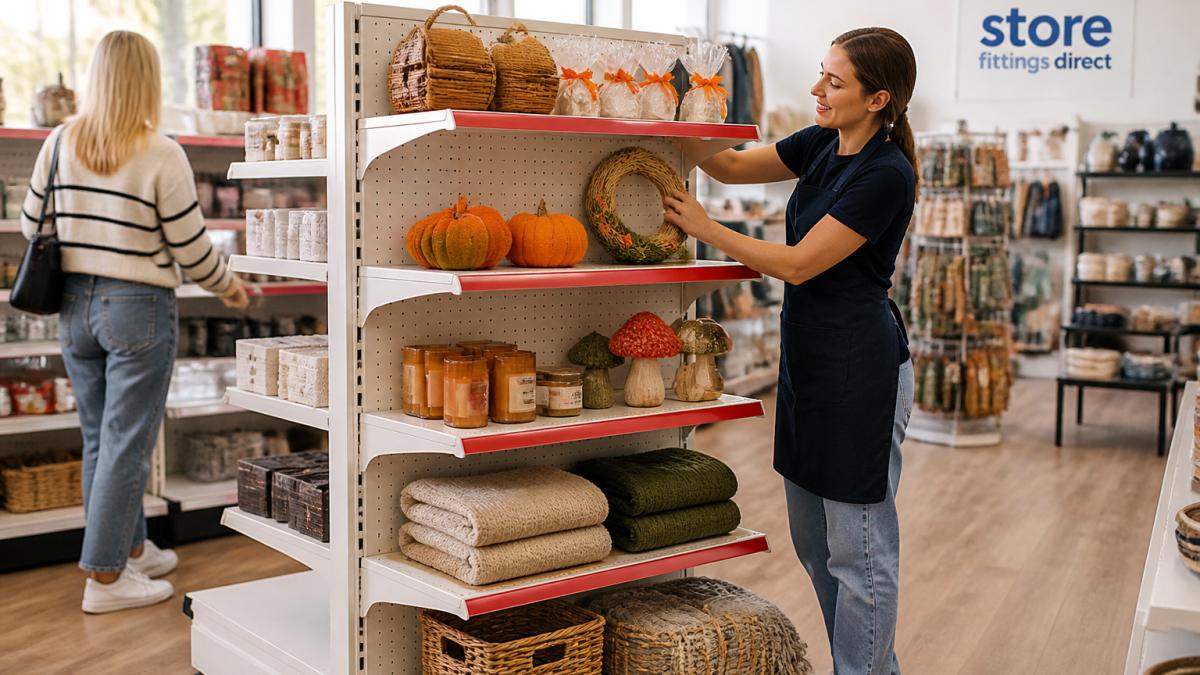
Better options include multi-buys on high-margin lines, bundle pricing that pairs a slow mover with a fast one, and short, well-signposted promotional bays that create a sense of event. A dedicated end bay, such as the Shelving End Promo Bay 1.8m High with Base Shelf at £122.17, gives a promotion its own physical space and keeps the main aisle clean.

Retail Customer Loyalty Strategies That Bring People Back
Retail customer loyalty strategies are cheaper than acquisition, yet most small retailers have none beyond a paper stamp card. Loyalty works when it is simple, immediate and relevant.
- Reward frequency, not just spend. A free item after five visits brings people back more reliably than a points scheme they never redeem.
- Capture contact details at the till. Email or SMS lets you bring customers back without paying for reach.
- Recognise regulars by name. This costs nothing and outperforms most formal schemes.
- Fix problems fast. A complaint resolved well creates a more loyal customer than one who never had an issue.
The mistake is complexity. Every extra tier or rule reduces uptake.
Retail Sales Performance Metrics Worth Tracking Weekly
Retail sales performance metrics only help if they are reviewed often enough to act on. Monthly is too slow. Weekly gives you time to correct a bad trend before it becomes a bad quarter.
| Metric | What It Tells You | Review Frequency |
|---|---|---|
| Conversion rate | How many visitors buy | Weekly |
| Average basket value | How much each buyer spends | Weekly |
| Items per transaction | Whether add-ons are working | Weekly |
| Footfall | Whether traffic is the problem | Weekly |
| Sell-through by line | Which stock is moving | Fortnightly |
| Queue wait time | Where customers abandon | Weekly |
If conversion is healthy but basket value is flat, the problem is merchandising and add-ons. If footfall is strong but conversion is weak, the problem is usually layout, signage or staffing. Office for National Statistics retail sales data
Where Shop Fittings Fit Into a Plan to Increase Retail Sales
Shop fittings are not decoration. They determine what customers can see, reach and pick up, and that shapes both conversion and basket value. A plan to increase retail sales that ignores the physical environment is leaving the cheapest lever untouched.
The Wood Effect Gondola Shelving Bay, 1.4m high with a 300mm base shelf, merchandises from both sides and suits the middle of the shop floor at £143.55. For wall runs, the Wood Effect Wall Bay Shelving, 2.4m high with a 570mm base shelf at £145.88, offers adjustable uppers and 19 finish combinations. Where signage drives the sale, the Full Frame A4 Advertising Portrait at £33.35 gives promotions a clean, heavy-duty frame.

Conclusion
Getting more from the shop you already have is harder than buying more traffic, because it demands attention to detail rather than budget. It means training staff, measuring the right numbers weekly, and making sure the fixtures actually put product where customers can see and reach it. Store Fittings Direct has supplied over 1.3 million products across more than 30 years, with a Price Match Promise, trade accounts offering 30 days interest-free credit, and bulk discounts available. Browse our shop shelving and merchandising range, and start with the one change that moves your weakest metric first.
Frequently Asked Questions
What are the best ways to increase retail sales?
Focus on three levers: more transactions, higher average transaction value, and more repeat visits. In practice that means training staff on add-on selling, testing retail promotion ideas that protect margin, running retail customer loyalty strategies such as a simple points scheme, and reviewing retail sales performance metrics weekly. Small, consistent changes across all three levers usually beat one big discount event, because each lever compounds over the trading year.
How can a small retailer attract more customers?
Start with what passing trade can actually see. A clean window, a clearly priced offer, and a well-stocked promotional bay at the entrance give people a reason to walk in. Local social media posts, a Google Business Profile with opening hours kept current, and staff who greet people within a few seconds of entry all help. Small shops win on service and speed, not on matching larger chains on price.
How can retail staff improve their sales skills?
Train staff on open questions rather than yes-or-no ones, so they learn what the customer is actually trying to solve. Practice linking a second product to the first at the till, and give them permission to walk a customer to an item instead of pointing. Short weekly briefings on the current promotion and best sellers keep knowledge fresh. Retail sales techniques improve fastest when staff see the numbers behind their own shifts.
What is the best way to encourage repeat purchases?
Make it easy to come back. A simple loyalty scheme, a receipt with a reason to return printed on it, and consistent stock of the lines people buy regularly all work. Retail customer loyalty strategies do not need software to start: a stamp card or a named email list both build habit. The key is to track whether the same customers return, not just how many people signed up.
How can retailers increase their average transaction value?
Place complementary items where the buying decision happens, such as the queue and the till point. A barrier merchandising bowl fitted to an existing queue post, for example, gives waiting customers something to pick up without staff effort. Bundle related products on a promotional end bay, and train staff to suggest one relevant add-on rather than a list. Track average basket value weekly so you can see which change actually moved it.
How do you measure retail sales performance?
Track a small set of retail sales performance metrics consistently: sales per square metre, average transaction value, items per transaction, conversion rate if you count footfall, and repeat purchase rate. Weekly comparison against the same week last year is more useful than month-on-month, because it removes seasonal noise. Pick five metrics, review them every Monday, and change one thing at a time so you know what caused the movement.
What are some examples of effective retail promotions?
Multi-buy offers on fast-moving lines, a time-limited discount on slow stock, free delivery over a spend threshold, and bundle pricing that pairs a staple with a treat all work without gutting margin. Seasonal or event-led promotions tied to a specific date give urgency. Whatever you run, give it its own display space and a clear price, and measure the uplift against the same period without the promotion.


