

Table of Contents
- What a Pedestrian Guardrail Actually Does
- Pedestrian Guardrail Installation Standards You Need to Meet
- Choosing Pedestrian Safety Barriers by Site Type
- Materials and Finishes for Long-Term Outdoor Use
- Guardrail Maintenance Best Practices
- How to Specify and Cost a Guardrail Project
- Frequently Asked Questions
Last Updated: October 2, 2026
What a Pedestrian Guardrail Actually Does
A pedestrian guardrail is a fixed barrier that separates people on foot from vehicles, protecting them along roadsides, car park edges, and site frontages. This guide from Store Fittings Direct explains how to choose one that meets UK installation standards, suits your site, and survives decades outdoors. The most important point comes first: a pedestrian guardrail is not a decorative extra. It is the component that decides whether a vulnerable road user walks safely past a vehicle route or shares space with it.
That distinction matters because most buyers conflate three different products. Getting it wrong means either overspending on the wrong barrier or installing something that fails to control vehicles at all.
Guardrails, Bollards and Delineators: Which One You Need
Each product does a separate job, and UK guidance treats them differently. A pedestrian guardrail is a continuous rail system that channels pedestrian movement and shields walkers from traffic. A bollard is a short vertical post that restricts or slows vehicle access to a defined area. A delineator is a post at the edge of a carriageway that marks road alignment or warns of a hazard in daylight.
The practical test is simple: if you need to keep people and vehicles apart along a route, you want a guardrail. If you need to stop vehicles entering a space at all, you want a bollard. If you need to mark where the road goes, you want a delineator. Product listings state this explicitly, and it is worth reading them before ordering. For example, the Leafield Edgeminder bollard specification notes that general bollards are not to be used as delineators, precisely because the two roles are governed by different expectations.
Pedestrian Guardrail Installation Standards You Need to Meet
Guardrail installation standards in the UK are set by national highways guidance and by the requirements of the site owner, whether that is a local authority, a school, an NHS trust, or a private landlord. The core principle is that a barrier must be visible, structurally sound, and positioned so it does not itself become a hazard. Local highway authorities typically apply the standards set out in the Department for Transport's guidance on pedestrian guardrails when deciding whether a barrier is acceptable on the public highway.
For private sites, the same logic applies even where the statutory framework does not bite directly. A school, retail park, or hospital entrance still needs a barrier that pedestrians can see in poor light and that will not fail if someone leans on it.
Height, Spacing and Visibility Requirements
Height and spacing follow a consistent pattern across most specifications. Guardrails are generally set at around 1.1 metres above ground level, with vertical bars spaced closely enough to prevent a small child passing between them. Post spacing typically falls between 1.5 and 2 metres, depending on the rail system and the wind loading at the site.
Cast Iron Manchester Bollard →
Visibility is the requirement buyers most often overlook. A guardrail at a vehicle exit needs contrast against its background, which is why reflective banding and a light-coloured finish matter in low light. The same principle drives bollard specification: the Cast Iron Manchester Bollard product details show a 1300mm overall height with 1000mm above ground, a 220mm diameter, and optional gold banding, all of which affect how visible the unit is to a driver.
Requirement |
Typical Specification |
Why It Matters |
|---|---|---|
Height above ground |
Around 1.1m |
Prevents climbing and falling over |
Bar spacing |
Close enough to block a child |
Stops pedestrians passing between bars |
Post spacing |
1.5m to 2m |
Balances strength against wind loading |
Visibility |
Reflective banding, contrast finish |
Keeps the barrier seen in low light |
Choosing Pedestrian Safety Barriers by Site Type
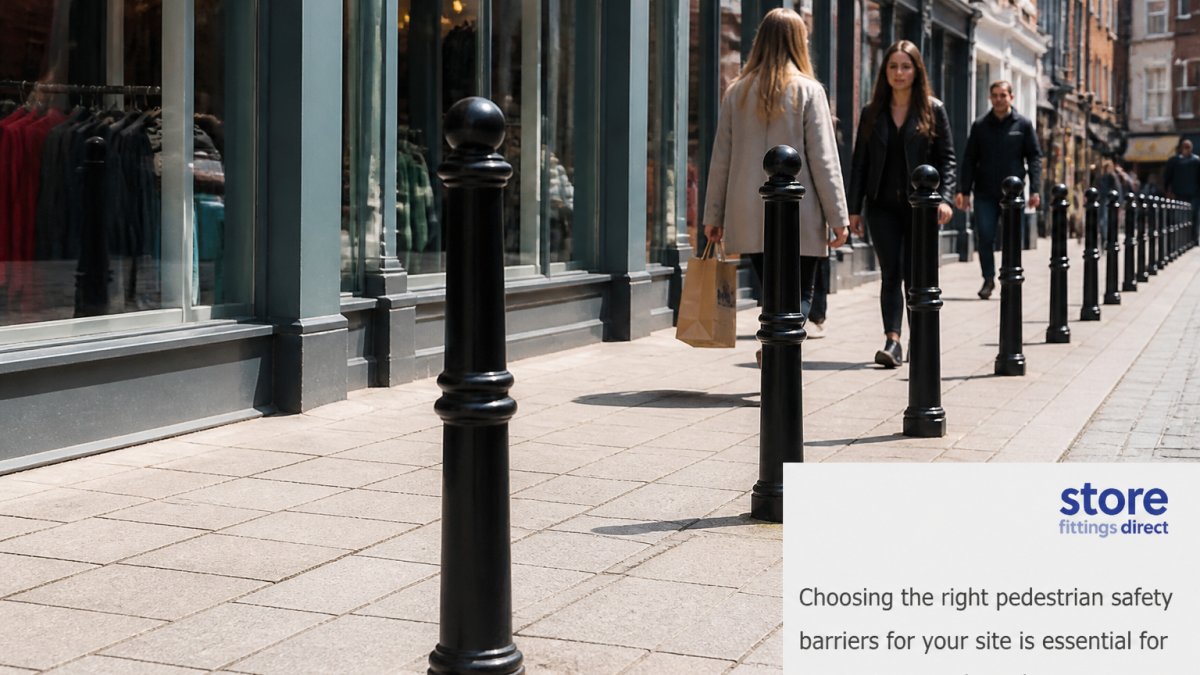
Pedestrian safety barriers are not a single product, and the right choice depends almost entirely on where the barrier sits and who uses it. A town centre frontage, a car park edge, and a landscaped verge each demand different materials and fixing methods.
Temporary barriers often serve as a necessary complement to permanent guardrails during construction phases, requiring strict adherence to scaffolding safety regulations to ensure the continued protection of the public.
For heritage and town centre settings, cast iron remains the traditional choice because it matches existing streetscape furniture and carries a visual weight that plastic cannot replicate. The Cast Iron Manchester Bollard is supplied plain black with optional gold banding and a removable socket option, which suits councils and facilities managers working in conservation areas. Where budget or maintenance access is the deciding factor, a Manchester Heritage Plastic Bollard offers the same traditional profile in maintenance-free polyethylene at a lower unit cost.

For grass verges, landscaped boundaries, and rural edges, medium-density polyethylene bollards such as the Leafield Edgeminder MDPE Bollard resist corrosion and UV degradation without painting. Where ram-raid deterrence or protected parking is the priority, galvanised mild steel is the stronger option: the Galvanised Mild Steel Bollards range runs from 60mm to 193mm diameter with 3mm or 5mm wall thickness depending on size.
Materials and Finishes for Long-Term Outdoor Use
Material choice determines how often you will be back on site. Cast iron and galvanised steel hold their appearance for decades but need periodic inspection for coating damage. MDPE and polyethylene resist rot, rust, and UV degradation with no painting at all, which suits exposed rural locations where maintenance visits are costly.
Finish matters as much as material. Galvanising protects mild steel from corrosion, but a scratched coating exposes the base metal. Powder coating adds colour and improves visibility. Reflective tape or banding, available in red, white, or a mix, is the cheapest way to raise night-time visibility on an existing barrier.

Guardrail Maintenance Best Practices
Guardrail maintenance best practices come down to regular inspection and prompt repair, not complex servicing. Walk the barrier line twice a year and after any vehicle strike. Check post fixings for movement, look for coating damage, and confirm reflective banding is still legible.
What most guides miss is that maintenance records carry weight. Local authorities and insurers increasingly ask for evidence of inspection, particularly where a barrier protects a school entrance or a public footpath. A simple dated log with photographs is enough.
Cast Iron Manchester Bollard →
How to Specify and Cost a Guardrail Project
Costing a guardrail project means measuring the run, choosing the product, and confirming the fixing method before you request a quote. Work through the sequence below and you will avoid the two most expensive errors: ordering the wrong length and discovering the fixing method does not suit the ground.
- Measure the full run in metres, including any returns or corners
- Confirm the ground type at each fixing point (soft ground, concrete, paving)
- Decide whether the site needs vehicle containment or pedestrian separation
- Check visibility requirements for the approach speed and lighting
- Confirm the required height and bar spacing against the site's specification
- Select material and finish, including reflective banding if needed
- Request a quote with delivery lead times stated
At Store Fittings Direct, competitive pricing sits alongside design assistance, so you can send a site plan and get help matching products to the run. With over 30 years of experience and more than 1.3 million products sold, the team can advise on fixing methods and finishes before you commit. Trade accounts come with 30 days interest-free credit, and bulk discounts apply on larger orders.
Specifying a pedestrian guardrail is straightforward once you separate the three product types and confirm your site's fixing conditions.
Frequently Asked Questions
What are the legal requirements for installing pedestrian guardrails?
There is no single Act that mandates pedestrian guardrail everywhere. In practice, requirements come from your local highway authority's design guidance, the Equality Act 2010 (which requires reasonable provision for disabled pedestrians, so gaps must allow wheelchairs and mobility scooters through), and planning conditions attached to your site. On private land such as a retail forecourt or car park, you still owe a duty of care under the Occupiers' Liability Act 1957 to keep visitors reasonably safe. Check with your local authority before installing on or near a public highway.
How do I determine the correct height for a pedestrian guardrail?
For most public-realm pedestrian guardrail in the UK, the working range is 1000mm to 1100mm above finished ground level, which is high enough to discourage climbing and low enough to keep sightlines open. Vehicle-facing protection such as car park edges may need taller, heavier systems. Children's areas and schools often specify a lower rail with tighter vertical spacing to prevent heads passing through. Confirm the figure with your local highway authority or specifier, because requirements vary by site and by who maintains the land.
What materials are best for long-term outdoor pedestrian protection?
Galvanised mild steel is the workhorse choice for guardrail and bollard frames because it resists rust without annual repainting, and it will not fracture on impact. Cast iron suits heritage and town-centre settings where period appearance matters, and it lasts for decades with minimal attention. MDPE and polyethylene options such as the Leafield Edgeminder work well on grass verges and landscaped boundaries, where they resist rot, corrosion and UV degradation without any maintenance. Match the material to the setting rather than defaulting to the cheapest option.
How can guardrails improve traffic flow in busy environments?
Guardrails separate pedestrians from vehicles and from each other, which reduces the stop-start hesitation that slows everyone down. At a supermarket entrance, a defined pedestrian lane means trolleys and pushchairs move in one direction instead of crossing the vehicle route. At a school gate, channelling parents to one collection point clears the surrounding road faster. The gain comes from clear, predictable routes, not from blocking movement, so leave adequate gaps at crossing points and entrances when you plan the layout.


