
Table of Contents
- Shop Fittings: What They Are and What Your Store Actually Needs
- Shop Shelving: Wall Bays, Gondolas and Corners Compared
- Retail Display Equipment: Getting Products Seen and Reached
- Shop Fitting Supplies: What a Complete Fit-Out Requires
- Retail Storage Solutions: Stockroom and Back-of-House
- Comparing Shop Fitting Suppliers: What to Check Before You Buy
- Shop Fittings: Common Mistakes and How to Avoid Them
- Conclusion
- Frequently Asked Questions
Last Updated: October 19, 2026
Shop Fittings: What They Are and What Your Store Actually Needs
Shop fittings are the fixed and movable equipment that hold, display and organise stock inside a retail space: shelving bays, gondolas, display units, storage and the small supplies that tie a fit-out together. At Store Fittings Direct, we have spent over 30 years supplying them, and the same question comes up in almost every first conversation: what does my store actually need?
The answer starts with your stock, not your floor plan. Heavy bulk goods need a deep base shelf; small high-value lines need shallower uppers with clear sightlines. Get that match right and everything else follows.
Below, we break down each category of shop fittings, compare the bay types side by side, and flag the mistakes that cost retailers the most money.
Shop Shelving: Wall Bays, Gondolas and Corners Compared
Shop shelving splits into three working types: wall bays that run along a perimeter, gondola bays that create aisles, and corner or promotional bays that fill the awkward spaces. Each does a different job, and most stores need a mix of all three rather than one type throughout.

Wall Shelving Bays
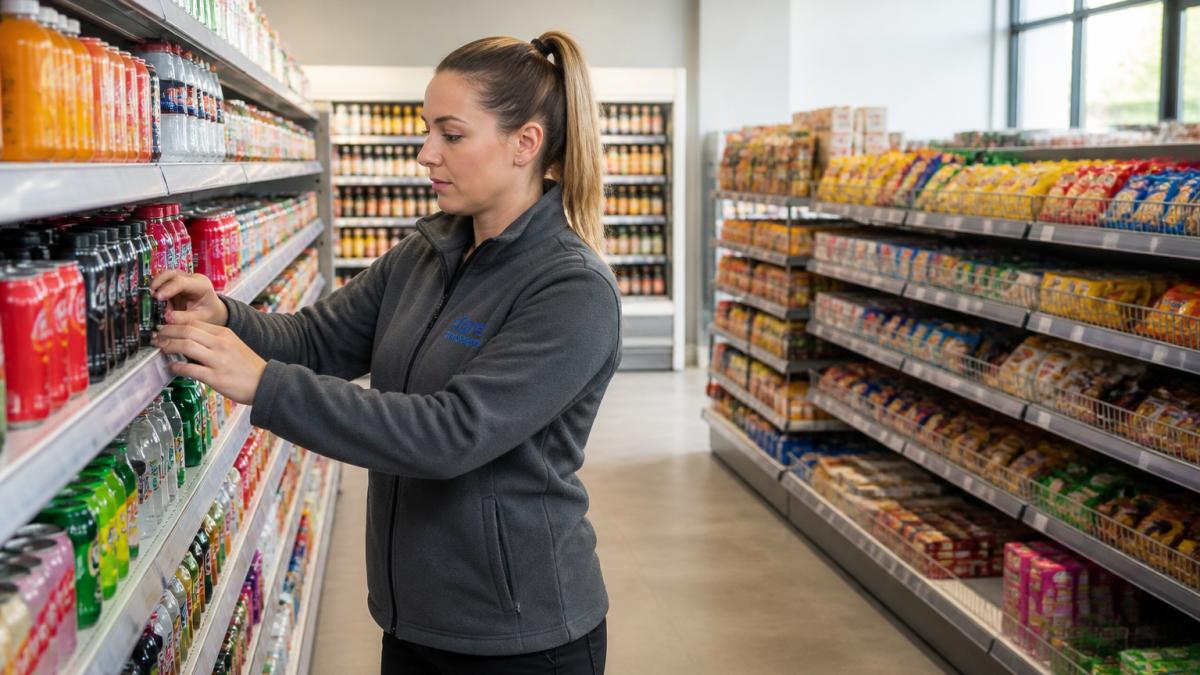
Wall bays make use of vertical space along a perimeter wall. Our 2.1m high wall shelving bay comes with a 470mm base shelf and a choice of four to eight upper shelves at 370mm depth, in widths from 500mm to 1250mm. All shelves are fully adjustable in height to accommodate products of varying sizes.
Gondola Bays
Gondolas are double-sided, so they display stock on both faces and form aisles between them. The 2.1m gondola bay uses the same 470mm base and 370mm uppers, with bays linking together into a continuous run.
Corner Bays and Promotional End Bays
Corners are dead space until you fit them. A corner shelving bay needs a minimum of 730mm on each joining wall, so measure before you order. End promo bays sit flush against a gondola run.
| Bay Type | Best For | Base Shelf | Typical Widths |
|---|---|---|---|
| Wall bay | Perimeter runs, vertical display | 470mm | 500-1250mm |
| Gondola bay | Aisles, double-sided display | 470mm | 500-1250mm |
| Corner bay | Filling unused corners | 470mm | Four widths |
| End promo bay | Promotions and seasonal stock | 300-570mm | 665-1250mm |
Retail Display Equipment: Getting Products Seen and Reached
Retail display equipment exists to close the gap between a customer noticing a product and picking it up. That gap is where most sales are won or lost, and it has little to do with how attractive a fixture looks in a brochure.
Three practical rules govern good display. Use EPOS label strips on every shelf so pricing stays accurate and staff can reprice quickly. And leave enough shelf depth that stock sits forward rather than disappearing into a recess.
Wall Shelving 2.1m High | 470mm Base Shelf | 370mm Uppers →
What most guides miss is that display equipment has to survive daily handling.
Shop Fitting Supplies: What a Complete Fit-Out Requires
Shop fitting supplies are the components that turn a set of bays into a finished, working store: back panels, kick plinths, brackets, feet, uprights and EPOS ticket strips. They are rarely exciting and always essential.
The mistake is treating supplies as an afterthought and ordering them separately once the bays arrive. Every bay we supply is specified as a complete unit, which means you know exactly what is included before you commit. Check the inclusion list on any bay you buy: uprights, feet, base shelf, back panels, brackets, ticket strips and kick plinth should all be itemised.
Colour matters more than buyers expect. Powder-coated finishes in black, grey, graphite and white let a shelving run blend into the interior rather than fight it.
Retail Storage Solutions: Stockroom and Back-of-House
Retail storage solutions cover everything the customer never sees: back-of-house shelving, overspill stock and the reserve holding that keeps the shop floor full. A store with weak back-of-house storage ends up using prime selling space as a stockroom.
Treat the stockroom as a working extension of the shop floor. Group reserve stock by the aisle it replenishes, keep heavy items low, and use the same bay system throughout so staff are not learning two different shelving types.
Durability is the deciding factor here. Back-of-house shelving takes knocks, holds heavier loads and gets loaded in a hurry.
Comparing Shop Fitting Suppliers: What to Check Before You Buy
Comparing shop fitting suppliers comes down to five checks, and price is only one of them. Lead time, delivery coverage, what is included in the price, whether bulk discounts are transparent, and how the supplier handles a shortfall mid-project all matter more than a headline figure.
Ask for the inclusion list in writing. Confirm delivery timescales against your opening date rather than assuming. And check whether trade terms are available, because interest-free credit over 30 days makes a real difference to cash flow on a larger fit-out.
We back our pricing with a Price Match Promise and offer trade accounts with 30 days interest-free credit, plus bulk discounts on larger orders. One customer noted we "assisted us in improving on delivery time for an important item required for project completion."
Wall Shelving 2.1m High | 470mm Base Shelf | 370mm Uppers →
Shop Fittings: Common Mistakes and How to Avoid Them
The costliest shop fitting mistakes are predictable, which means they are avoidable. Here are the ones we see most often, and the fix for each.
- Measuring after ordering. Confirm wall lengths and corner dimensions first; corner bays need 730mm on each joining wall.
- Buying add-on bays as standalone units. Budget for finisher legs or plan a linked run.
- Ignoring shelf depth. A 370mm upper shelf suits boxed and bottled goods; bulkier stock needs the deeper base.
- Skipping the stockroom. Under-specifying back-of-house storage pushes stock onto the shop floor.
- Chasing the lowest quote. Compare inclusion lists, not headline prices.
Each of these is cheap to get right at the planning stage and expensive to correct once the bays are bolted together.
Conclusion
Fitting out a store is a project with a fixed opening date and no room for a supplier who goes quiet mid-order. The right shop fittings are the ones specified for your stock, delivered when promised, and built to survive daily use.
At Store Fittings Direct, we supply wall shelving, gondola and corner bays as complete units, with fast nationwide delivery, a Price Match Promise and trade accounts with 30 days interest-free credit. With over 1.3 million products sold and more than 30 years of experience behind our range, we can help you specify the right bays the first time.

Get started with Store Fittings Direct and fit out your store with shelving built to last.
Frequently Asked Questions
What shop fittings does a retail business need?
Most stores need wall shelving for perimeter displays, gondola bays for aisles, corner bays to use dead space, and end promo bays for promotions. Add EPOS label strips, kick plinths and finisher legs to complete a run. Back-of-house retail storage solutions such as stockroom shelving keep deliveries organised. Start with the fixtures that hold your best-selling lines and expand as your range grows.
How do I choose shop shelving for my store?
Match shelf depth to your products: a 470mm base shelf suits bulkier stock, while 370mm uppers work for standard packaged goods. Check bay widths (500mm to 1250mm) against your wall run, and confirm shelves are height-adjustable. For aisles, a double-sided gondola bay makes better use of floor space than single-sided units. Always check whether a bay is an add-on that needs a finisher leg to stand alone.
What should I look for when comparing shop fitting suppliers?
Check what is included in the bay price: back panels, kick plinths, EPOS strips and brackets are sometimes extra. Confirm delivery times and whether bulk discounts apply. Ask about trade accounts and price match promises, and read reviews about durability after months of daily use. A supplier with decades of experience and a clear returns policy is lower risk than the cheapest quote.
Can shop fittings be adapted as a business changes?
Yes, if you choose modular systems. Bays in the same range connect together, and finisher legs let units stand alone when you reconfigure. Adjustable shelves accommodate new product sizes, and add-on bays extend a run without replacing existing units. Buying modular shop fittings from the start means a refit later is a case of adding bays rather than starting over.


