

Table of Contents
- What Products for Local Councils Actually Need to Do
- Council Shelving for Offices, Libraries and Storage Rooms
- Crowd Control Barriers for Public Buildings
- Site Protection Products for Public Facilities
- Cycle Parking and Outdoor Infrastructure for Council Sites
- Procurement Specifications for Council Equipment
- Comparing Products for Local Councils: Cost, Durability and Lead Time
- Conclusion
- Frequently Asked Questions
Last Updated: October 19, 2026
What Products for Local Councils Actually Need to Do
Products for local councils have one job that private-sector equipment rarely faces: survive years of public use, public scrutiny and public budgets. That combination changes what "good" looks like. A shelf in a library has to hold dense reference stock and still look presentable at a ribbon-cutting. A barrier on a civic forecourt has to stay upright through a bank holiday crowd and still pass an insurance inspection.
At Store Fittings Direct, we have supplied this sector for over 30 years, and the pattern is consistent: councils that specify for durability and standardisation spend less over a five-year term than those buying on unit price alone. Below, we break down the categories that matter most, what to check in a specification, and how to compare quotes properly.
The Local Government Association's guidance on procurement is a sensible starting point for anyone new to council buying.
Council Shelving for Offices, Libraries and Storage Rooms
Council shelving splits into three practical jobs: office storage, public-facing library shelving, and back-of-house storage rooms. Each has different demands, and conflating them is where specifications go wrong.
Office shelving prioritises adjustability and load tolerance for files and boxed archives. Library shelving needs bay widths that suit face-on display as well as spine-out stock. Storage room shelving needs depth and a finish that copes with damp, dust and heavy totes. Ergonomic considerations for the staff using these storage solutions remain equally vital, as detailed in our office seating guide to ensure that physical workspace configurations support both archival efficiency and daily comfort.
A common mistake is specifying domestic-grade units for a public building. They flex, the powder coating chips at the corners, and within two years the bays look tired. Specify powder-coated steel with adjustable shelf pitch, and confirm the load rating per shelf rather than per bay.
Crowd Control Barriers for Public Buildings
Crowd control barriers for public buildings are a safety item before they are a queue-management item. That distinction matters when a risk assessment lands on your desk.
The practical questions are: what length do you need per barrier, how does it connect to the next one, and what surface is it standing on? Interlocking barriers with weighted feet work on flat concourse flooring. On sloped or uneven ground, you need a different foot arrangement or a fixed solution.
Councils also ask us about storage. Barriers that stack flat take a fraction of the space of rigid ones, which matters if your team stores them in a plant room between events. Check the stacking depth before you order a batch of twenty.
Sheffield Toast Cycle Rack Galvanised →
Site Protection Products for Public Facilities
Site protection products for public facilities cover the unglamorous items that prevent expensive claims: wheel stops in car parks, protective bollards, corner guards and impact protection around loading areas.
Wheel stops are a good example of a product that pays for itself. Our Health and Safety Executive guidance on workplace transport is clear that vehicle movement around buildings is a significant risk area, and a simple rubber stop that prevents a car reversing into a glass frontage or a brick wall is cheap insurance.

Recycled rubber stops are the practical choice for most sites. They are oil, heat and UV resistant, come with reflective panels for visibility, and can be fixed with bolts where drilling is permitted or with a specialist adhesive on multi-storey decks where it is not.
Cycle Parking and Outdoor Infrastructure for Council Sites
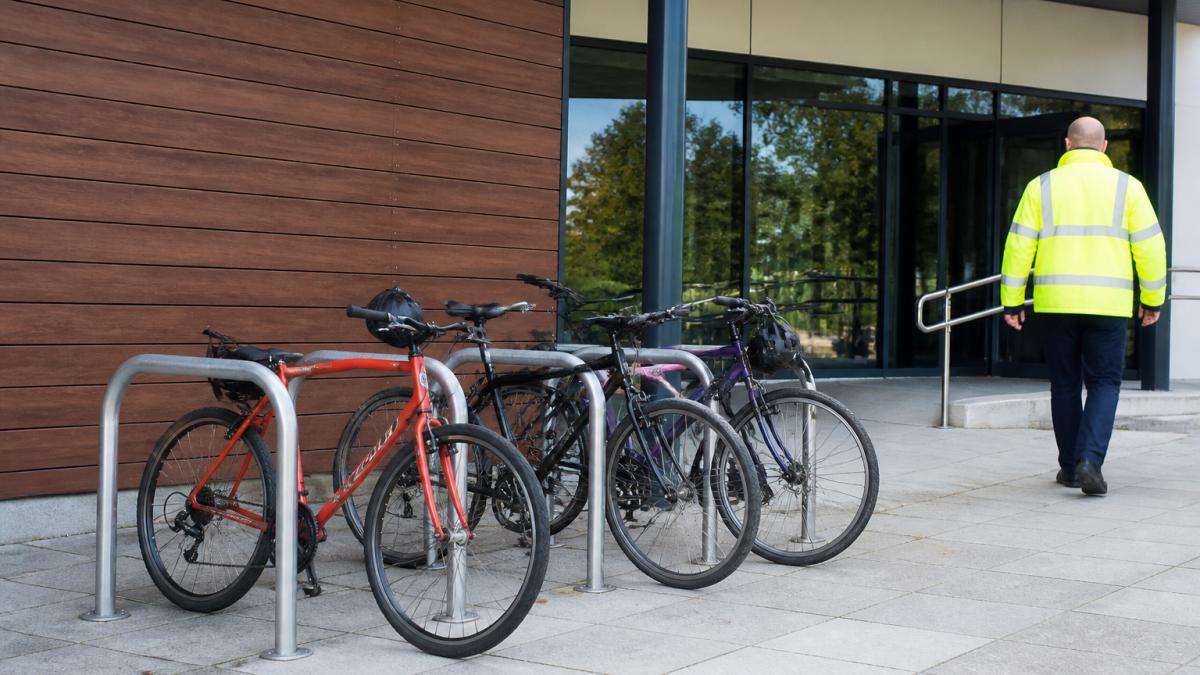
Cycle parking is now a standard line in most council outdoor schemes, and the specification is refreshingly simple. The Sheffield-style stand remains the workhorse: two contact points, a secure lock-up, and a design that has survived decades of use without reinvention.

Our Sheffield Toast Cycle Rack Galvanised is hot dip galvanised to BS EN ISO 1461:2009, uses 48mm outer-diameter tube with a 3.2mm wall, and gives 800mm centre-line gaps between stands. It is bolt-down fixed for rigidity, and bays can be ordered individually or extended into a longer run.
For sites needing weather protection, a shelter such as the Queensway 20 Cycle Shelter uses 50mm x 50mm steel strongbox section to EN 10219:2006 with Pet-G UV2 sheeting, and offers above- or below-ground fixing at no extra cost.

Procurement Specifications for Council Equipment
Procurement specifications for council equipment should be written so that any compliant supplier can bid, and so that non-compliant bids are obvious. That means naming the standard, not the brand.
A workable specification includes: the material and finish standard (for galvanised steel, BS EN ISO 1461), the dimensional tolerances that matter, the fixing method, the load or performance rating, and the warranty period. Add the delivery and installation responsibilities, and state whether you need a single drop or phased delivery across sites.
Our advice after three decades of these tenders: put the standard in the specification and let suppliers prove compliance. It keeps the process defensible and it stops the cheapest bid from winning on a technicality.
Sheffield Toast Cycle Rack Galvanised →
Comparing Products for Local Councils: Cost, Durability and Lead Time
Price is the easiest column to fill in and the least useful on its own. The comparison that matters weighs unit cost against service life, fixing requirements and how quickly the item lands on site.
| Category | Typical unit cost (GBP) | Durability driver | Lead time to watch |
|---|---|---|---|
| Galvanised cycle rack | £173.72 per rack | Hot dip galvanising to BS EN ISO 1461 | Batch size affects dispatch |
| 20-bike cycle shelter | £2,876.51 | Steel strongbox frame, Pet-G sheeting | Shelter size drives delivery |
| Outdoor digital signage | £1,540.75 | IP65 enclosure, 3-year warranty | Screen size and mounting |
| Rubber wheel stops | £24.08 per stop | Recycled rubber, UV and oil resistant | Fixing method and quantity |
Two patterns show up again and again. First, the galvanised and powder-coated options cost more upfront and cost less across a maintenance cycle. Second, lead time is usually driven by quantity and finish, not by the product itself, so confirm it in writing before you commit a programme date.
Store Fittings Direct offers a Price Match Promise, trade accounts with 30 days interest-free credit, and bulk discounts, which is how most councils structure repeat orders across sites.
Conclusion
The hard part of buying products for local councils is not choosing a shelf or a barrier. It is writing a specification that survives an audit, a budget review and five winters of public use.
That is where we can help. Store Fittings Direct has spent over 30 years supplying durable fixtures and site equipment, with fast nationwide delivery, a Price Match Promise and trade accounts with 30 days interest-free credit. Start with our Sheffield Toast Cycle Rack Galvanised or browse the full range to build your next schedule of rates.
Frequently Asked Questions
What products do local councils need for public buildings?
The core list covers shelving for offices, libraries and storage rooms, crowd control barriers for public buildings, site protection products for public facilities, and outdoor infrastructure such as cycle racks and shelters. Add digital signage for public-facing noticeboards and wheel stops for car parks. The right mix depends on the building type: a library needs adjustable shelving and quiet-zone barriers, while a depot needs heavy-duty storage and vehicle protection. Build your list around what each site actually does, then check each item against your procurement specification.
What shelving is suitable for council offices and libraries?
Look for shelving with adjustable shelf heights, a powder-coated or galvanised finish, and a stated load rating per shelf. Libraries need bays deep enough for bound volumes and clear labelling, while offices need filing and archive storage that can be reconfigured when teams move. Confirm the finish suits the environment: galvanised steel resists damp better in storage rooms, and powder coating gives a cleaner look in public areas. Ask for fixing kits and assembly instructions so estates teams can install without specialist contractors.
How should councils choose barriers for public spaces?
Start with the job the barrier does: queue management, event segregation, road closure or pedestrian routing. For crowd control barriers for public buildings, check the link system (fixed or detachable), the finish, and whether feet are included. Barriers used at events need to be stable under crowd pressure and easy for staff to move and store. Confirm the barrier meets your insurance and event safety requirements, and check delivery lead times against your event calendar before ordering.
What should a council include in a product specification?
A workable specification covers dimensions in millimetres, material and finish, load ratings where relevant, fixing method, relevant British or European standards, warranty length, delivery lead time and whether installation is included. Add the quantity, the site address and any access restrictions. Where the product is galvanised, quote the standard, for example BS EN ISO 1461. A clear specification reduces queries, makes quotes comparable and gives you a defensible record if a product underperforms later.


