

Table of Contents
- What the Simpler Recycling Legislation Actually Requires
- Simpler Recycling Requirements for Businesses of Every Size
- Simpler Recycling Implementation Dates: What Applies From When
- Your Simpler Recycling Compliance Checklist
- Choosing Recycling Bins for Businesses: What Works in Retail and Warehousing
- Common Mistakes That Undo Compliance
- Conclusion
- Frequently Asked Questions
Last Updated: 15 October 2026
What the Simpler Recycling Legislation Actually Requires
The Simpler Recycling legislation is a set of rules from the Environment Agency that requires businesses in England to separate dry recyclable materials from general waste at the point of disposal. In practice, that means every site must sort its waste into defined streams rather than putting everything into one bin.
This guide from Store Fittings Direct breaks down what each site must do, when the deadlines apply, and how to stay compliant without overcomplicating your waste setup.
The rules were introduced under the Environment Act 2021 and are enforced by the Environment Agency. Most businesses now fall within scope, and the requirements apply whether you run a single shop or a large warehouse.
The core idea is simple: recyclable materials should never end up in general waste. But the detail matters, and that is where most businesses trip up.
Default Waste Streams Every Site Must Separate
Every business must separate these dry recyclable streams:
- Glass bottles and containers
- Metal cans and tins
- Plastic bottles, pots, tubs and trays
- Paper and card
- Food waste (for most businesses)
Each stream needs its own container. Mixed recycling is not permitted, so a single "recycling bin" is no longer enough.
One Bin or Several? What the Rules Permit
The rules require separate collection of each dry recyclable stream. You can use one bin per stream, or a multi-compartment bin that keeps streams apart. What you cannot do is mix them together in one container.
For smaller sites with limited storage, multi-compartment bins are usually the practical answer. For larger sites, separate wheeled bins or skips work better.
Simpler Recycling Requirements for Businesses of Every Size
The requirements scale with the size of your operation, but the core duty stays the same: separate your recyclables from general waste.
Small shops with a single waste bin must still separate streams. Many businesses find that a compact multi-compartment unit fits into the same space as their old general waste bin. The key is choosing containers that match your weekly waste volume, not your floor area.
Larger sites need a clearer plan. Warehouses and retail chains often produce high volumes of cardboard, so balers and dedicated card containers make sense. Food waste needs covered containers to meet hygiene rules.
Small Sites, Shared Buildings and Exemptions
If you share a building with other businesses, you can arrange a shared waste collection. Each business remains responsible for separating its own waste, but the containers can be communal.
Some exemptions exist for very small producers of food waste. Check the Environment Agency guidance on Simpler Recycling for the current thresholds.
Simpler Recycling Implementation Dates: What Applies From When
Implementation dates have rolled out in stages, and the deadlines differ by business type and size.
| Business Type | Key Date | What Applies |
|---|---|---|
| Large businesses (10+ employees) | Already in force | All dry recyclables plus food waste |
| Micro-firms (under 10 employees) | Later phase | All dry recyclables plus food waste |
| Non-domestic premises | Phased rollout | Full stream separation |
The safest approach is to assume your site is in scope now. Deadlines for micro-firms have moved closer, and waiting until the last minute leaves no room to source bins or train staff.
Your Simpler Recycling Compliance Checklist
Use this checklist to confirm your site is ready:
- Identify every waste stream your site produces
- Confirm which streams the rules require you to separate
- Count your current bins and note what each one holds
- Order separate containers for each required stream
- Label every bin clearly with words and symbols
- Brief staff on what goes where
- Check your waste collector accepts separated streams
- Review your setup every quarter
Choosing Recycling Bins for Businesses: What Works in Retail and Warehousing
The right bin setup depends on your waste volume, your floor space, and how far staff must walk to use it.
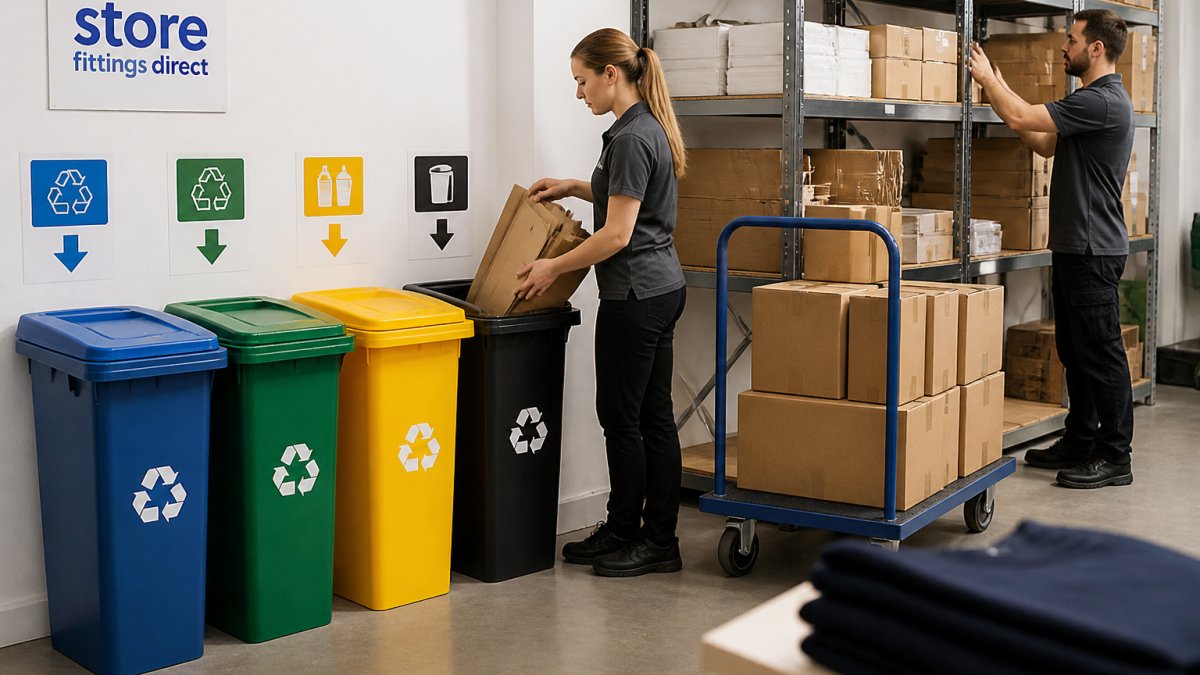
In retail, compact multi-compartment bins work well behind the counter and in stockrooms. Look for units with removable inner buckets, since these make emptying faster and cut down on spills. Wheels help if you move bins between the shop floor and the back.
In warehousing, cardboard dominates. A dedicated card container next to a baler saves space and keeps the yard tidy. For food waste, choose covered bins with liners to meet hygiene standards.
Durability matters more than price here. A bin that cracks within a year costs more than a sturdier unit that lasts five. We recommend checking load ratings and hinge quality before ordering, especially for high-traffic sites.
At Store Fittings Direct, we stock recycling bins and site protection products built for daily commercial use. Our range covers compact units for small shops and larger containers for warehouses.
Order one extra bin per stream if you can. When a bin is being emptied or cleaned, staff still have somewhere to sort waste. Skipping this step is how mixed loads happen.
Common Mistakes That Undo Compliance
Most compliance failures come down to a handful of repeat mistakes.
The first is mixing streams "just for today" during a busy period. One mixed bag can contaminate an entire collection, and collectors can refuse it.
The second is missing signage. Bins without clear labels get used incorrectly, no matter how well staff are trained.
The third is ignoring collection logistics. If your waste contractor does not collect separated streams, your sorting is wasted. Confirm your contract covers each stream before you order bins.
A fourth mistake is buying bins that are too small. Overflowing bins get topped up with the wrong waste. Size your containers for your busiest week, not your average one.
Conclusion
Getting Simpler Recycling right comes down to planning your waste streams before you buy a single bin. Most businesses that struggle do so because they sort waste without matching containers, labels, and collections to the rules.
Store Fittings Direct can help you build a setup that works from day one. We offer durable recycling bins, clear labelling options, and a Price Match Promise, backed by over 30 years of experience and more than 1.3 million products sold. Our trade accounts come with 30 days interest-free credit for larger orders.
Get started with Store Fittings Direct and build a recycling setup that keeps your site compliant and your waste flowing out the door.
Frequently Asked Questions
Do small businesses have to comply with Simpler Recycling?
Yes. Micro-firms with fewer than 10 employees were given until 31 March 2027 to arrange separate collection of core recyclable streams, while larger businesses had to comply from 31 March 2025. The rules apply to any business that produces waste, including independent shops, pharmacies and convenience stores. If you share a building or a waste container with other occupiers, check who holds the collection contract before assuming someone else has it covered.
Which waste streams must businesses separate under Simpler Recycling?
The default set is dry mixed recyclables (glass bottles and jars, metal tins and cans, plastic bottles, pots, tubs and trays, and paper and card), plus food waste for most businesses. Plastic film and flexible packaging are collected separately from 31 March 2027. Garden waste is only relevant if your site produces it. Your waste collector may accept a single mixed recycling container, provided the materials are collected separately from residual waste.
How can a business prepare for Simpler Recycling before the deadline?
Start with a waste audit: note what your site throws away over a typical week and in what volumes. Then map where each stream will be stored, checking door widths, aisle space and access for collection crews. Label every container clearly, brief staff on what goes where, and update your waste transfer documentation. Review your collection contract early, because lead times for new containers and revised schedules are longer than most operators expect.
What happens if a business does not comply with Simpler Recycling?
Non-compliance is enforced by the environmental regulator for your nation, and enforcement is generally advisory first: a warning or an enforcement notice setting out what must change. Ignoring that notice can lead to fines. The bigger practical risk is contaminated recycling loads being rejected by your collector, which means paying for the material to go to residual waste instead. Getting the segregation right from the start is cheaper than correcting it later.


