

Table of Contents
- 304 vs 316 Stainless Steel Bollards: Key Differences
- Grade Comparison Table: 304 vs 316
- Pros and Cons of Each Grade
- Choosing the Right Grade for Your Site
- Stainless Steel Bollard Installation: Step-by-Step
- Surface-Mounted Bollards: When and How to Fit Them
- Concrete-Set Bollards: A Permanent Fix
- Stainless Steel Bollard Maintenance That Keeps Them Looking New
- Frequently Asked Questions
Last Updated: October 6, 2026
304 vs 316 Stainless Steel Bollards: Key Differences
Choosing between 304 and 316 stainless steel bollards comes down to one question: what is the bollard actually standing in? This guide from Store Fittings Direct explains the difference between the two grades and walks through stainless steel bollard installation from first measurement to final fix. Both grades resist rust, both look identical on the surface, and both will outlast painted steel by years. The difference is what happens when salt, chlorine or industrial cleaners reach the metal.
304 stainless steel is an austenitic alloy containing around 18% chromium and 8% nickel (Cutlery Stainless Steel Grades). That chromium content forms a passive oxide layer that protects the surface from rust.
316 stainless steel contains the same base elements plus 2-3% molybdenum, which makes the passive layer far more resistant to chlorides.
Inland sites with normal rainfall rarely need the extra protection. Coastal sites, swimming pool surrounds, and locations where road salt is used in winter are a different story.
British Stainless Steel Association guidance on grade selection
How Each Grade Performs in Practice
The molybdenum in 316 is what stops chloride ions from breaking down the protective oxide layer. Where chlorides are present, 304 will develop tea-staining and, over time, pitting. That is not a manufacturing fault. It is the grade doing what the chemistry dictates.
What most guides miss is that grade is only half the story. Surface finish matters just as much. A brushed or satin finish traps fewer contaminants than a mirror polish, and regular cleaning does more for longevity than upgrading the grade alone.
Grade Comparison Table: 304 vs 316
| Property | 304 Stainless Steel | 316 Stainless Steel |
|---|---|---|
| Typical composition | 18% chromium, 8% nickel | 18% chromium, 8% nickel, 2-3% molybdenum |
| Chloride resistance | Moderate | High |
| Best for | Inland, sheltered sites | Coastal, poolside, salted roads |
| Appearance | Brushed or polished | Brushed or polished |
| Cleaning frequency | Monthly wipe-down | Monthly wipe-down |
| Relative cost | Lower | Higher |
The table tells you the trade-off in one glance. If your site sits more than a few miles from the coast and sees no de-icing salt, 304 is the sensible spend. If you can taste salt in the air, specify 316.
Pros and Cons of Each Grade
304 stainless steel bollards
- Lower cost for the same profile and diameter
- Excellent corrosion resistance in inland and sheltered locations
- Easy to clean and repair surface scuffs
- Drawback: chlorides will stain and eventually pit the surface
- Drawback: not suited to pool surrounds or exposed coastal frontages
316 stainless steel bollards
- Handles salt spray, pool chemicals and road salt without staining
- Longer service life in aggressive environments
- Same fixing options and dimensions as 304, so installation is identical
- Drawback: higher upfront cost
- Drawback: over-specifying it for a dry inland site adds cost for no practical gain
Choosing the Right Grade for Your Site
Work through the site conditions before you order. Ask three questions: how close is the sea, will de-icing salt reach the bollard, and will chlorine or strong cleaning chemicals be used nearby?
For most retail frontages, school entrances and warehouse yards away from the coast, 304 does the job. For seafront promenades, marina walkways, leisure centres with outdoor pools and anywhere the local authority grits the road, specify 316.
A common mistake is ordering 316 for the whole site when only the seaward line needs it. Splitting the order by exposure keeps the budget sensible without compromising the bollards that actually face the salt.
Stainless Steel Bollard Installation: Step-by-Step
Stainless steel bollard installation follows the same sequence whether you are fitting a surface-mounted unit or setting one into concrete. The grade you choose does not change the method.
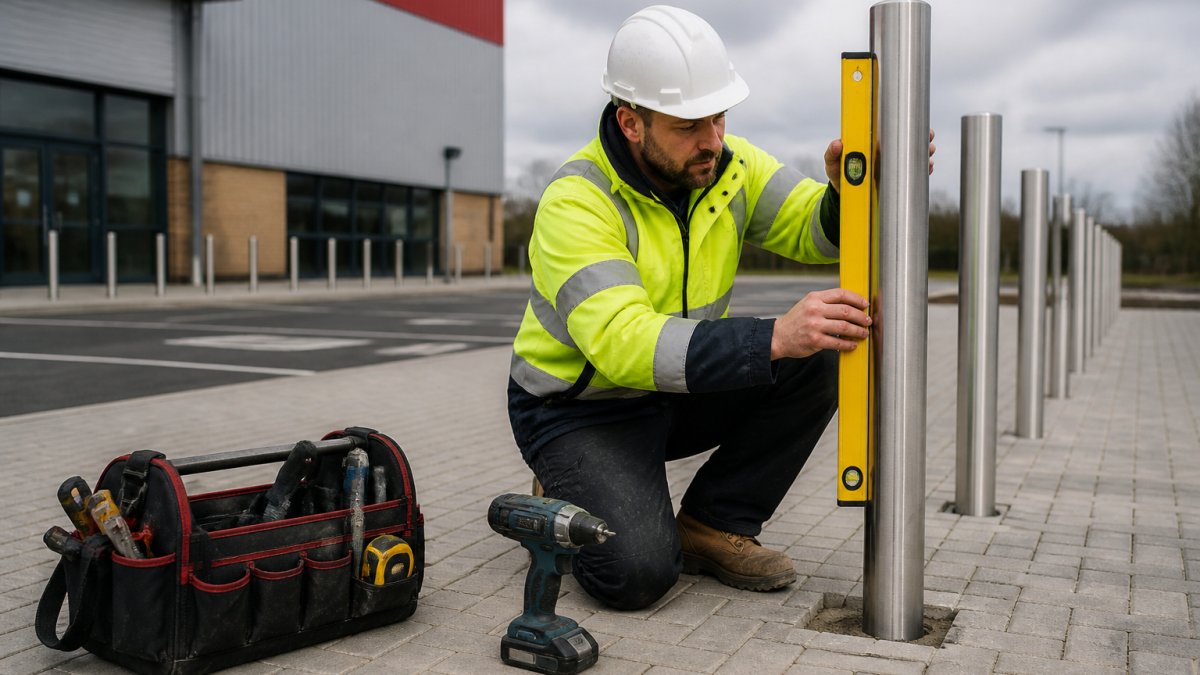
What You'll Need Before You Start
- Stainless steel bollards in the chosen grade and diameter
- Base plates and anchor bolts, or postcrete for set-in units
- Tape measure, string line and spirit level
- SDS drill with the correct bit size for your fixings
- Torque wrench and adjustable spanner
- Personal protective equipment: gloves, eye protection, hi-vis
Mark the centre point of each bollard along a string line first. Spacing should let pedestrians and trolleys pass comfortably while still blocking vehicle access. Check for buried services before you drill.
Surface-Mounted Bollards: When and How to Fit Them
Surface-mounted bollards suit existing hardstanding where you cannot break out the paving. They bolt directly to the slab through a base plate.
Drill the anchor holes to the depth specified by the fixing manufacturer, blow out the dust, then set the bollard and tighten the bolts in a cross pattern to keep the plate flat. Check the level in two directions before final torque.
The limitation is the slab itself. A surface-mounted bollard is only as strong as the concrete it sits on. If the paving is thin or cracked, the fixing will work loose under impact. Concrete-set units avoid that problem entirely.
Concrete-Set Bollards: A Permanent Fix
Concrete-set bollards are the stronger option where vehicles may actually strike them. The post is embedded directly into a concrete footing, so impact loads transfer into the ground rather than into a base plate.
Dig the footing to the depth and diameter specified for your bollard. Pour the concrete, set the bollard plumb, brace it, and leave it undisturbed while the concrete cures.
Get the alignment right before the mix stiffens. Once it sets, correcting a leaning bollard means breaking out the footing and starting again.
Health and Safety Executive guidance on vehicle and pedestrian segregation
Stainless Steel Bollard Maintenance That Keeps Them Looking New
Stainless steel bollard maintenance is simple, and skipping it is the fastest way to ruin a good installation. Wipe the surface down monthly with warm water and a mild detergent, then rinse.
Never use wire wool, bleach-based cleaners or abrasive pads. These scratch the passive layer and leave particles that rust. On coastal sites, wash more often and rinse thoroughly after storms.
Inspect fixings twice a year. Check anchor bolts for torque and look for movement at the base. A bollard that rocks is a bollard that will fail.
Steel particles from nearby grinding or cutting work settle on stainless steel and rust on the surface. Cover bollards during any adjacent metalwork, or the staining will look like a grade failure when it is contamination. ::: Preventing such surface oxidation is particularly critical when installing marine grade hardware in coastal environments where atmospheric salt exposure accelerates the degradation of unprotected metal surfaces.
At Store Fittings Direct, we supply stainless steel bollards and site protection equipment backed by over 30 years of experience, with fast nationwide delivery and trade accounts offering 30 days interest-free credit. Our team can help you match the grade to your site conditions and get the fixing method right first time.
Frequently Asked Questions
What is the difference between 304 and 316 stainless steel bollards?
304 contains chromium and nickel, offering good corrosion resistance for most inland sites. 316 adds molybdenum, which significantly improves resistance to chlorides and salt. For coastal or exposed areas, 316 stainless steel bollards are the better choice, while 304 suits typical urban or retail environments where salt exposure is low.
Are 304 stainless steel bollards suitable for outdoor use?
Yes, 304 stainless steel bollards are suitable for most outdoor settings away from the coast. They resist rust and weathering well in typical UK conditions. However, if the site is within a few miles of the sea or exposed to de-icing salts, 316 grade will last longer and require less maintenance.
How do you install a stainless steel bollard?
Installation depends on the fixing method. For surface-mounted bollards, mark positions, drill into the base material, and secure with anchor bolts. For concrete-set bollards, dig a hole to the specified depth, place the bollard, and fill with concrete. Always check local regulations and ensure the bollard is vertical and stable before final tightening.
How do you maintain stainless steel bollards?
Regular cleaning with warm soapy water and a soft cloth removes dirt and prevents surface staining. For coastal or high-traffic areas, use a proprietary stainless steel cleaner every few months. Avoid abrasive pads or chloride-based cleaners, which can damage the protective oxide layer. Inspect fixings annually and tighten any loose bolts.
Getting the grade wrong is an expensive mistake to correct once concrete has set. Store Fittings Direct supplies durable stainless steel bollards in both 304 and 316, alongside barriers and site protection equipment built for daily use. With bulk discounts, a Price Match Promise and over 1.3 million products sold, we make specifying site protection straightforward. View details on our stainless steel bollards and get the right grade for your site.


