

Table of Contents
- What Checkout Gates Actually Do for Your Store
- Mechanical vs Automatic Swing Gates for Shops
- How Checkout Gates Fit Into Retail Queue Management Systems
- Checkout Gates as Retail Loss Prevention Equipment
- Which Checkout Gate Suits Your Premises?
- Installation, Maintenance and Legal Duties
- Frequently Asked Questions
Last Updated: 21 September 2026
What Checkout Gates Actually Do for Your Store
Checkout gates are pedestrian control barriers installed at the entrance to, or exit from, a checkout zone, designed to direct customer flow in a single direction and return automatically to a closed position. For independent retailers, they solve a specific problem: keeping the walkway clear and the exit controlled without tying up a member of staff to police it.
This guide from Store Fittings Direct draws on more than 30 years supplying shop fixtures and barriers to retailers, schools and venues. Below, we break down the mechanical and automatic options, how gates sit inside wider retail queue management systems, and which specification suits a tight shop floor.
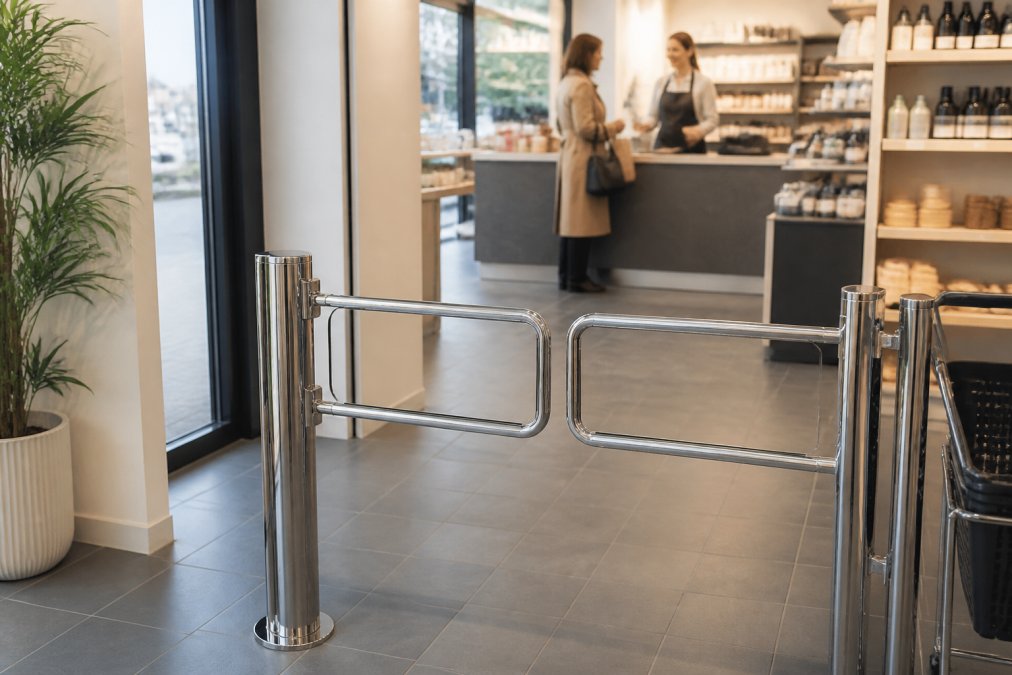
Most shoplifters don't run. They walk out through an unattended side exit with goods in a bag. A gate that snaps shut behind every person removes that option.
Mechanical vs Automatic Swing Gates for Shops
Mechanical gates rely on spring tension and need no power supply, while automatic swing gates for shops use powered operation and are better suited to high-footfall sites where hands-free entry matters. The trade-off is cost and complexity versus convenience.
Mechanical units suit most independent stores. They install without an electrician, keep working in a power cut, and cost a fraction of powered alternatives.
Automatic gates make sense where trolleys, pushchairs or high daily footfall make manual pushing impractical.
How the Spring and Cushioned Return Mechanism Works
The gate opens through 90 degrees and returns to closed under spring tension. An integrated hydraulically cushioned locking mechanism slows that return so the barrier settles smoothly rather than snapping.
A standard anti-panic function lets the gate be pushed open in the reverse direction under firm body pressure, giving an emergency exit route. A simple adjustment disables this when the gate is used purely as an exit.
How Checkout Gates Fit Into Retail Queue Management Systems
Checkout gates are the final control point in a retail queue management system, sitting alongside lane dividers, belt barriers and directional signage. Get the sequence right and customers self-organise; get it wrong and you create a bottleneck at the till.
The useful comparison is how each element earns its place:
| Component | Job It Does | Best For |
|---|---|---|
| Swing gate | Controls entry/exit direction | Store entrance, checkout exit |
| Belt barrier | Defines queue lanes | Till queues, service desks |
| Directional signage | Tells customers where to go | Multi-lane checkouts |
| Turnstile gate | One-person-at-a-time flow | Venues, ticketed entry |
A common mistake is buying gates before mapping the customer route. Walk the store yourself at peak time first, note where people hesitate or cut across, and place the gate where the flow actually needs correcting.

Checkout Gates as Retail Loss Prevention Equipment
Checkout gates function as retail loss prevention equipment by removing unmonitored exit points and forcing every customer past a staffed position. They are not a substitute for CCTV or tagging, but they close the easiest gap in a store's defences.
Where they earn their keep is at secondary exits: the fire door propped open "just for a minute", the side entrance near the stockroom, the corridor that bypasses the tills entirely. A self-closing gate at each of those points means the walkway stays clear and used as intended, with no physical interaction needed from staff or customers. Securing these transition points effectively requires a robust selection of commercial door hardware to ensure that every mechanism remains reliable under the constant strain of high-traffic retail environments.
The staffing effect matters as much as the security one. Every gate that enforces a one-way system is a member of staff freed up from watching a doorway.
Which Checkout Gate Suits Your Premises?
Match the gate to the traffic pattern, not the other way round. A single-direction entrance needs a different unit from a two-way corridor, and a checkout-mounted gate solves a problem a floor-standing one cannot.
Choosing Between the Wanzl Mechanical Range
Store Fittings Direct stocks four Wanzl mechanical gates, each aimed at a different layout:
- Wanzl Manual Mechanical Swing Gate (£749.00) - the standard single-direction unit, with free delivery
- Wanzl Manual Swing Gate Bi-Directional (£769.00) - for corridors where traffic moves both ways
- Mechanical Checkout Swing Gate (£695.00) - the economical option for lower-security areas
- Wanzl Checkout Lockable Mechanical Swing Gate (£749.00) - mounts directly to the checkout for a lockable exit
All four share the same chrome or powder-coated finish, cushioned return and anti-panic function. The bi-directional model is the one most buyers overlook, and it's usually the right answer for a library, gym or office building with a shared entrance and exit.


Installation, Maintenance and Legal Duties
Installation is straightforward on a level floor and needs no power for mechanical units, but the legal side is where most buyers get caught out. Under the Regulatory Reform (Fire Safety) Order 2005, the responsible person for a premises must keep escape routes clear and usable, which means any gate on an escape route must allow egress. The Health and Safety Executive treats pedestrian traffic routes as a risk-assessment item, so gates should be included in your written assessment.
Maintenance is minimal: check the spring tension and cushioning action periodically, and confirm the anti-panic function still releases under pressure. Wanzl gates are engineered for long-term performance with minimal maintenance.
Frequently Asked Questions
What are the primary benefits of installing checkout gates?
Checkout gates give you control over how people move through entrances, exits and payment areas. A spring-loaded gate closes behind each person automatically, so walkways stay clear and one-way systems hold without staff policing them. They also deter trolley push-throughs and slip-outs at busy exits, support social distancing measures and keep fire routes usable. The Wanzl range adds hydraulically cushioned closing and an anti-panic function as standard, so the gate returns smoothly rather than snapping back.
Are checkout gates suitable for small retail environments?
Yes. The Wanzl Manual Mechanical Swing Gate is a single unit that fits a standard doorway or aisle end, so it works in a boutique just as well as a supermarket. There is no power supply to run, no wiring and no control panel, which keeps the footprint small. You can start with one gate at the main exit and add more units later if your layout changes.
How do automatic swing gates for shops differ from mechanical ones?
Automatic gates use sensors or push-button controls to open and close, which suits high-footfall sites where hands-free access matters. Mechanical gates rely on spring tension and body pressure, so they need no power and cost less to run. The Wanzl mechanical models open through 90 degrees and return under spring tension, with a cushioned locking mechanism for a smooth close. Both types can be set to allow or block reverse passage.
What maintenance is required for retail checkout gates?
Mechanical swing gates need very little attention. Check the swivel tube and base fixings periodically for movement, wipe the powder-coated or chrome surfaces clean, and confirm the gate still returns fully to its resting position. The Wanzl units are designed for long-term performance with minimal maintenance, and the anti-panic function should be tested as part of your regular fire safety checks. If a gate starts to drag or stick, adjust the spring tension rather than forcing it.
The challenge for most independent retailers isn't choosing a gate, it's knowing which of the four Wanzl units fits a specific doorway. Store Fittings Direct has supplied over 1.3 million products across three decades, with free delivery, bulk trade pricing and a Price Match Promise. Get started with Store Fittings Direct and put the right gate on the right exit.


