

Table of Contents
- Why Fruit and Vegetables Storage Decides Your Profit Margin
- Best Practices for Fresh Produce Storage
- How to Reduce Produce Spoilage in Shops
- Retail Produce Display Ideas That Keep Stock Fresh
- Fruit and Vegetables Storage Equipment: Baskets, Crates and Displays
- Common Storage Mistakes That Cost Independent Retailers Money
- Conclusion
- Frequently Asked Questions
Last Updated: 22 September 2026
Why Fruit and Vegetables Storage Decides Your Profit Margin
Fruit and vegetables storage is the single most controllable cost line in a fresh produce operation, and most independent retailers treat it as an afterthought. At Store Fittings Direct, we've spent over 30 years supplying shop fixtures to greengrocers, farm shops and convenience stores, and the pattern is consistent: the shops that lose the least on waste are the ones that treat storage and display as one system rather than two separate jobs.
The margin maths is unforgiving. A crate of soft fruit that sits at the wrong temperature for a day can lose a meaningful share of its saleable value overnight, and that loss comes straight off the bottom line because the stock was already paid for.
Below, we'll show you exactly how to match storage conditions to produce type, what to keep apart, and which display setups actually slow spoilage instead of accelerating it.
Best Practices for Fresh Produce Storage
Good fresh produce storage comes down to three variables you can actually control: temperature, humidity and airflow. Get those right and most produce holds its quality far longer than a default "chuck it in the back room" approach allows.
Airflow is the one most shops get wrong. Sealed crates and tightly packed shelves trap ethylene and moisture, which speeds ripening and encourages mould. Perforated or slatted containers let air move around the produce, which is why open basket systems consistently outperform closed boxes for anything short-lived.
Temperature and Humidity by Produce Type
Different crops want different conditions, and grouping them by "fresh" versus "chilled" is too crude. Leafy greens and herbs want cool, humid conditions. Root vegetables and onions want cool and dry. Tropical items such as bananas and tomatoes are actively damaged by refrigeration and should sit at ambient shop temperature.
A workable rule for a small shop with limited back-room space:
- Cool and humid: leafy greens, herbs, brassicas, berries
- Cool and dry: onions, garlic, potatoes, squash
- Ambient: tomatoes, bananas, avocados, citrus (short term)
What to Store Together and What to Keep Apart
Ethylene is the hidden cost in most produce sections. Bananas, apples, pears and tomatoes release it as they ripen, and it accelerates ripening in whatever sits nearby. Keep high-ethylene producers away from ethylene-sensitive items such as leafy greens, cucumbers and carrots.
Physical separation matters as much as temperature separation. A single shelf between two groups is often enough, and stackable crate systems make that easy to maintain because you can dedicate specific crates to specific groups rather than mixing stock.
Fruit and Vegetable Basket | 5 →
How to Reduce Produce Spoilage in Shops
The most effective way to reduce produce spoilage in shops is disciplined rotation combined with fast culling. Neither is glamorous, and both are routinely skipped when a shop is busy, which is exactly when they matter most.
Rotation, Culling and the Cost of Ignoring Them
First in, first out is the standard, but it only works if new deliveries physically go behind old stock. In practice, that means unpacking to the back of the shelf or crate run, not the front. A common mistake is stacking new deliveries on top of older stock because it's quicker; the older stock then sits underneath, ripens unseen and gets thrown away.
Culling is the harder discipline. One soft item in a crate spreads mould to its neighbours within a day, so removing it immediately protects the rest of the crate. Retailers who cull twice daily typically throw away less overall than those who cull once, because they catch problems before they spread.
Retail Produce Display Ideas That Keep Stock Fresh
The best retail produce display ideas do two jobs at once: they sell the produce and they extend its shelf life. Those goals are not in conflict, but they do require the right fixtures.
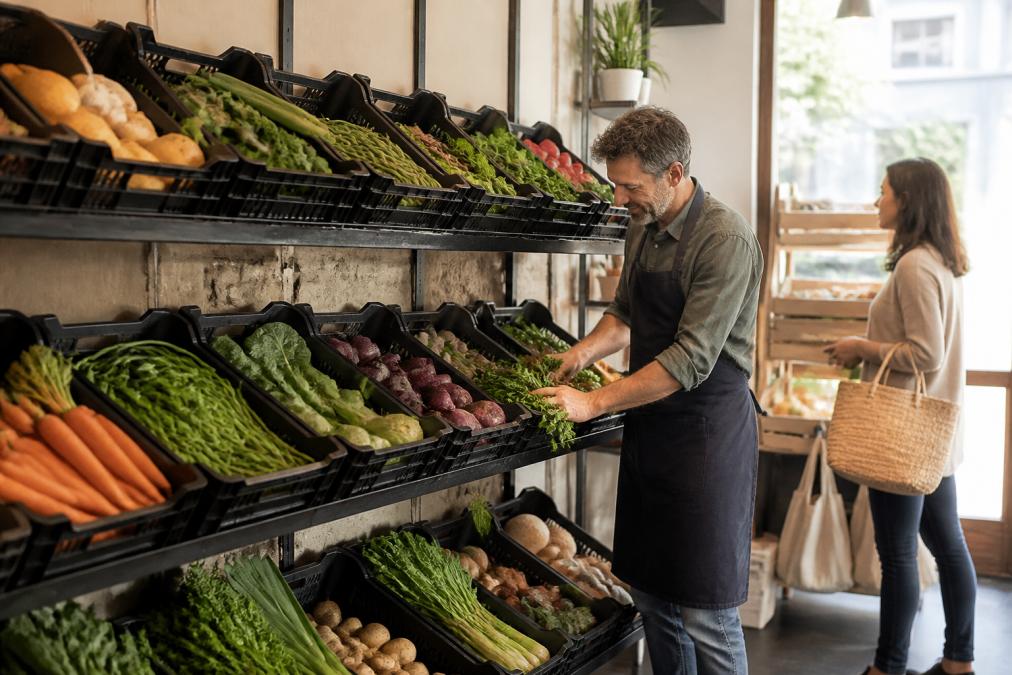
Tilted shelf displays present produce at an angle that customers can see and reach easily, and the tilt also discourages over-stacking, which improves airflow around each item. Wall-mounted units make use of vertical space, which matters in a small shop where floor area is at a premium.
Basket-based displays beat solid trays for anything short-lived. The open weave of a basket lets air circulate around the produce, and it lets you rotate stock without dismantling the whole display. Our fruit and vegetable displays are built around this principle, with tilted shelves and optional green baskets that keep produce visible and ventilated at the same time.

For shops that need flexibility, collapsible baskets are worth considering because they fold flat when not in use. That makes seasonal range changes far less disruptive.

Fruit and Vegetables Storage Equipment: Baskets, Crates and Displays
Choosing the right containers is where most shops either save money or quietly lose it. The key specifications are depth, ventilation and whether the container stacks.
| Equipment | Best For | Key Feature | Price |
|---|---|---|---|
| Stackable Fruit and Veg Crates 35L (pack of 5) | Back-room storage, markets, catering | Perforated design, fold-down handles, stacks vertically | £85.22 |
| Plastic Collapsible Vegetable Baskets | Smaller stores, seasonal ranges | Collapses flat, ventilated, black or green | £9.36 |
| Plastic Fruit and Veg Crates | General shop-floor display | 150mm deep, ventilated, stackable | £11.14 |
| 4 Tier Wall Fruit & Vegetable Display | Wall-mounted produce sections | Tilted shelves, mirrored canopy, four widths | £346.63 |
The 35-litre stackable crates are the workhorse option for back-room storage and transport. Their perforated design promotes air circulation, which is the whole point, and the fold-down handles make them practical to carry when full. Deep baskets at 200mm give you enough volume for root vegetables without the produce sitting in a solid tray.
Fruit and Vegetable Basket | 5 →

For shop-floor presentation, the 4-tier wall display is the fixture that ties storage and selling together. It's available in 665mm, 800mm, 1000mm and 1250mm widths, so it works in a compact corner shop as well as a larger farm shop, and it ships as an add-on bay designed to run alongside others. If you need it freestanding, a finisher leg is available separately.
Common Storage Mistakes That Cost Independent Retailers Money
The expensive mistakes are rarely dramatic. They're small, repeated daily, and invisible until you add up a month of waste.
- Refrigerating ethylene producers. Bananas, tomatoes and avocados deteriorate faster in the cold. Keep them ambient.
- Mixing ethylene producers with sensitive crops. One crate of apples next to your greens shortens their life noticeably.
- Over-stacking displays. A display packed to the top looks abundant but kills airflow and hides older stock underneath.
- Culling once a day. Mould spreads between checks. Twice daily is the practical minimum.
- Buying solid trays to save money. Ventilation is the feature you're paying for. A solid tray costs less and wastes more.
The throughline across all five is the same: every one of them trades a small, visible convenience today for a larger, invisible cost later. Fresh produce punishes that trade more than almost any other retail category.
Conclusion
Fresh produce margins are decided by what you throw away, not by what you sell, and the shops that control waste are the ones that treat storage conditions and display fixtures as one decision.
Store Fittings Direct supplies the crates, baskets and wall displays that make that decision easier, backed by over 30 years of experience, over 1.3 million products sold, fast nationwide delivery and trade accounts with 30 days interest-free credit. Get started with Store Fittings Direct and build a produce section that keeps stock fresher for longer.
Frequently Asked Questions
What is the best way to store fruit and vegetables in a retail environment?
Keep produce cool, ventilated and off the floor. Use stackable crates and baskets with perforated sides so air moves around the stock, and store items at the temperature each type prefers, such as 4-7°C for leafy greens and 7-10°C for tomatoes. Rotate older stock to the front daily. Proper fruit and vegetables storage like this slows ripening and keeps displays looking full for longer.
Which fruits and vegetables should be stored separately?
Keep ethylene-producing items such as bananas, apples, pears and tomatoes away from ethylene-sensitive produce like leafy greens, cucumbers, carrots and broccoli. Ethylene speeds up ripening in nearby stock, so separating the two groups in different crates or bays extends shelf life. Onions and potatoes should also be stored apart, as each releases gases that spoil the other.
How does proper storage reduce food waste in retail?
Correct temperature, airflow and rotation cut the number of items that wilt, soften or mould before they sell. Grouping produce by its storage needs and using ventilated crates reduces moisture build-up, which is a common cause of spoilage. Less waste means lower replacement costs, fuller displays and better margins on every delivery.
How do I maintain produce freshness in a shop display?
Check displays at the start and end of each day, removing damaged items before they affect neighbouring stock. Mist leafy greens lightly, keep the display out of direct sunlight and avoid overloading shelves, as tight packing blocks airflow. Refill from the back and rotate older stock forward so nothing sits untouched for too long.


