

Table of Contents
- What Is a Deposit Return Scheme?
- How the Deposit Return Scheme Works
- Reverse Vending Machine Requirements for Retailers
- Benefits of Compact Reverse Vending Units
- DRS Compliance for Small Businesses
- Implementation Timeline and What to Expect
- Preparing Your Retail Space for the Scheme
- Frequently Asked Questions
Last Updated: September 3, 2026
What Is a Deposit Return Scheme?
A deposit return scheme (DRS) is a system where consumers pay a small deposit on single-use drinks containers and receive that deposit back when they return the empty container for recycling. From October 2027, this system will operate across England, Scotland, Wales, and Northern Ireland, fundamentally changing how retailers handle beverage packaging and customer transactions (gov.uk).
The deposit return scheme works by creating a financial incentive for consumers to return bottles and cans rather than discarding them. When a shopper purchases a drink in a participating container, they pay an additional deposit (typically 20 pence per item) (gov.uk). Upon returning the empty container to a participating retailer, they receive their deposit back. This creates a circular economy for beverage packaging, dramatically increasing recycling rates and reducing litter.
For retailers, understanding the deposit return scheme is essential. Most shops will need to accept returned containers and integrate new processes into their operations. This isn't optional, it's a regulatory requirement that affects convenience stores, supermarkets, garden centres, petrol stations, and independent retailers alike.
How the Deposit Return Scheme Works
The deposit return scheme operates through a straightforward process that benefits both retailers and consumers. When a customer purchases a beverage in a participating container, the till price includes the base cost of the drink plus a separate 20 pence deposit charge. The customer sees this clearly on their receipt.
When the customer returns with empty containers, they insert them into a reverse vending machine or hand them to staff at a designated counter. The machine reads the barcode or processes the container manually, verifies it's eligible, and either dispenses the refund immediately or credits the customer's account. The retailer then stores the containers for collection by a distribution network that transports them to recycling facilities.
This system creates accountability at every stage. Retailers must track deposits received and refunds issued. The scheme includes a centralised registry that manages participating retailers, container types, and compliance. Retailers who fail to participate face regulatory action, so adoption isn't a choice, it's a requirement.
For small independent shops, this means integrating new payment processes, training staff on container eligibility, and managing physical space for returned containers. The complexity increases if manual handling is involved, which is why many retailers are investing in compact reverse vending machines designed for smaller spaces.

Reverse Vending Machine Requirements for Retailers
Retailers must meet specific requirements when installing reverse vending machines to comply with the deposit return scheme. The machine must accurately read and identify eligible containers, calculate the correct refund amount, and process transactions securely. It must also integrate with the centralised scheme registry to report data accurately.
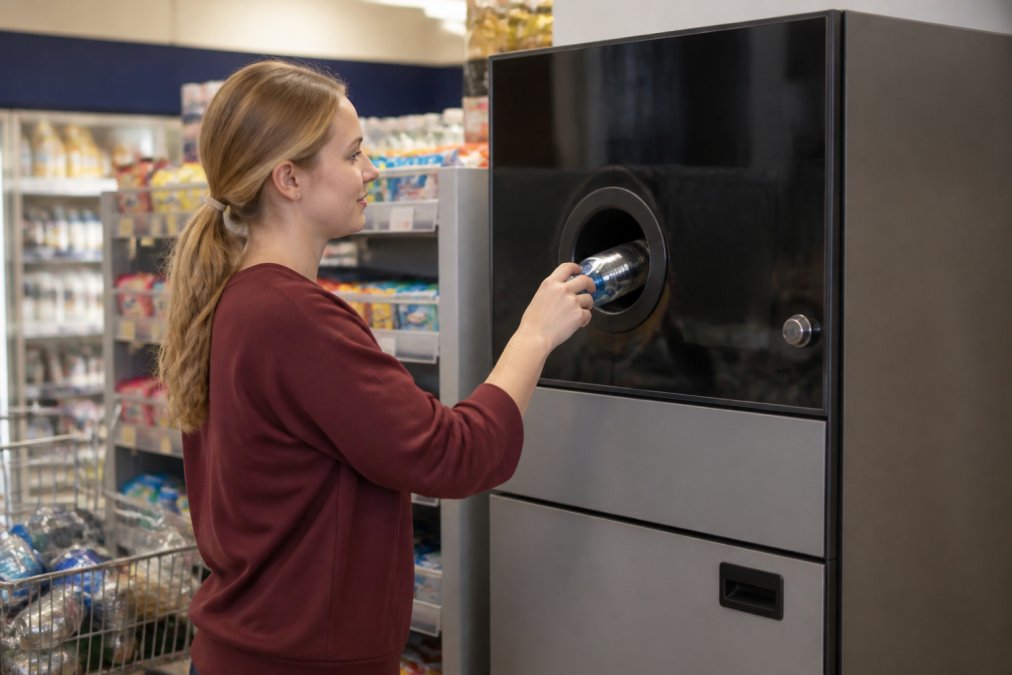
Space is a critical constraint for many retailers. Traditional reverse vending machines occupy significant floor space, often the size of a large refrigerator or vending cabinet. For independent boutiques, garden centres, petrol stations, and small convenience stores, this presents a genuine challenge. Store Fittings Direct has addressed this with a compact reverse vending unit designed specifically for retailers with limited space. Our new Deposit Return Machine | Compact Reverse Vending Unit | Cans & Bottles | DRS is built to handle cans and bottles efficiently without dominating the shop floor.
The machine must be positioned accessibly for customers but away from main traffic flows to avoid congestion. Retailers need adequate space behind or beside the unit for staff to manage collected containers and perform basic maintenance. Most machines require a standard power connection and may need a data connection for scheme reporting.
Machine capacity matters. Smaller units may need emptying more frequently during peak periods, increasing labour costs. The right machine balances capacity with footprint, essential for retailers operating in tight spaces.
Benefits of Compact Reverse Vending Units
Compact reverse vending units deliver several advantages for retailers managing the deposit return scheme. They automate the refund process, reducing staff time spent manually processing returned containers. This efficiency gain is particularly valuable during busy trading periods when till staff are stretched.
Customer experience improves significantly with a self-service machine. Customers appreciate the convenience of instant refunds without queuing at a counter. This reduces friction and can increase customer satisfaction, especially for regular returners. The automated process also eliminates disputes over container eligibility, the machine makes consistent, objective decisions.
For retailers, data collection is simplified. Compact machines integrate with the scheme's centralised registry, automatically reporting transactions. This removes manual paperwork and reduces the risk of compliance errors. Retailers gain visibility into return patterns, which can inform decisions about stock levels and promotional strategies.
Space efficiency is perhaps the most significant benefit for independent retailers. A compact unit occupies roughly the footprint of a standard vending machine, making it feasible for shops that previously assumed they couldn't participate. This democratises access to automated handling, allowing smaller players to compete fairly with larger chains.
DRS Compliance for Small Businesses
Small businesses face unique compliance challenges with the deposit return scheme. Unlike large supermarket chains with dedicated compliance teams, independent retailers must understand and implement requirements themselves. Non-compliance carries financial penalties and reputational damage.
The first compliance requirement is participation itself. Retailers cannot opt out of the deposit return scheme. If a shop sells beverages in participating containers, it must accept returns and process refunds. This applies to convenience stores, garden centres, petrol stations, and any other retail format.
Record-keeping is essential. Retailers must maintain accurate data on deposits collected and refunds issued. This information feeds into the centralised scheme registry. Most modern point-of-sale systems integrate with the scheme, automating much of this reporting. However, retailers using older systems may need upgrades to ensure compliance.
Staff training is another critical area. Employees must understand which containers qualify for returns, how to process refunds, and how to handle disputes. Poorly trained staff can create customer frustration and inadvertently process ineligible containers, creating financial exposure.
For businesses considering compact reverse vending machines, compliance becomes significantly easier. The machine handles eligibility verification automatically, reducing human error. Store Fittings Direct's compact unit is designed with small business compliance in mind, integrating seamlessly with scheme reporting requirements.
Implementation Timeline and What to Expect
The deposit return scheme launches in October 2027, giving retailers approximately eighteen months to prepare. Understanding the implementation timeline helps businesses plan investments and operational changes strategically.
From now until spring 2027, retailers should audit their current operations and assess space constraints. Businesses selling beverages in participating containers must decide whether to use manual processing or invest in reverse vending equipment. This is the period to evaluate suppliers and place orders, as demand for machines will likely surge as the launch date approaches.
By summer 2027, physical installations should be complete. Retailers need time to test equipment, train staff, and integrate systems with their point-of-sale software. This period also allows businesses to work through initial problems before the scheme goes live.
From October 2027 onwards, the scheme operates in full effect. Retailers must process all eligible returns and maintain compliance with reporting requirements. The first few months typically see higher volumes as consumers adjust to the new system, so retailers should prepare for increased activity.
Early action provides several advantages. Retailers who prepare early can negotiate better pricing on equipment, secure installation slots before contractors are overbooked, and build staff confidence through thorough training. Delaying preparation increases risk, last-minute installations are often rushed, and staff training becomes superficial.
Preparing Your Retail Space for the Scheme
Physical space preparation is fundamental to successful deposit return scheme implementation. Retailers must designate an area for customer returns, storage for collected containers, and potentially space for the reverse vending machine itself.
Customer-facing space should be visible and accessible. The return area must be positioned where customers can easily find it without disrupting main shopping flows. Clear signage is essential, many first-time users won't know where to look. Retailers should allocate at least one metre of linear space or a dedicated corner, depending on their chosen approach.
Behind-the-scenes space is equally important. Collected containers require temporary storage before collection by the scheme's distribution network. Retailers typically need space equivalent to a small storage cupboard or section of stockroom. Containers must be stored safely to prevent damage and kept separate from other waste streams.
For retailers using compact reverse vending machines, space planning is more straightforward. The machine occupies roughly 0.5 square metres of floor space, similar to a standard vending cabinet. Placement near the entrance or exit works well, as it doesn't disrupt the main shopping experience whilst remaining highly visible.
Staff areas need preparation too. Employees need access to training materials, clear procedures for troubleshooting common issues, and a designated person responsible for machine maintenance and container collection scheduling.
Preparing for the deposit return scheme requires planning across multiple dimensions, regulatory compliance, staff training, physical space, and equipment selection. For independent retailers, the challenge is significant but manageable with the right approach and tools. Store Fittings Direct's Deposit Return Machine is specifically engineered for retailers facing space constraints, delivering automated processing without demanding the footprint of traditional solutions. By starting preparations now, retailers can ensure smooth implementation and position themselves to benefit from the scheme's efficiency gains and customer engagement opportunities.
Frequently Asked Questions
When will the deposit return scheme be implemented across all regions?
The deposit return scheme launches in October 2027 across England, Scotland, Wales, and Northern Ireland. All single-use drinks containers will require a deposit at the point of sale. Retailers must be ready to accept returns and process refunds from that date. Preparation should begin well in advance to ensure smooth integration with your operations.
Do small retailers like convenience stores need to install a reverse vending machine?
Not necessarily. Whilst large supermarkets typically use automated machines, smaller retailers have flexibility in how they handle returns. Many convenience stores, petrol stations, and garden centres can manage returns manually or with compact units. The key requirement is accepting containers and processing refunds. A compact reverse vending unit offers efficiency without requiring extensive floor space, making it ideal for smaller operations.
What are the main benefits of using a compact reverse vending unit?
Compact units reduce manual handling, speed up the return process, and improve customer experience. They require minimal floor space compared to supermarket-grade machines, making them suitable for independent retailers. Benefits include reduced labour costs, fewer errors in counting, and the ability to track returns data. For small businesses, this means efficient compliance without major operational disruption.
Which types of containers are included in the deposit return scheme?
The scheme covers single-use drinks containers made of plastic, metal, and glass between 50 millilitres and 3 litres in capacity. This includes plastic bottles, aluminium cans, steel cans, and glass bottles. Containers for milk and milk alternatives are currently excluded. Retailers must accept all qualifying containers regardless of where they were purchased, as long as they fall within the scheme's scope.
This article was written using GrandRanker


