

Table of Contents
- Understanding Damage to Warehouse Storage Uprights
- SEMA Rack Inspection Guidelines for Identifying Damage
- Tools and Materials You'll Need
- Step-by-Step Repair Process for Uprights
- Using Pallet Racking Repair Kits
- When to Replace Pallet Racking Instead
- Common Mistakes to Avoid
- Protecting Your Uprights from Future Damage
- Frequently Asked Questions
Last Updated: September 4, 2026
Understanding Damage to Warehouse Storage Uprights
Damage to warehouse storage uprights is one of the most serious safety issues in any facility that uses pallet racking. A damaged upright column compromises the structural integrity of the entire rack, creating a risk of collapse that can injure staff and destroy inventory. Whether the damage comes from a forklift impact, a dropped pallet, or years of wear, the question of how to repair damaged warehouse storage uprights demands a careful, standards-driven answer.

At Store Fittings Direct, we supply warehouse protection equipment across the UK, and we see the consequences of ignored rack damage far too often. The first thing to understand is that a bent or dented upright is never purely cosmetic. The load-bearing capacity of the column reduces the moment it deforms, and that reduction grows as the damage worsens.
The decision to repair or replace comes down to one factor: whether the upright can be returned to a condition that safely supports its rated load. If it cannot, no amount of straightening will make it safe. This guide walks through the inspection process, the repair options, and the protection measures that stop damage from happening in the first place.
SEMA Rack Inspection Guidelines for Identifying Damage
The starting point for any repair decision is a formal inspection using recognised standards. In the UK, the [SEMA guidelines for the inspection of pallet racking(/products/pallet-racking-protection-black-bull-uprofile) | sema.org.uk] set the benchmark for identifying and classifying damage. SEMA, the Storage Equipment Manufacturers' Association, publishes thresholds that tell you whether an upright is safe to keep in service, safe to repair, or needs immediate replacement.
A qualified inspector should examine every upright for visible distortion, paying particular attention to the base area where most forklift impacts occur. They will measure the depth of any dent or bend and compare it against SEMA's published limits. If your facility has not had a formal rack inspection in the past 12 months, book one before attempting any repair work. Guessing at the severity of damage is how minor issues become catastrophic failures.
Red, Amber, and Green Risk Levels
SEMA classifies damage into three clear categories. Green means the damage is within acceptable tolerances and the rack can remain in service, though it should be monitored. Amber indicates damage that requires remedial action, which may include repair using approved methods or replacement of the affected component. Red means the damage is severe enough that the rack must be unloaded and taken out of service immediately.
Understanding these levels is critical to how to repair damaged warehouse storage uprights because it dictates whether a repair is even permissible. A red-rated upright should never be straightened in place. The forces involved in bending steel back into shape can introduce micro-cracks that are invisible to the naked eye but fatal to the rack's integrity.
Tools and Materials You'll Need
Before starting any repair, gather the correct equipment. Attempting to repair damaged warehouse storage uprights with improvised tools is a common mistake that leads to poor results and unsafe racking.
For minor straightening work, you will need a hydraulic jack or portable press, wooden or rubber packing blocks to spread the load, and a straightedge or laser level to verify alignment. For measuring damage against SEMA tolerances, a calibrated depth gauge and a steel rule are essential. You will also need the manufacturer's specifications for the rack, which state the maximum allowable distortion for that particular upright section.
For repairs that involve replacing a damaged section, you will need a cutting disc suitable for steel, replacement sections from the original manufacturer, and high-tensile bolts of the correct grade. Never mix components from different manufacturers. Racking is engineered as a system, and substituting parts voids the structural calculations that keep it safe.
Step-by-Step Repair Process for Uprights
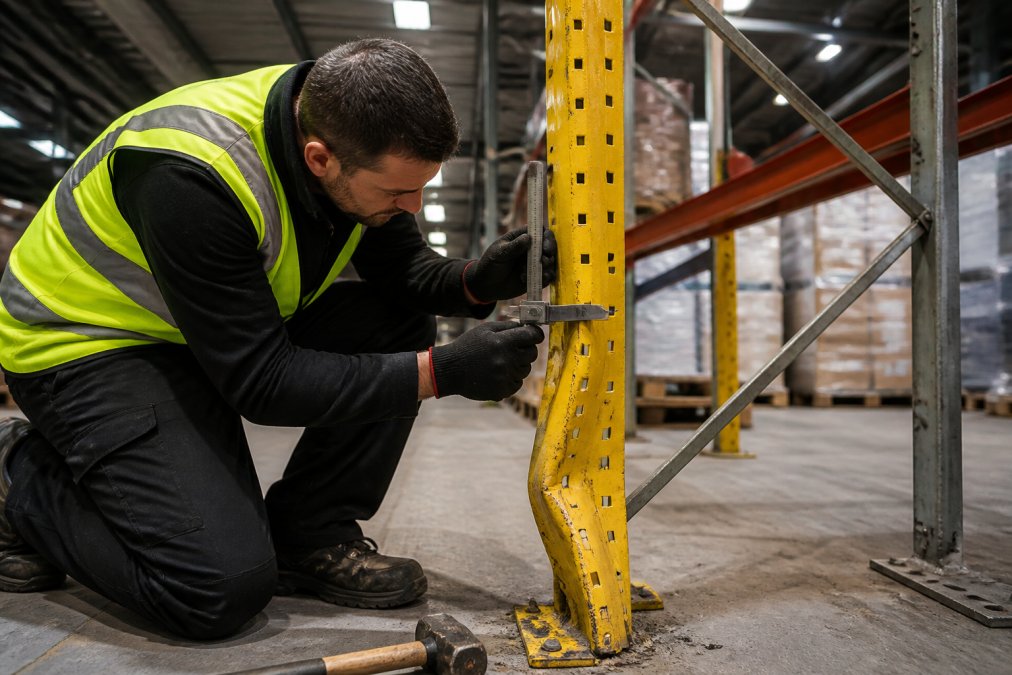
If an inspection confirms the damage is within the amber category and a repair is permissible, the process follows a strict sequence. Attempting to repair damaged warehouse storage uprights without following this order risks making the damage worse and endangering anyone nearby.
Step 1: Assess the Extent of Damage
Measure the deformation at its deepest point using a depth gauge. Record the measurement and compare it against the SEMA thresholds and the manufacturer's specifications. Check the welds at the base plate and at beam connections for cracking. If any weld has failed, the upright must be replaced, not repaired. Also check the floor anchors, as a significant impact may have loosened the fixing that holds the upright in place.
Step 2: Isolate and Unload the Affected Section
Clear the affected bay and the bays immediately adjacent on both sides. Remove all pallets and ensure no staff are working in the aisle. If the damage is rated amber but the rack is holding heavy loads, the weight must come off before any straightening begins. The rack must also be isolated from use with a visible tag or barrier so nobody loads it while you work.
Step 3: Straighten or Replace Damaged Sections
For minor bends that fall within permissible repair limits, use a hydraulic jack with packing blocks to apply slow, controlled pressure to the damaged area. Work gradually, checking alignment frequently with a straight edge. Stop immediately if the steel shows any sign of cracking. For more significant damage, cut out the damaged section and splice in a replacement section from the original manufacturer, following their approved repair procedure.
Step 4: Reinstall and Test Stability
Once the upright is straight or the replacement section is fitted, verify the column is plumb using a spirit level. Check that beam connectors seat correctly and that the rack stands level. Before returning the rack to service, a competent person must sign off the repair confirming it meets the required standard. Then reload gradually, starting with the bottom beams and working up.
Using Pallet Racking Repair Kits
Pallet racking repair kits offer a practical solution for specific types of damage, particularly damage to the base of an upright. These kits typically include a replacement leg section that bolts over the damaged area, restoring the column's load path without requiring a full upright replacement.
The advantage of a repair kit is speed. A bolted splice can often be fitted in under an hour, whereas replacing a full upright means unloading the rack, dismantling beams, and potentially removing the entire bay.
However, repair kits are not a universal fix. They must be approved by the rack manufacturer or a structural engineer for your specific installation. Using a generic kit on a rack it was not designed for creates a false sense of security. The kit also needs to be compatible with the upright profile, so check the dimensions and bolt pattern carefully before ordering. Always confirm the repair method you choose is acceptable under SEMA's guidance on rack repair before proceeding.
When to Replace Pallet Racking Instead
Knowing when to replace pallet racking instead of repairing it is just as important as knowing how to repair damaged warehouse storage uprights. Some damage is simply beyond repair, and trying to fix it puts everyone at risk.
Replace the upright entirely if the damage is rated red under SEMA guidelines, if the column is twisted rather than simply bent, or if any weld has cracked. Replacement is also required if the damage extends across more than one face of the column or if the upright has been damaged more than once in the same area. Multiple impacts in the same location weaken the steel even if each individual dent looks minor.
The cost of replacement often feels painful, but it is a fraction of the cost of a rack collapse. A collapse can destroy thousands of pounds of stock, damage the building, and cause serious injury. If there is any doubt about whether a repair will restore the upright to its original load-bearing capacity, err on the side of replacement.
Common Mistakes to Avoid
Several recurring mistakes undermine attempts to repair damaged warehouse storage uprights. The most dangerous is straightening a red-rated upright in place. Bending steel back and forth work-hardens it, making it brittle and more likely to fracture under load. A straightened upright may look fine but have significantly less strength than before.
Another frequent error is ignoring the base plate and floor fixings. An impact that dents an upright often shears the anchor bolts holding it to the floor. If you repair the column but leave the anchors loose, the rack can topple sideways under load. Always check and re-torque the floor fixings after any impact.
Finally, do not rely on visual inspection alone. A dent that looks shallow from one angle can be far deeper when measured properly. Use the correct measuring tools and document every repair with photographs and written records. This documentation is essential for insurance purposes and for demonstrating compliance during a SEMA inspection.
Protecting Your Uprights from Future Damage
Prevention is always cheaper than repair. The most effective way to protect damaged warehouse storage uprights from recurring impacts is to install physical barriers around them. Forklift operators will make mistakes, and the right protection equipment absorbs those impacts before they reach the rack.
The HSE's guidance on workplace transport safety emphasises the importance of segregation between vehicles and racking, and physical protection is a key part of that strategy. A Pallet Racking Protection | Black Bull unit from Store Fittings Direct provides a durable steel shield that absorbs impacts at the most vulnerable point of the upright. For corners and exposed columns, the Pallet Racking Protection 'U' Profile | Black Bull wraps around the column for 180-degree coverage. Where maximum protection is needed, the Warehouse Column Protector Guard offers heavy-duty safeguarding manufactured in the UK.


Beyond barriers, train your forklift operators on aisle discipline and speed limits. Establish a reporting culture where any impact, no matter how minor, is logged and inspected immediately. With over 30 years of experience supplying warehouse equipment, Store Fittings Direct recommends combining physical protection with a regular inspection schedule as the most reliable way to keep your racking safe and your operation running.
Repairing damaged warehouse storage uprights is a task that demands respect for the engineering limits of your racking. Assess the damage against SEMA standards, repair only what is safely repairable, and replace anything that falls short. Store Fittings Direct supplies the column protectors and racking protection that prevent this damage from happening in the first place, backed by fast nationwide delivery and trade accounts with 30 days interest-free credit. Protect your racking, protect your team, and keep your warehouse running safely. View the full protection range and get started with Store Fittings Direct today.
Frequently Asked Questions
What are the SEMA guidelines for damaged pallet racking?
SEMA (Storage Equipment Manufacturers Association) guidelines classify racking damage into three risk levels: green (safe to operate), amber (operate with caution, plan repairs), and red (unsafe, must be repaired or replaced immediately). Damage assessment focuses on structural integrity, including bends, cracks in welds, and deformation affecting load capacity. Regular inspections by qualified personnel are required to identify damage early and maintain warehouse safety compliance.
Can you repair a damaged warehouse upright, or must it be replaced?
Minor damage to warehouse storage uprights can often be repaired using specialist pallet racking repair kits, depending on the extent and location of the damage. Small dents and minor bends in non-critical areas may be straightened and reinforced. However, severe bending, cracks in welds, or damage affecting load-bearing capacity typically requires full replacement. A qualified inspector must assess the damage to determine whether repair is safe and cost-effective, or if replacement is necessary.
How do you know when to replace pallet racking rather than repair it?
Replace pallet racking when damage includes deep cracks in welds, bends, deformation in the base or connection points, or any structural compromise affecting load capacity. Uprights that have been damaged multiple times should also be replaced to ensure long-term reliability. Always consult a SEMA-qualified inspector before deciding between repair and replacement.
What tools and materials are essential for repairing damaged warehouse uprights?
Essential tools include a spirit level, measuring tape, hydraulic jack, socket set, and welding equipment for serious damage. Pallet racking repair kits typically include reinforcement plates, bolts, and brackets designed to stabilise damaged sections. For minor dents, a rubber mallet and wooden block may suffice. Always wear appropriate personal protective equipment including steel-toed boots, high-visibility clothing, and safety glasses. If welding is required, only qualified welders should perform this work.


