

Table of Contents
- What Electronic Shelf Labels (ESL) Actually Do in a Store
- How Electronic Shelf Labels Work: Displays, Gateways and Software
- Electronic Shelf Label Benefits for Retailers
- Electronic Labels for Warehouses: Picking, Storage and Stock Accuracy
- Electronic Labels for Conferences, Events and Public Buildings
- What to Check Before You Roll Out ESLs
- Where the ESL Market Is Heading in 2026
- Frequently Asked Questions
Last Updated: October 6, 2026
What Electronic Shelf Labels (ESL) Actually Do in a Store
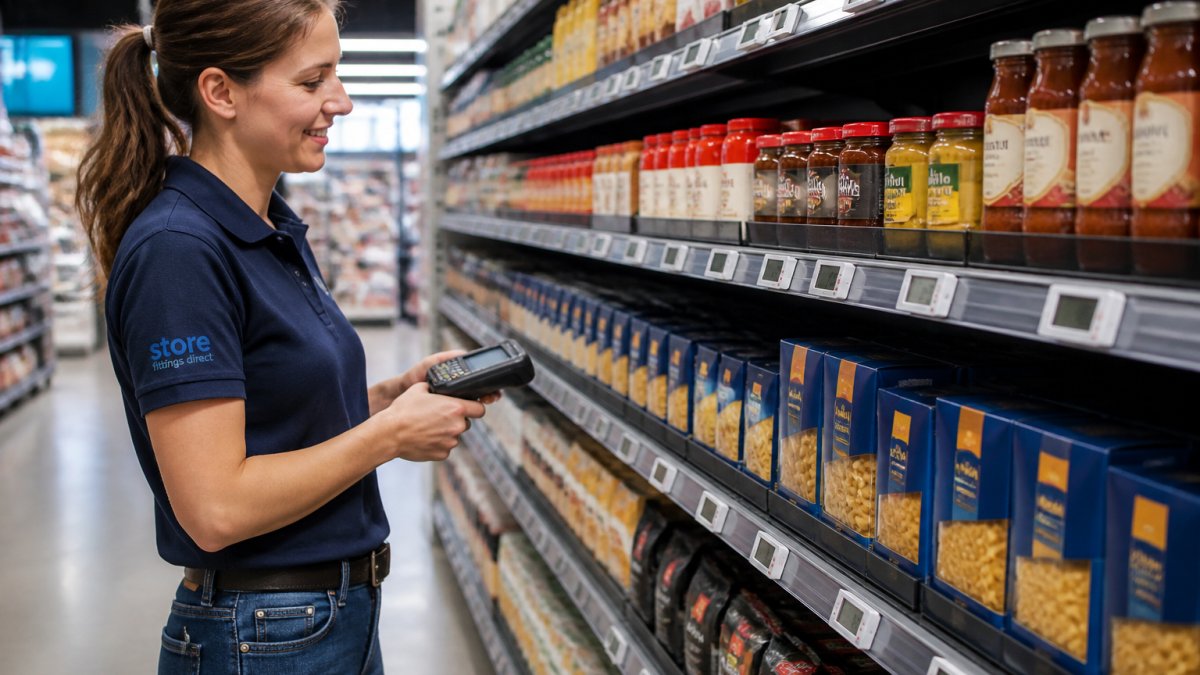
Electronic shelf labels are small digital screens mounted on the shelf edge that display prices and product information, updating automatically from a central system rather than by hand. At Store Fittings Direct, we have spent over 30 years fitting out retail spaces, and the shift from paper tickets to digital labels is one of the more practical changes we have watched arrive on the shop floor.
The core job is simple: a price change made in your till or ERP system appears on the shelf within seconds, across every store, without a member of staff walking the aisles with a label gun. For a grocery or convenience format running hundreds of promotions a week, that alone removes a daily administrative burden.
How Electronic Shelf Labels Work: Displays, Gateways and Software
An electronic shelf label system has three parts: the labels themselves, a gateway that transmits to them, and software that pushes the data. The label is a low-power display, usually e-paper or a similar bistable technology, which means it holds an image without drawing current, so a coin cell can last for years.
Each label has a unique ID tied to a product and a shelf position. When your pricing system changes, the software sends the update through a gateway, which broadcasts over radio to every label in range. E-paper labels are readable in bright light and from an angle, which matters in a busy aisle.
The software layer is where most of the work happens. It maps labels to products, schedules updates, and often links to stock and promotion systems so the shelf, the till and the website agree.
What a Label Can Show Beyond the Price
- Unit pricing, so a shopper can compare value across pack sizes
- Promotional messaging, such as a multi-buy or a limited-time offer
- Stock or availability flags, useful for click-and-collect
- QR codes linking to product detail, allergens or care instructions
- Batch or date information in fresh food and pharmacy settings
That flexibility is the real argument for the technology. A paper ticket shows one price. A digital label can show whatever the shopper needs at that moment.
Electronic Shelf Label Benefits for Retailers
The clearest benefit is accuracy. When shelf prices and till prices drift apart, you get customer complaints and, in the worst case, a pricing integrity problem that a trading standards officer will not treat lightly. Because the label pulls from the same source as the till, that gap closes.
The second benefit is labour. Manual price changes consume staff hours that could go to serving customers, and they are prone to error, especially during a busy promotional reset. Digital labels remove the walk-round entirely.
There is a compliance angle too. Consumer protection rules require that the price a shopper sees is the price they pay, and the Chartered Trading Standards Institute guidance on pricing is clear that displayed prices must not mislead. A system that keeps shelf and till in sync makes that obligation easier to meet.
Where the Payback Comes From
- Fewer staff hours spent on manual ticketing
- Reduced pricing errors and the complaints they generate
- Faster promotional resets, so campaigns go live on time
- Less waste on printed paper tickets
- Better data on what is actually displayed and when
For a small independent, the arithmetic is tighter than for a chain. A single-site boutique may struggle to justify the outlay on labour savings alone, but a pharmacy or convenience store with frequent price changes will feel the difference sooner.
Electronic Labels for Warehouses: Picking, Storage and Stock Accuracy
Warehouse use is a different problem from shop-floor pricing, and it is where electronic labels earn their keep in a picking environment.
The gain is accuracy. A picker who reads a live digital label is less likely to take the wrong item or the wrong quantity than one working from a printed pick list that was correct an hour ago. In a fast-moving operation, that difference shows up in fewer mis-picks and less rework.
Labels also help with put-away and replenishment. When a location is full or reserved, the label can say so, which stops stock being slotted into the wrong place. For operations running batch or date-sensitive goods, the label can flag rotation requirements at the point of pick.
We supply the racking and shelving that these systems mount to, and the practical lesson is the same one we give on any fit-out: decide the label mounting method before you order the shelving, not after. A label that will not clip cleanly to your beam is a daily irritation.
Electronic Labels for Conferences, Events and Public Buildings
Away from retail and warehousing, electronic labels solve a naming and wayfinding problem. At a conference or exhibition, a digital label on a stand or a meeting-room door can show the session, the speaker and the time, and update when the programme shifts. No reprinting, no crossed-out names. This seamless transition between physical and digital information mirrors the efficiency required for retail POS hardware when managing high-volume transactions.
The same logic applies in public buildings. A council reception, a university department or an NHS outpatient area can use digital labels for room names, clinic times and directional information, changed centrally when the schedule changes. For a multi-room venue, that is far cheaper than reprinting signage for every timetable revision.
Events are where the technology shines because programmes change constantly. A printed card is obsolete the moment a speaker cancels. A digital label is not.
What to Check Before You Roll Out ESLs
Start with your pricing and stock systems, not the hardware. If your till and your ERP do not share clean product data, no label system will fix that, and you will spend the project cleaning up master data instead of rolling out.
Next, check connectivity. Gateways need to reach every label, and a steel-framed building or a chilled aisle can interfere with radio coverage. A site survey before purchase is not optional.
Then consider the human side. Staff need to know how to trigger an update, what to do when a label fails, and how to handle a price query at the till. A short training session prevents most day-one confusion.
Finally, plan the rollout in phases. One aisle, one department, or one store, then review before scaling. It is far easier to correct a mounting or coverage problem on a pilot than across a whole estate.
Fit With Your Existing Shelving and Fittings
Label mounting is where fit-out and technology meet. Shelf-edge labels are usually designed for a standard ticket strip or a dedicated rail, and if your existing shelving lacks one, you will need an adapter or a different label format. Electronic labels for racking often clip to the beam or sit in a protective holder.
This is the part most suppliers gloss over. We would rather you measure your shelf edge and beam profile first, because the label is only as good as the fixture it sits on. If you are refitting anyway, specify the label rail at the same time as the shelving.
British Standards Institution guidance on product information and labelling is a useful reference when you are setting internal rules for what a label must display.
Setting |
What the Label Shows |
Mounting Point |
Main Benefit |
|---|---|---|---|
Grocery shelf edge |
Price, unit price, promotion |
Ticket strip or rail |
Pricing accuracy |
Pharmacy |
Price, batch, allergen flag |
Shelf-edge holder |
Compliance and clarity |
Warehouse pick face |
Location, product, quantity |
Racking beam |
Picking accuracy |
Conference room |
Session, speaker, time |
Door or stand mount |
Fast programme changes |
Public building |
Room name, clinic time, direction |
Wall or frame mount |
Central updates |
Where the ESL Market Is Heading in 2026
Two forces are shaping the market. The first is cost: as e-paper production scales, the per-label price falls, which brings the technology within reach of smaller formats that could not justify it a few years ago. The second is integration, as label systems connect more tightly to stock, promotions and online pricing so that one price governs every channel.
Expect more labels to carry QR codes and richer product data, and expect battery life and colour options to keep improving. For retailers, the practical question is no longer whether the technology works, but whether their systems and fixtures are ready for it.
At Store Fittings Direct, we have sold over 1.3 million products and fitted out spaces from single boutiques to large estates, so we see both sides of that question. If you are planning a refit and want the shelving, racking and label rails specified together, our team can help you get the details right the first time.
Frequently Asked Questions
What are electronic shelf labels?
Electronic shelf labels are small digital displays that clip to the front edge of a shelf in place of printed paper tickets. Each label shows a price and can also show unit pricing, product names, promotional messages, stock information or QR codes. They connect wirelessly to a central system, so a price change made once reaches every label in every store at the same time. Most run on button or coin cells that last several years, and they are available in sizes to suit standard retail shelving as well as wider warehouse racking.
Can electronic shelf labels be used for warehouse labelling?
Yes. Electronic labels for warehouses attach to racking beams and shelf edges to show bin locations, product codes, quantities and pick status. Because they update from a central system, staff do not need to reprint and reattach paper labels when stock is relocated or a line is discontinued. Look for larger displays that stay readable from a distance, and check that the mounting suits your beam profile. Labels on racking should be positioned so they stay visible when pallets and totes are in place.
Can electronic shelf labels be used at conferences and events?
They can. Electronic labels for conferences replace printed name cards, session boards and stand signage. A label on a delegate desk can show a name, company and seat number, and can be changed between sessions without reprinting anything. Organisers also use them on exhibition stands to display product details or live pricing, and on room doors to show the current session or speaker. Battery-powered labels need no cabling, which makes them straightforward to place across a venue and collect afterwards.
What should businesses consider before adopting electronic shelf labels?
Check three things first. Wireless coverage: labels need reliable signal throughout the shop floor or warehouse, so a survey of the space matters more than the label spec. Fit: confirm the mounting suits your existing shelf edges and racking beams, since a label that will not sit securely causes more work than it saves. Software: make sure the system connects to your till or stock platform, because the value comes from changing a price once and having every label follow. Also plan who will manage the system day to day.
The challenge with any label rollout is that the technology is only half the job; the fixture it mounts to is the other half. Store Fittings Direct supplies the shelving, racking and fittings that make an electronic label system practical, backed by over 30 years of experience, a Price Match Promise and trade accounts with 30 days interest-free credit. Get started with Store Fittings Direct and fit your space so the technology works from day one.


