

Table of Contents
- Why Outdoor Bike Storage Matters for Schools, Workplaces and Retail Sites
- Comparing Bike Shelter Types: Which Outdoor Bike Storage Suits Your Site?
- Materials That Make Weatherproof Bike Storage Last
- Bike Shelter Installation: Ground Fixing, Layout and Site Preparation
- Secure Bicycle Storage: Locks, Visibility and Access Control
- Choosing the Right Outdoor Bike Rack for Your Shelter
- Frequently Asked Questions
Last Updated: 5 October 2026
Why Outdoor Bike Storage Matters for Schools, Workplaces and Retail Sites
Bike shelters are covered, fixed structures that protect bicycles from weather and theft on a site's external footprint. For schools, workplaces and retail sites, it turns a scattered parking problem into a managed, visible facility. At Store Fittings Direct, we supply bike shelters and outdoor bike racks to organisations that need staff, pupils and visitors to arrive by bicycle and leave it somewhere sensible. Our primary focus is on delivering durable, professional products that enhance customer flow, improve service, and ultimately increase sales for businesses of all sizes.
The case for installing proper provision is straightforward. Bicycles left against railings, walls or trolley bays get damaged, block fire routes and look untidy. A dedicated shelter keeps frames dry, keeps stands occupied, and gives site managers something they can point to when they need to demonstrate cycling provision. The Department for Transport guidance on cycling and walking infrastructure sets out how local transport bodies expect cycle parking to be planned, and the Sustrans guidance on cycle parking design explains what good practice looks like on the ground.
Below, we break down shelter types, materials, installation and security so you can specify the right outdoor bike storage for your site in one pass.
Comparing Bike Shelter Types: Which Outdoor Bike Storage Suits Your Site?
The right shelter type depends on capacity, exposure and whether you need the bikes visible or hidden from view. Three broad categories cover most sites: open-sided, enclosed, and high-capacity modular.
| Shelter type | Typical capacity | Best for | Main trade-off |
|---|---|---|---|
| Open-sided steel | 6-20 bikes | Schools, offices, retail staff | Bikes visible to passers-by |
| Enclosed | 10-50 bikes | Town centres, transport hubs | Higher cost, needs access control |
| High-capacity modular | 20+ bikes | Campuses, large employers | Requires more ground space |
Open-Sided Steel Shelters
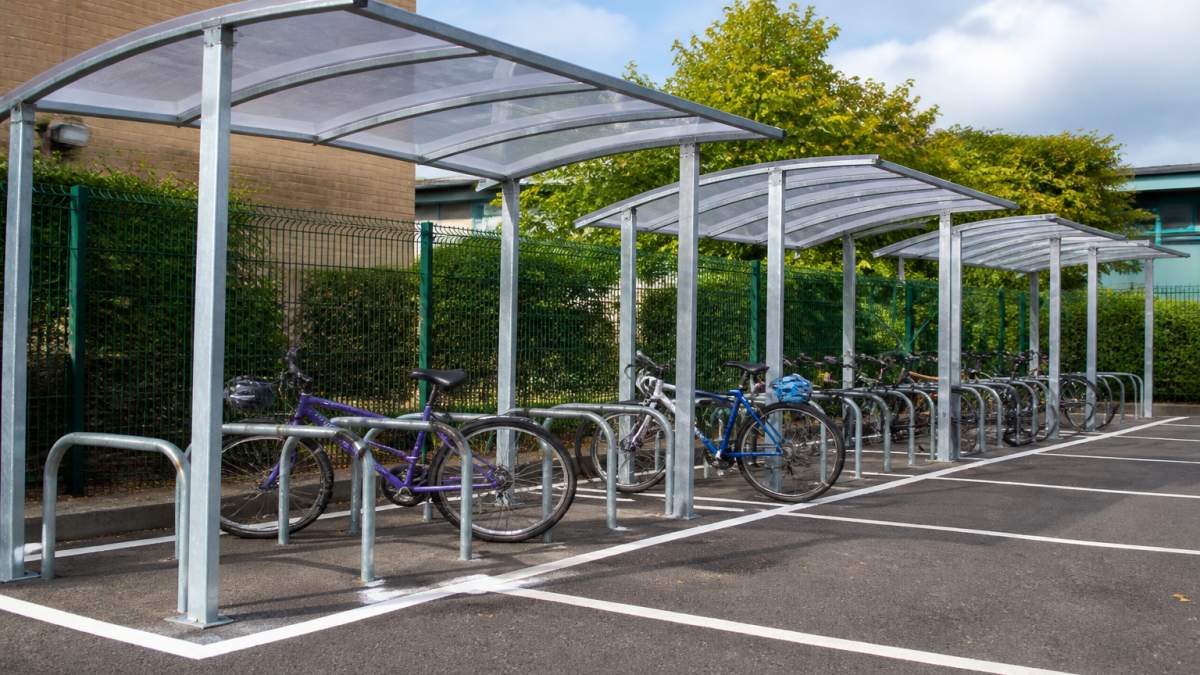
Open-sided shelters are the workhorse of exterior bike storage. A galvanised frame with a sheet roof and back panel keeps rain off the saddles and drivetrains while leaving the ends open for easy access. The Leyton Cycle Shelter, for example, uses a galvanised mild steel frame with a plate-mounted bolt-down base, comes flat-packed for on-site assembly, and extends in bays from 1m to 5m to reach the length you need.

The advantage is cost and airflow. Bikes dry faster and there is nowhere for moisture to sit. The drawback is that an open shelter offers no protection from determined thieves, so it suits supervised or overlooked locations best.
Enclosed and High-Capacity Shelters
Enclosed and modular shelters carry larger fleets. The Holwell range runs from a 10-cycle unit up to a 20-cycle configuration, with bespoke options available for larger requirements. Frames use 100mm x 100mm support posts and 50mm x 50mm roof framework in steel strongbox section to EN 10219:2006, with 3mm Pet-g UV2 roof sheets.
If you are comparing options, weigh capacity against access. A 20-cycle shelter on a school site needs a wide approach and a turning space for pupils arriving at once. On a workplace site, a smaller shelter near the entrance usually beats a large one in a far corner.
Leyton Cycle Shelter | Steel Roof With Cycle Stands →
Materials That Make Weatherproof Bike Storage Last
Weatherproof bike storage lives or dies on its frame treatment and roof material. Galvanised steel is the default choice for a reason: the zinc coating sacrifices itself to protect the steel beneath, so a galvanised frame resists rust for years even when scratched.
Powder-coated finishes add colour and a further barrier, and are worth specifying where the shelter sits on a visible frontage. Roof sheets matter just as much. Pet-g UV2 clear sheeting, used across the Holwell range, resists UV degradation and stays clear rather than yellowing, which keeps the shelter looking presentable.

What most guides miss is the fixing. A galvanised frame bolted to a sound concrete pad will outlast a better-specified shelter fixed to cracked tarmac. Budget for the base before you budget for the roof.
Bike Shelter Installation: Ground Fixing, Layout and Site Preparation
Bike shelter installation starts with the ground, not the frame. Every shelter needs a level, load-bearing surface, and the fixing method must match it. Above-ground fixing suits existing concrete or block paving that is already sound. Below-ground fixing, where posts are set into concrete, gives a stronger hold on new-build sites or soft ground.
Layout follows three rules. Leave at least 1m of clear space in front of the stands so bikes can be wheeled in and out. Keep the shelter off pedestrian desire lines. Orient the open side away from prevailing wind and driving rain.
For schools and local authority sites, check whether planning permission is needed before ordering. A free-standing structure under a certain footprint often falls outside permitted development, but the rules differ for listed buildings and conservation areas, so confirm with your local planning authority.
Secure Bicycle Storage: Locks, Visibility and Access Control
Secure bicycle storage is a combination of physical fixing, stand design and surveillance, not a single product. A shelter that cannot be lifted or unbolted is the starting point. Beyond that, three layers do the work:
- Anchored stands. Sheffield-style stands set into the ground let riders lock the frame and both wheels.
- Natural surveillance. Position the shelter where staff, cameras or passing footfall can see it.
- Access control. Enclosed shelters can be keyed or fob-controlled so only registered users get in.
The most effective single measure is visibility. Thieves avoid locations where they can be seen and challenged. A shelter tucked behind a bin store will be targeted regardless of how well it is built.
Leyton Cycle Shelter | Steel Roof With Cycle Stands →
Choosing the Right Outdoor Bike Rack for Your Shelter
An outdoor bike rack determines how many bikes fit and how easily they park. Two-bike Sheffield stands are the standard for open shelters because they support the frame at two points and work with most locks. Wheel-grip racks hold bikes upright but only secure the front wheel, so they suit short-stay or supervised sites.
Capacity is not simply the number of stands. Riders need clearance to manoeuvre, and a stand spaced too tightly becomes unusable.
Our Leyton and Holwell shelters both ship complete with cycle stands, so capacity and rack type are matched at the point of order rather than bolted on afterwards. Delivery is free across England, Wales and Southern Scotland on the Holwell range. If you are comparing suppliers, our Price Match Promise covers like-for-like quotes, and trade accounts come with 30 days interest-free credit.
Getting cycling provision right comes down to matching shelter type, capacity and fixing to the site you actually have, not the site you wish you had. Store Fittings Direct has spent over 30 years supplying durable cycle shelters and outdoor bike racks to schools, workplaces and retail sites, with fast nationwide delivery, free delivery on the Holwell range, and trade accounts with 30 days interest-free credit. For example, consider our Leyton Cycle Shelter | Steel Roof With Cycle Stands or the robust 10 Cycle Bike Shelter | The Holwell. View the full cycle shelter range and check current pricing on our product pages to specify the right outdoor bike storage for your site.
Frequently Asked Questions
What is the best way to store a bike outside?
A covered bike shelter gives the best protection for daily outdoor storage. A steel-framed shelter with a sheet roof keeps rain and direct sun off the bike while allowing airflow, which reduces rust and mould compared with a fully enclosed box or a fabric cover. Pair the shelter with a ground-fixed outdoor bike rack so the frame can be locked securely, and choose a galvanised finish for long-term weather resistance.
Are bike shelters secure?
A shelter itself is a weather shield, not a locked compound, so security comes from how you combine it with locking points and site layout. Bolt-down cycle stands let riders lock the frame and wheels to a fixed anchor, and positioning the shelter in a visible, well-lit area discourages theft. For higher-risk locations, enclosed shelters with controlled access add another layer, but the anchor point remains the most important factor.
How much space do I need for a bike shelter?
Space depends on capacity. A small open-sided shelter measuring around 2m wide can house up to six bikes, while larger shelters scale in length or bay count to hold ten, fourteen or twenty cycles. As a rule, allow roughly 1m of length per additional bike plus clearance around the structure for access and fixing. Measure your available footprint and confirm extension bays can be added later if demand grows.
Can outdoor bike storage be fixed to the ground?
Yes. Most steel cycle shelters are plate-mounted and bolt down as standard, which anchors the structure against wind uplift and casual tampering. Some models also offer a below-ground fixing option where surface mounting is not suitable. Check the surface first: concrete and tarmac take bolt-down fixings well, while loose gravel or soft ground may need a prepared base before bike shelter installation begins.


