

Table of Contents
- Why Customer Flow in Checkout Zones Matters
- Assess Your Current Checkout Layout
- Retail Queue Management Strategies That Work
- Queue Management Equipment for Shops
- Reducing Customer Wait Times in Retail
- Implement Staffing and Process Changes
- Monitor and Adjust Your Checkout Flow
- Frequently Asked Questions
Last Updated: September 18, 2026
Why Customer Flow in Checkout Zones Matters
Checkout is where customers decide whether they'll return. A congested, slow, or confusing queue doesn't just frustrate people in the moment, it shapes their entire impression of your store.

Most retailers treat the checkout zone as an afterthought. They set up tills, add a queue line, and hope it works. The result is bottlenecks, abandoned baskets, and customers who leave before they've even paid. At Store Fittings Direct, we've worked with retailers who discovered that fixing their checkout flow directly increased sales. When customers move through efficiently, they're happier, less stressed, and more likely to buy again.
The stakes are high. A single poorly designed checkout can cost you sales every single day. Conversely, a well-planned checkout zone turns waiting time into an opportunity, to display impulse items, reduce perceived wait times, and create a professional impression that builds loyalty.
This guide covers exactly how to improve customer flow in checkout zones, from assessing what you have now to implementing changes that actually stick.
Assess Your Current Checkout Layout
Before you change anything, understand what's happening right now.
Spend 30 minutes observing your checkout during a busy period. Watch how customers move through the space. Do they know where to queue? Do they bunch up at certain points? Are some tills faster than others? Are customers picking up items from displays while they wait, or just standing still?
Note the physical layout:
- How many tills do you have active during peak times?
- How much space is between the tills and the shop floor?
- Can customers see the queue, or do they stumble into it?
- Are there bottlenecks where people pile up?
Ask your staff too. They see problems you don't. They know which tills jam, which queues get longest, and what frustrates customers most.
Measure your current wait times. Use a stopwatch during peak hours. Record how long it takes from when a customer joins the queue to when they leave with their purchase. Track this for a week. You'll spot patterns, maybe Tuesday mornings are fine but Saturday afternoons are chaos.
Look at your impulse sales. Check your till data. Are customers buying items from queue-zone displays? If not, you're wasting valuable real estate. If yes, which items sell best?
This assessment takes an hour and costs nothing. It gives you a baseline to measure improvements against.
Retail Queue Management Strategies That Work
How you manage queues shapes the entire checkout experience. The right strategy depends on your store type and customer volume.
Single-line vs multi-line queuing
A single queue feeding multiple tills is almost always better than separate queues at each till. Customers see one clear line. They don't waste mental energy choosing which queue looks shortest, only to pick the slow one. It feels fairer because it is.
Single-line systems also balance load automatically. When one till finishes, the next customer moves forward. No till sits idle while another has a queue. Customers move faster overall.
Multi-line queues create psychological problems. Customers feel cheated if they pick the "wrong" queue. They get frustrated watching other lines move faster. Staff feel rushed and make mistakes.
The only exception is if you have very high volume and limited space. Even then, a single queue with clear barriers is better than chaos.
Set up a single queue using clear floor markings or a rope barrier. Make it obvious where the queue starts and ends. This removes confusion and prevents customers from cutting in.
Express checkout lanes
Express lanes (for customers with fewer items) work when your store is large enough to staff them separately. A dedicated till for 5-item purchases or under reduces wait times for small transactions.
But express lanes only work if you enforce the limit. Customers will try to sneak through with 10 items. Staff need to politely but firmly turn people away. If you can't enforce it, don't create the lane.
Express lanes also need to be visible and clearly marked. Customers won't use what they can't see.
Queue Management Equipment for Shops
The right equipment makes queuing less painful and more profitable.
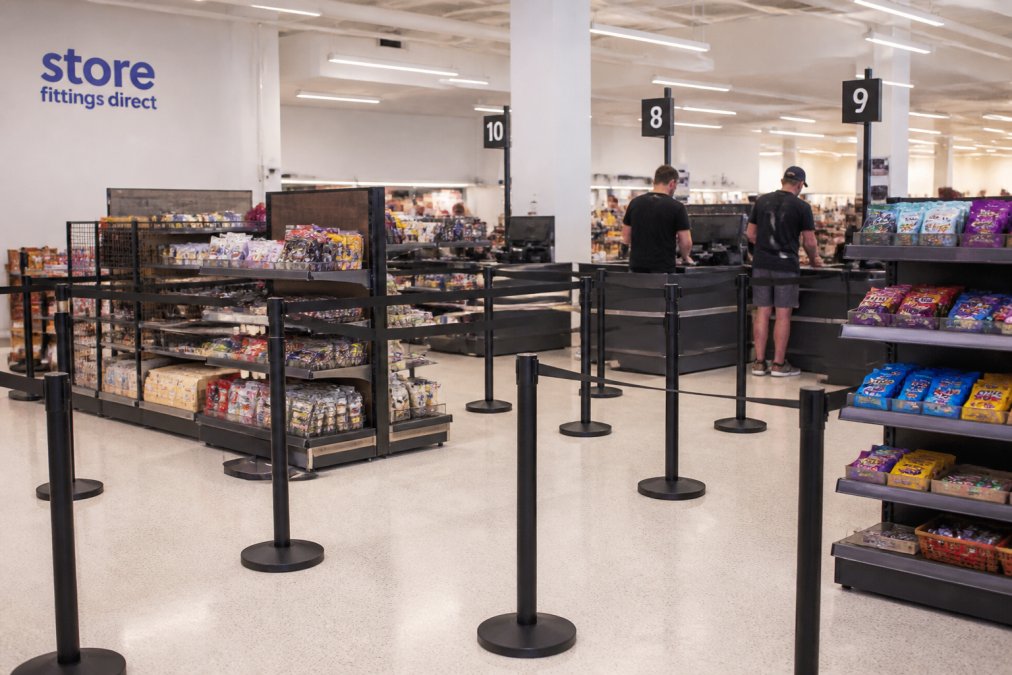
Barrier systems and queue guides
Physical barriers create order. They show customers where to queue. They prevent people from cutting in. They also slow the pace, which sounds bad but actually reduces stress, when customers know the queue is orderly, they perceive waits as shorter.
Retractable belt barriers are the most common. They're professional, flexible, and durable. You can reposition them as your needs change. The Retractable Belt Queue Barrier from Store Fittings Direct uses a strong design that handles high-traffic retail environments. At £99.00, it's a straightforward investment in checkout clarity.

Barriers also serve another purpose: they define space. A clearly bounded queue zone prevents customers from wandering into staff areas or blocking other parts of the store.
Use barriers to create a single, obvious path through your checkout. Avoid creating maze-like routes that frustrate people. Make the path as direct as possible from the shop floor to the tills.
Queue Management System | Standard →
Impulse merchandising in queue zones
Your queue is prime real estate. Customers are captive. They're waiting. Their minds are open to suggestions. Use this time to sell more.
Impulse items work best in queues: sweets, magazines, small accessories, batteries, phone chargers. Items customers want but don't plan to buy. Items they see while waiting and think, "Oh, I'll grab that too."
Position displays at eye level. Shelving works, but so do hooks or hanging displays. The Queue Management System with Standard Shelf Bay from Store Fittings Direct is designed specifically for this. At £327.07, it provides multiple shelves for merchandise display. Customers can browse while they wait, which also makes the wait feel shorter.
Rotate stock regularly. What sells one month might not sell the next. Keep displays fresh and relevant.
Track what sells. Your till data will show which items perform. Double down on winners. Remove losers.
Reducing Customer Wait Times in Retail
Speed matters. But so does perception.
The actual wait time and the perceived wait time are different things (Effect of waiting time on patient satisfaction in outpatient: An empirical investigation). A 5-minute queue with nothing to do feels long. A 5-minute queue with interesting displays and clear progress feels short.
Here are the ways to reduce both:
Actual wait time:
- Open more tills during peak hours. This is the most direct solution.
- Train staff to work faster. Faster scanning, faster payment processing, faster bagging.
- Use self-checkout if your customers accept it. Some do, some don't.
- Reduce the number of payment methods if possible. Contactless and card only is faster than cash, cheque, and card.
Perceived wait time:
- Add displays and signage to the queue zone. Give customers something to look at.
- Show progress. Let customers see when tills are opening. If a queue is long, open a new till visibly. Customers feel better when they see action.
- Provide information. A sign saying "Average wait time: 3 minutes" is reassuring. Customers without information assume it's longer.
- Keep the queue zone clean and professional. Mess and clutter make waits feel worse.
The best approach combines both. Reduce actual waits by staffing properly. Reduce perceived waits by making the queue zone engaging and transparent.
Implement Staffing and Process Changes
Equipment alone won't fix checkout flow. Your team makes the difference.
Schedule staff based on demand, not convenience. If Saturday afternoons are busy, schedule more staff then. If Tuesday mornings are quiet, schedule fewer. Look at your data from the assessment phase.
Train till staff on speed and friendliness. Speed reduces wait times. Friendliness makes customers feel valued despite waiting. Both matter.
Create a protocol for opening new tills. When the queue reaches a certain length (say, 5 people), a manager opens another till. Don't wait for tills to get desperate. Prevent long queues before they form.
Cross-train staff. If your tills staff can also help with bagging or payment issues, they can help each other during rushes. Flexibility prevents bottlenecks.
Set clear expectations. Staff should know they're responsible for queue flow. Make it a metric. Track it. Reward improvement.
Monitor and Adjust Your Checkout Flow
Changes don't work unless you measure them.
After you implement changes, measure wait times again. Did they improve? By how much? Track impulse sales. Did they increase? Are customers happier? Ask them.
Use your till system to spot patterns. Which times are busiest? Which staff members are fastest? Which products sell in queues?
Review quarterly. Retail changes. Seasons change.
Frequently Asked Questions
What is the best layout for a retail checkout zone?
The most effective checkout layout depends on your store size and customer volume. Single-line systems work well for smaller shops and reduce perceived wait times, whilst multi-line setups suit high-traffic retailers. Position your checkout near the store exit to create a natural flow, ensure adequate spacing between queues (at least 1.5 metres), and keep sightlines clear so customers can see how many tills are open. Impulse merchandise displays in queue zones can increase sales by up to 400% whilst customers wait.
How do you reduce queueing time in a retail shop?
Reducing customer wait times in retail involves three key actions: opening additional checkouts during peak hours, streamlining payment processes to speed up transactions, and managing queue perception through distraction and engagement. Queue management equipment like barrier systems and merchandising displays help organise flow and occupy customers' attention. Staff training on efficient scanning and payment handling also cuts transaction time significantly.
What are the benefits of a single-line queue system?
Single-line queue systems reduce customer frustration by eliminating the stress of choosing a queue and watching others move faster. They feel fairer, lower perceived wait times, and allow you to open tills flexibly without customers feeling abandoned. Single-line systems also make better use of floor space in smaller shops and create a clearer, more professional appearance than multiple separate queues.
How can queue management equipment improve the shopping experience?
Queue management equipment like retractable barriers, merchandising bowls, and shelving systems organises customer flow, prevents congestion, and creates space for impulse purchases. Clear visual guides reduce confusion, whilst merchandising displays in queue zones keep customers engaged and reduce perceived wait time. Professional barrier systems also communicate that your store values organisation and customer care, enhancing the overall shopping experience.


