

Table of Contents
- What Bollards Actually Do and Where They Belong
- Security Bollards for Retail: Protecting Shopfronts and Pedestrians
- Choosing the Right Bollard Material for Each Environment
- Bollard Installation Best Practices for a Lasting Fit
- Bespoke Bollard Design: Matching Function to Your Brand
- Where Bollards Work Best: Retail, Schools, Car Parks and Warehouses
- Frequently Asked Questions
Last Updated: September 18, 2026
What Bollards Actually Do and Where They Belong
A bollard is a short, sturdy vertical post installed to control vehicle movement, protect people and property, and mark boundaries between pedestrian and traffic areas. This guide from Store Fittings Direct explains the main types, the materials that suit each environment, and how to choose bollards for your site.
The core job is simple: a bollard puts a physical barrier where a kerb, line marking or sign cannot. Bollards channel traffic, shield shopfronts from vehicle impact, and separate walkways from delivery routes. Many site managers find that a well-placed run of bollards solves problems that signage alone never fixes.
Where you place them matters as much as what you buy. Bollards belong at building entrances, along shop frontages, at car park edges, around school gates, and wherever vehicles and pedestrians share space. Get the layout right and the protection works without getting in anyone's way.
Security Bollards for Retail: Protecting Shopfronts and Pedestrians
Security bollards for retail are the first line of defence between a shopfront and a vehicle, whether that vehicle is a delivery van, a trolley or something worse. For independent shops and chain stores alike, the calculation is straightforward: glass frontages and door frames are expensive to replace, and bollards cost far less than a single repair.
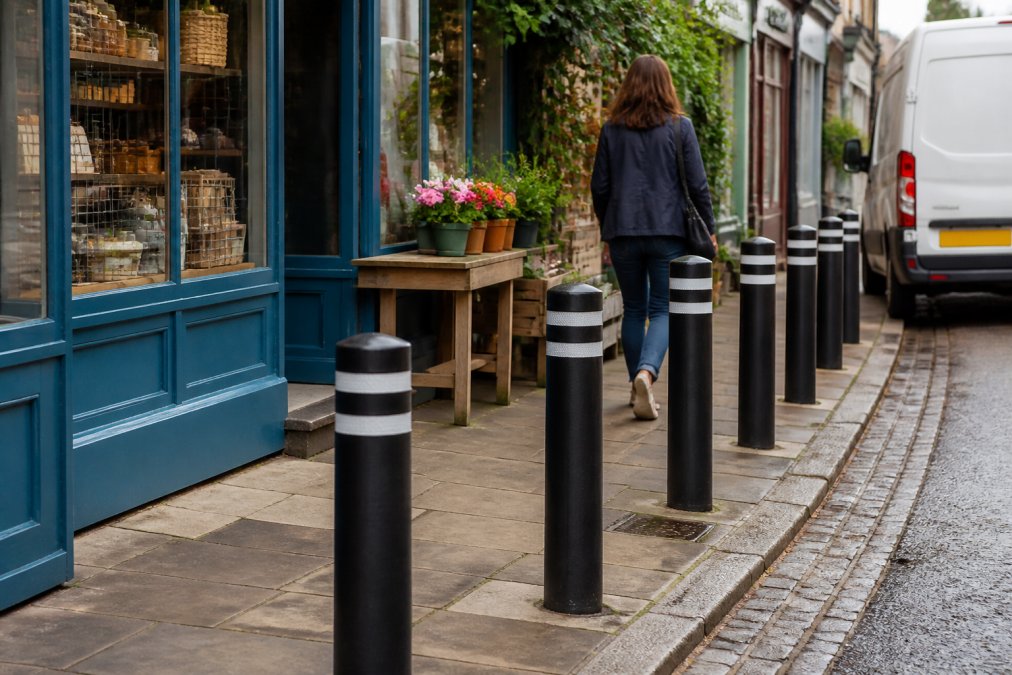
Placement follows a simple rule. Position bollards as a demarcation line between pedestrians and vehicles, and leave enough clearance for wheelchairs, prams and delivery trolleys to pass. The Health and Safety Executive guidance on workplace vehicle safety is clear that separating pedestrians from vehicles is one of the most effective controls a site can put in place, and bollards are often the cheapest way to do it.
Choosing the Right Bollard Material for Each Environment
Material choice decides how long a bollard lasts and how much maintenance it needs. Recycled plastic and recycled rubber now cover most retail, school and car park applications, while traditional styles suit heritage frontages and public spaces where appearance carries weight.
Recycled Plastic Bollards with a Steel Core
Recycled plastic bollards with a steel core combine a weather-resistant outer body with an internal steel tube for strength. Our Plastic Bollards | Recycled with a Steel Core are made from recycled materials, resist fading, cracking and peeling, and need almost no upkeep. They suit parks, car parks and pedestrian pathways, and can be supplied in different colours and sizes.

For higher-risk locations, the 3RS Retail Park Plastic Bollard offers an anti-ram version with a 90x3mm tube core potted to a depth of 950mm. That extra depth is what resists a high-speed collision, so it belongs at vulnerable points rather than along an entire run.

Recycled Rubber and Traditional Styles
Recycled rubber bollards are a strong alternative where impact absorption matters. The Berkeley Recycled Rubber Bollard is 100% recycled rubber with a steel core and reflective strips for night visibility. It does not rot, splinter or discolour, and it can be recycled again at the end of its working life.
Where a site calls for a classic look, the Manchester Plastic Bollard recreates the cast iron style in maintenance-free polyethylene, with recesses for decorative bands and reflective material. It will not need painting, which is the main reason specifiers move away from metal in the first place.

Material |
Best For |
Maintenance |
Reflective Option |
|---|---|---|---|
Recycled plastic with steel core |
Car parks, pathways, retail frontages |
Minimal |
Yes, reflective band |
Recycled rubber with steel core |
Schools, play areas, car parks |
Minimal |
Yes, reflective strips |
Traditional polyethylene |
Heritage frontages, public spaces |
None, no painting |
Yes, recessed band |
Anti-ram plastic |
High-risk vehicle approaches |
Minimal |
Yes, reflective band |
Bollard Installation Best Practices for a Lasting Fit
Bollard installation best practices come down to depth, spacing and concrete. A bollard that wobbles after a year was almost always under-potted, not under-specified.
Standard plastic bollards are typically potted 500mm below the surface. Anti-ram models go deeper, to 950mm with bottom cross bracing set in concrete, because that is what stops a vehicle rather than merely marking a line. Spacing matters too: keep a maximum of 1200mm between bollard centres and a minimum of 1200mm between a bollard and the surface it protects.
Plastic Bollards | Recycled with a →
- Confirm the service depth before digging; cables and pipes sit closer than expected
- Mark centres at no more than 1200mm apart
- Pot to the depth the manufacturer specifies, never less
- Use concrete, not post mix, on anti-ram installations
- Check reflective bands face oncoming traffic
Skipping the sub-surface depth is the most common installation error. A bollard potted too shallowly looks fine on day one and leans within a season, and once it has moved, the concrete has to be broken out and redone. ::: Ensuring this structural integrity is just as critical when installing commercial grade fencing to maintain a secure and level perimeter over the long term.
Bespoke Bollard Design: Matching Function to Your Brand
Bespoke bollard design lets a site carry its identity on the street rather than settling for standard black posts. Colour, height, head style and banding can all be adjusted, and because recycled plastic takes colour well, a matched run is straightforward to produce.
This is where specification gets interesting. A school may want bright, high-visibility posts at the gate and something more restrained along the boundary. A retail park may want a consistent colour across several units, or branding that ties a row of bollards to the shopfront behind it. GOV.UK guidance on accessible public spaces is worth checking before finalising colour, since contrast against the surrounding surface affects how visible a bollard is to partially sighted pedestrians.
The practical rule: choose bespoke options where appearance is part of the job, and standard stock where it is not. Bespoke work adds lead time, so it belongs in the plan early rather than as a late change.
Where Bollards Work Best: Retail, Schools, Car Parks and Warehouses
Retail, schools, car parks and warehouses are the four settings where bollards earn their place fastest, because each one puts vehicles close to people or property on a daily basis.
In retail, bollards protect glazing, door frames and shutters from delivery vehicles and trolleys. At schools, they keep the gate area clear at drop-off and pick-up, which is the busiest ten minutes of the day. Car parks use them to define bays, protect pay stations and keep vehicles off verges and walkways. Warehouses use them at doorways and shutter openings to prevent costly collisions with walls and frames.
Store Fittings Direct supplies bollards across all four settings, with free delivery on the ranges shown above and a Price Match Promise on like-for-like products. For larger projects, trade accounts with 30 days interest-free credit and bulk discounts make a multi-site rollout easier to budget. With over 30 years of experience and more than 1.3 million products sold, we can advise on layout and specification before you order, and our team can help with bespoke requirements where standard stock will not do.
Bollards only work when they are specified for the site, installed to depth and positioned where vehicles actually go. If you are planning a shopfront, school gate, car park or warehouse entrance, Store Fittings Direct can help you choose from our full range of bollards and discuss bespoke options, with fast nationwide delivery, trade accounts offering 30 days interest-free credit, and bulk discounts on larger orders. Get started with Store Fittings Direct and specify bollards that protect your site for years, not seasons.
Frequently Asked Questions
What are the primary purposes of installing bollards?
Bollards serve three main purposes: controlling vehicle access, protecting people and property from impact, and marking boundaries. In retail settings they keep cars away from shopfronts and pedestrians. In car parks and schools they separate traffic from walkways. Anti-ram models add protection against high-speed collisions at vulnerable points such as doors and shutters. Choosing the right type depends on whether you need simple demarcation or genuine impact resistance.
Are there specific regulations for bollard installation in commercial spaces?
There is no single regulation covering all bollards, but several apply depending on location. Bollards on or near the public highway may need approval from the local highway authority. Any reflective bands should meet the relevant CE marking standard, as the Manchester Plastic Bollard's reflector material does. For anti-ram installations, manufacturers specify concrete depth and cross bracing. Always check with your local authority before installing on public land.
What is the difference between static and removable bollards?
Static bollards are fixed permanently, usually potted into concrete below the surface, and offer the highest impact resistance. Removable or socket-base versions sit in a ground socket and can be lifted out when vehicle access is needed, such as for deliveries. The Manchester Plastic Bollard offers a socket base version for easy installation and removal. Choose static where protection matters most and removable where access flexibility is a priority.
Can bollards be customised to match brand aesthetics?
Yes. Many bollard ranges can be supplied in different colours and sizes to suit a design scheme. The Recycled Plastic Bollards with a Steel Core, for example, can be customised in various colours and sizes. Decorative options such as the Manchester Plastic Bollard include recesses for gold bands and a reflective strip. Bespoke design lets you match bollards to shopfront colours, school branding or car park wayfinding without losing functionality.


