

Table of Contents
- What Are the 5 P's in Retail? The Framework Explained
- Product and Price: Getting the First Two P's Right
- Place: Optimising Shop Floor Layout Around the 5 P's
- Promotion in Practice: Retail Marketing Mix Examples That Work
- Process: Why the Fifth P Decides Repeat Business
- Retail Merchandising Best Practices That Bring the 5 P's Together
- Conclusion
- Frequently Asked Questions
Last Updated: September 16, 2026
What Are the 5 P's in Retail? The Framework Explained
The 5 P's in retail are Product, Price, Place, Promotion, and Process. This framework extends the classic marketing mix with a fifth element that recognises something the original four miss: how a customer is served matters as much as what they buy.
At Store Fittings Direct, we've spent over 30 years fitting out shops of every size, from single-site boutiques to multi-location chains. That work has taught us a simple lesson. A great product in a poorly planned space still underperforms.
Below, we'll break down each P, show how the five connect, and explain why the fifth one so often decides whether a customer comes back. For a broader view of how the mix fits together, the Chartered Institute of Marketing's marketing mix guidance is a useful reference point.
How the Fifth P Changed the Retail Marketing Mix
The original marketing mix, taught for decades, stopped at four P's: Product, Price, Place, and Promotion. Process was added later, and it changed the maths.
Process covers everything that happens between a customer deciding to buy and walking out with the goods: queue management, till speed, staff knowledge, returns handling, and how easily someone finds what they came for. Two shops can stock identical products at identical prices and still deliver completely different experiences.
That gap is where loyalty is won or lost. Process is the P most retailers neglect, and it's usually the cheapest to fix.
Product and Price: Getting the First Two P's Right
Product and Price are the foundation. Get them wrong and no amount of clever promotion will rescue the shop.
Product decisions cover range, depth, and quality. A boutique with limited floor space can't compete on breadth, so it competes on curation. Price decisions cover positioning: budget, mid-market, or premium, and how consistently that position is held across the range.
The two must agree. A premium price on a product that looks ordinary on the shelf creates friction no signage can fix. Many retailers find that mismatches here show up first as high return rates and low repeat visits. Aligning your presentation with your pricing strategy often requires finding efficiencies in production, such as reducing retail packaging costs to ensure that the physical experience of the item justifies its cost to the consumer.
Place: Optimising Shop Floor Layout Around the 5 P's
Optimising shop floor layout means arranging fixtures, aisles, and display zones so customers move naturally toward the till while seeing more of your range on the way. Place is where the 5 P's in retail become physical.
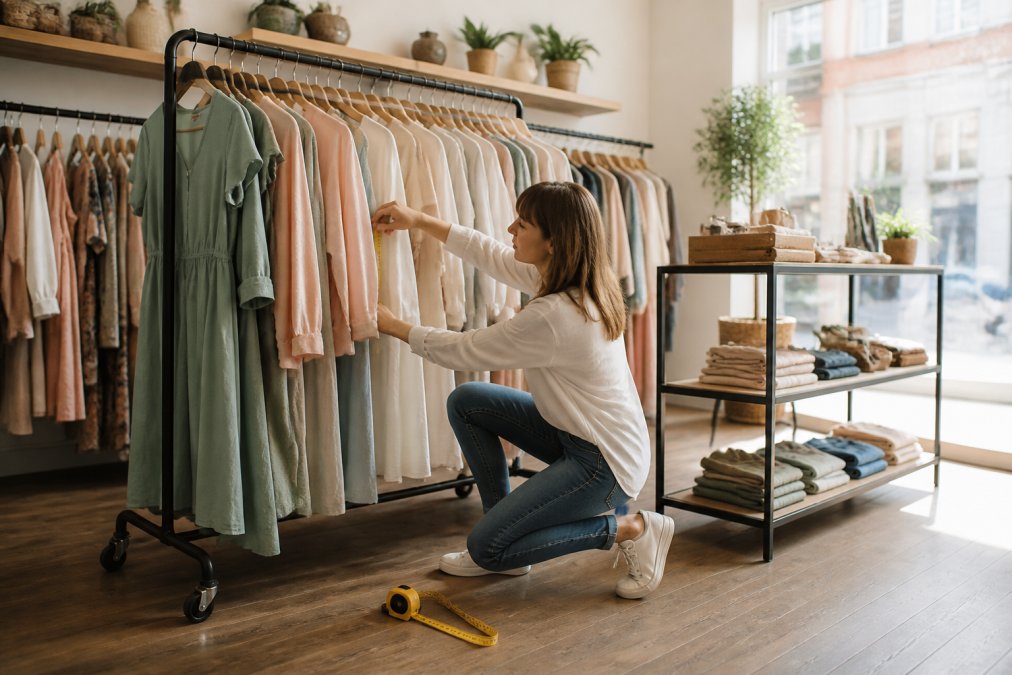
Three layout principles matter most:
- Sightlines: a customer should see the back of the shop from the door. Blocked sightlines kill exploration.
- Dwell zones: place higher-margin displays where people naturally slow down, not in the fastest corridor.
- Flow direction: most shoppers turn left on entry, so plan your highest-priority zone accordingly.
Modular shelving and adjustable rails make this practical. You can test a layout, measure what happens, and move fixtures without a full refit.
Promotion in Practice: Retail Marketing Mix Examples That Work
Promotion covers every message a customer sees, in-store and out. The retail marketing mix examples that work best are the ones tied to a physical location rather than a generic campaign.
Consider three approaches:
LED Slimline PCAP Android POS Display →
- Window storytelling: a themed window display that changes fortnightly gives passers-by a reason to re-check the shop.
- In-store digital signage: screens near the till or entrance can rotate offers, new arrivals, and seasonal messaging without reprinting anything.
- Staff-led promotion: a well-briefed team recommending a complementary product outperforms most printed material.
The common thread is placement. A promotion nobody walks past isn't a promotion.
Process: Why the Fifth P Decides Repeat Business
Process is the operational side of retail: how quickly customers are served, how easily they find help, and how problems are resolved. It decides repeat business more than any other P.
Two shops can share a product range and a price point, but the one with a clear till queue, knowledgeable staff, and a simple returns policy wins the second visit. Process failures are rarely dramatic. They're small frictions that accumulate.
Retail Merchandising Best Practices That Bring the 5 P's Together
Retail merchandising best practices tie the other four P's into one system. Merchandising is the discipline of deciding what goes where, at what height, and next to what.
The strongest merchandising habits we see among independent retailers:
- Group products by use case, not just category, so a customer buying one item sees the natural companion.
- Keep the top two shelves for display and the lower shelves for stock depth.
- Refresh one zone at least monthly to give regulars something new to notice.
- Use consistent signage so pricing and promotions are legible from the aisle.
| P | What It Covers | Main Risk If Neglected |
|---|---|---|
| Product | Range, quality, curation | Nothing worth a return visit |
| Price | Positioning and consistency | Margin erosion, lost trust |
| Place | Layout, fixtures, flow | Customers miss half the shop |
| Promotion | Windows, signage, staff | Offers nobody sees |
| Process | Service, queues, returns | One-time buyers only |
Conclusion
The hardest part of the 5 P's isn't understanding them. It's keeping all five aligned as your range, prices, and shop layout change. Most retailers nail two or three and let the rest drift.
Frequently Asked Questions
What are the 5 P's of retail marketing?
The 5 P's are Product, Price, Place, Promotion and Process. The first four come from the traditional marketing mix; Process was added to reflect how service, fulfilment and after-sales experience shape whether customers return. In retail, each P affects the others: a premium price needs a shop floor layout that feels worth it, and strong promotion fails if the checkout process is slow. Treating them as one connected system, rather than five separate tasks, is what makes the framework useful for independent shops.
How do the 5 P's help improve retail store layout?
The 5 P's give you a checklist for layout decisions. Product tells you which lines deserve the most visible shelving or rails. Place covers where fixtures sit, how wide aisles should be and where customers naturally walk. Promotion decides where signage and digital screens go. Price influences whether you use open display or locked cabinets. Process covers the till area and click-and-collect point. Working through them in order stops you buying fixtures before you have decided what the shop actually needs to do.
What is the difference between the 4 P's and the 5 P's of retail?
The 4 P's (Product, Price, Place, Promotion) describe what you sell and how you take it to market. The 5 P's add Process, which covers everything the customer experiences around the purchase: how quickly they are served, how returns are handled, how online orders are picked and how staff resolve problems. Process matters more in retail than in pure product marketing because customers judge the shop on the whole visit, not just the item they bought. Many retailers now treat it as the P that drives repeat trade.
How can independent boutiques use the 5 P's to compete with larger chains?
Independents win on Process and Place, not on Price. A chain cannot match a boutique's knowledge of its regulars or the speed of a personal service. Use modular shelving and clothes rails so the layout can change with the season without a full refit. Keep the till area clear and the queue short. Run promotions that suit your customer base rather than copying national campaigns. Where price is genuinely higher, make the Product story clear: provenance, quality and the fact that someone in the shop can explain the difference.
How does visual merchandising fit into the 5 P's framework?
Visual merchandising sits mainly under Place and Promotion. It is the physical expression of both: where products are positioned, how high they sit, what customers see first and how signage guides them. Good visual merchandising also supports Process, because clear zoning and well-placed fixtures reduce staff time spent directing customers. When you plan a display change, check it against the other P's first. A promotion display that blocks an aisle or hides the till area may lift one product's sales while damaging the overall visit.
Why is Process considered the fifth P in modern retail?
Process was added because customers increasingly judge shops on the experience around the product, not just the product itself. Click-and-collect, easy returns, quick till service and consistent stock availability all sit outside the original four P's. In practice, a shop with excellent product and price can still lose customers to slow service or unclear returns. Process also covers the back-of-house side: how orders are picked, how deliveries are checked and how fixtures are maintained so the shop floor stays presentable.
Can the 5 P's be used for online and physical retail at the same time?
Yes, and most independent retailers now need to. Product and Price stay largely the same across channels. Place splits into the shop floor layout and the website's navigation and product pages. Promotion covers in-store signage, email and social media together. Process is where the two channels meet: click-and-collect, buy-online-return-in-store and consistent stock information. The main risk is treating them as separate businesses. Customers expect one experience, so the fixtures, signage and staff scripts on the shop floor should reflect what the website promises.


