

Table of Contents
- Why Regular Pallet Racking Inspections Matter
- What Does a Pallet Racking Damage Inspection Involve?
- Understanding Pallet Racking Damage Classification
- How Often to Inspect Pallet Racking: Frequency Guidelines
- SEMA Pallet Racking Inspection Guidelines Explained
- Choosing a Competent Person for Racking Inspection
- Preventing Damage with Pallet Racking Protectors
- Conclusion
- Frequently Asked Questions
Last Updated: 8 September 2026
Why Regular Pallet Racking Inspections Matter
A damaged upright or beam in a pallet racking system rarely fails at the moment of impact. It fails weeks or months later, under a routine load, when the weakened component finally gives way. This is why knowing how to inspect industrial pallet racking for damage is not merely a compliance exercise; it is a core safety practice that protects your workforce and your stock. At Store Fittings Direct, we supply racking protection, and we understand the importance of regular inspections.
The financial and human cost of a racking collapse is severe. Beyond the obvious risk of injury, a single failure can halt warehouse operations, damage thousands of pounds worth of inventory, and trigger enforcement action from the Health and Safety Executive (HSE). The purpose of an inspection is to catch deterioration early, before a minor dent becomes a structural problem. Regular checks also extend the working life of your racking, delaying the significant capital expense of replacement.
What Does a Pallet Racking Damage Inspection Involve?
A pallet racking damage inspection is a systematic visual and physical examination of the entire storage structure, from floor level to the top beam. The goal is to identify any deviation from the racking's original manufactured condition, including deformation, corrosion, missing components, and the effects of impact. This process should be methodical, covering every bay and every level, rather than a quick glance from a forklift.
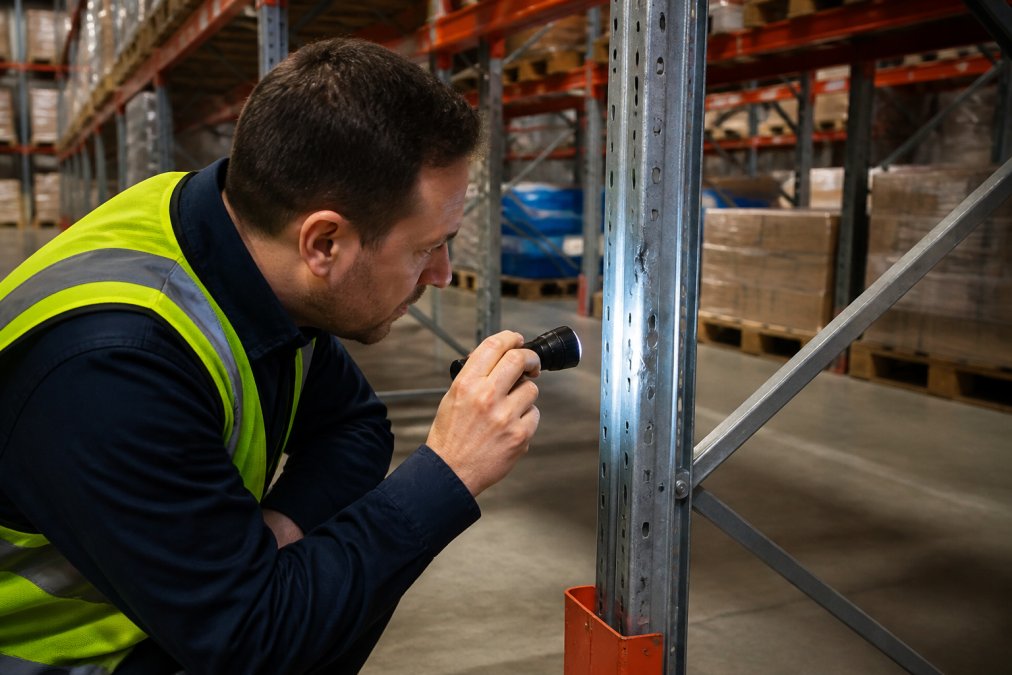
Inspections are not just about looking. They require checking specific tolerances, feeling for sharp edges that indicate fresh fractures, and verifying that safety clips and locks are present and functional. A thorough inspection follows a clear sequence, checking the structure from the ground up so that no component is overlooked.
Key Components to Check
When you inspect industrial pallet racking for damage, focus on the load-bearing elements first. The upright frames and their bases are most vulnerable to forklift impact, so examine them for any visible bowing, twisting, or denting. Even a slight bend in an upright can reduce its load capacity dramatically.
- Upright frames: Check for dents, bends, and twisting along the full height.
- Beams and beam connectors: Look for deformation and ensure all safety clips are engaged.
- Base plates and floor fixings: Verify bolts are tight and anchors are not pulling out of the concrete.
- Bracing and welds: Inspect for cracks, especially at welded joints.
- Shelves and decking: Confirm panels are intact and properly seated.
Understanding Pallet Racking Damage Classification
Once damage is found, the next step is to classify its severity to decide on the appropriate action. The pallet racking damage classification system used widely across warehouses is based on the Storage Equipment Manufacturers' Association (SEMA) guidelines, which assign a colour-coded risk level to each type of damage. This system provides a clear, standardised way to communicate risk between inspectors, managers, and maintenance teams.
A common mistake is treating all damage as equal. A paint scratch is cosmetic, while a bent upright is a structural hazard. Using a classification framework ensures that minor issues are monitored and major issues are addressed immediately, preventing both overreaction and dangerous complacency.
Red, Amber, and Green Risk Levels
The classification system sorts damage into three clear categories. Green indicates minor, superficial damage such as surface scratches or light rust that does not affect structural integrity; it should be monitored but requires no immediate action. Amber covers damage that reduces load capacity but is not an immediate collapse risk, such as a shallow dent in an upright; this racking should be repaired or have its load rating reduced by a competent person. Red signifies critical structural damage, like a deep dent or a bent frame, where the racking must be unloaded and taken out of service immediately.
How Often to Inspect Pallet Racking: Frequency Guidelines
How often to inspect pallet racking is determined by the level of risk in your operation, not by a fixed calendar date. While an annual inspection by a specialist is the minimum recommended baseline, facilities with high forklift traffic or impact-prone aisles require more frequent checks. The Health and Safety Executive (HSE) expects inspections to be frequent enough to identify new damage before it leads to failure.
A practical schedule typically involves three tiers of checks. Daily or weekly visual checks by floor staff catch new impacts quickly. A formal monthly inspection by a trained internal team member documents the racking's general condition. Finally, a thorough annual inspection by an external SEMA-approved company provides the expert, independent assessment required for compliance. The table below summarises this approach.
| Inspection Type | Frequency | Who Conducts It | Primary Focus |
|---|---|---|---|
| Visual check | Daily/Weekly | Warehouse staff | New impacts, obvious damage |
| Internal audit | Monthly | Trained team member | Structural condition, housekeeping |
| Expert survey | Annually | SEMA-approved specialist | Full compliance, load capacity |
SEMA Pallet Racking Inspection Guidelines Explained
The SEMA pallet racking inspection guidelines are the definitive standard for racking safety in the UK. SEMA, the Storage Equipment Manufacturers' Association, publishes codes of practice that define how inspections should be carried out and what constitutes reportable damage. Following these guidelines demonstrates that you are meeting your obligations under health and safety law to maintain safe equipment.
The guidelines are specific about what an inspector must record. They require measurements of any deformation, with tolerances for acceptable damage clearly stated. For example, the depth of a dent in an upright is measured and compared against a maximum allowable limit. The SEMA guidelines also mandate that any racking found with critical damage is clearly marked and taken out of use until repaired or replaced by a competent person.
Choosing a Competent Person for Racking Inspection
The term "competent person" has a specific legal meaning under UK health and safety regulations. A competent person for racking inspection is someone with sufficient training, experience, and knowledge to identify damage and assess its severity correctly. This is not a role for a general maintenance worker without specific racking training.
For internal inspections, staff must receive formal training on SEMA guidelines, including how to measure damage and classify risk levels. For the crucial annual inspection, most warehouses appoint an external specialist company. These specialists bring independent expertise and up-to-date knowledge of current standards. When selecting a provider, verify their credentials and ensure they are members of SEMA or hold equivalent recognised qualifications. The cost of a professional survey is minimal compared with the liability of an undetected structural failure.
Preventing Damage with Pallet Racking Protectors
The most effective way to reduce the frequency of serious damage is to prevent impacts from happening in the first place. Pallet racking protectors act as a sacrificial barrier, absorbing the energy of a forklift impact before it reaches the structural uprights. They are a mandatory requirement in many installations where industrial trucks operate, serving as the first line of defence for your racking system and your safety record.
At Store Fittings Direct, we supply a range of durable protection options designed for busy warehouse environments. Our Plastic Pallet Racking Protection is a cost-effective choice for corners and columns. For higher-impact areas, the Pallet Racking Protection Black Bull range offers a heavy-duty design, with a U-Profile variant for enhanced coverage. These protectors are simple to install and significantly cheaper than repairing or replacing a damaged upright frame.
Conclusion
Knowing how to inspect industrial pallet racking for damage is a fundamental skill for any warehouse manager. By following a structured inspection routine, classifying damage against the SEMA framework, and scheduling checks at the right frequency, you protect your team and your investment. The process is straightforward: look for damage regularly, act on what you find, and use protection to stop damage from happening.
A proactive approach to racking safety prevents the small dent from becoming the catastrophic failure. Combine a rigorous inspection schedule with physical protection, and you create a warehouse environment where safety is engineered into the daily operation. Review your current inspection plan today and ask whether it truly reflects the risks in your facility.
Frequently Asked Questions
How often should pallet racking be inspected in the workplace?
A formal pallet racking inspection by a competent person should happen at least every 12 months, as recommended by SEMA guidelines. However, in busy warehouses with frequent forklift traffic, a more frequent inspection, such as every six months, is often necessary. Additionally, you should conduct informal visual checks weekly or monthly as part of your routine. After any significant impact or near-miss, an immediate inspection is required to ensure the racking's integrity hasn't been compromised.
What constitutes 'red risk' damage in pallet racking?
'Red risk' damage is the most severe category in the SEMA pallet racking damage classification. It means the structural integrity of the racking is compromised and it presents an immediate safety hazard. This includes deep gouges, significant bends or twists in the upright frames, or missing safety clips. Racking with red risk damage must be taken out of service immediately and unloaded. Do not attempt to repair it yourself; you must contact a specialist for assessment and replacement.
Who is qualified to perform a pallet racking inspection?
A 'competent person' for racking inspection is someone with the relevant training, knowledge, and experience to assess the condition of pallet racking. They should be familiar with SEMA guidelines and be able to identify various types of damage. This could be an in-house trained individual, but many warehouses use an external specialist inspector from a SEMA member company. The key is that they are independent and have the authority to recommend racking be taken out of service if they find red risk damage.
What should be included in a pallet racking inspection checklist?
Your inspection checklist should cover all main components: upright frames for bends or cracks, beam connectors for damage or missing safety clips, and horizontal and diagonal braces for distortion. You should also check the floor anchors to ensure they are secure and look for any signs of impact on the base plates. A good checklist includes the racking's location, the date, and the inspector's name. It will also have a column to note the type and classification of any damage found, such as red, amber, or green risk.
Racking inspections are only part of the solution. Protecting your racking from impact is the other half. At Store Fittings Direct, we offer a comprehensive range of pallet racking protection with free nationwide delivery, backed by over 30 years of experience. View our range of barriers and protectors to find the right defence for your warehouse.


