

Table of Contents
- What You'll Need Before You Install Steel Bollards
- Choosing Between Root-Fixed and Surface-Mounted Steel Bollards
- Steel Bollard Installation Depth: How Deep Should You Go?
- Bollard Spacing for Retail Parks and Car Dealerships
- Bollard Installation Tools You'll Actually Use
- Step-by-Step: Installing Your Steel Bollards
- Common Mistakes to Avoid
- Frequently Asked Questions
Last Updated: September 29, 2026
What You'll Need Before You Install Steel Bollards
Steel bollards are fixed posts, usually galvanised mild steel or stainless steel, set into the ground to stop vehicles hitting buildings, pedestrians or stock. Getting the groundwork right before you dig is what separates a bollard that lasts 20 years from one that wobbles within a season.

This guide from Store Fittings Direct covers the full process: choosing a fixing method, working out depth and spacing, and setting posts correctly. It is written for retail parks, car dealerships and anywhere vehicles and people share the same entrance.
Before you order anything, sort out the practical checks.
- Confirm where vehicles actually drive and park
- Get a plan of underground services (water, gas, electric, fibre)
- Decide root-fixed or surface-mounted
- Measure the run and work out how many posts you need
- Check whether you need planning permission or a licence
- Book a concrete delivery or mix on site
Tools and Materials Checklist
You do not need specialist kit for most jobs. Here is what a typical installation uses:
- Spirit level (long, for checking posts are plumb)
- Measuring tape and string line for marking out
- Post-hole digger or auger for root-fixed posts
- SDS drill and masonry bits for surface-mounted base plates
- Concrete (a standard mix is fine for most posts)
- Safety gloves, boots and high-visibility vest
- Bollard caps and reflective bands if you want extra visibility
If your run needs to stay accessible for deliveries, a removable post may suit better than a fixed one. Store Fittings Direct stocks stainless steel removable bollards to 304 grade alongside the fixed range, so you can mix both on one site.
Choosing Between Root-Fixed and Surface-Mounted Steel Bollards
Root-fixed bollards are cast into the ground and resist the hardest impacts. Surface-mounted bollards bolt to an existing slab and install in a fraction of the time. The right choice comes down to what is under the surface.
Root-fixed posts suit car parks, forecourts and any spot where a vehicle could hit at speed. The concrete around the base spreads the load, so the post bends rather than shears off.
Surface-mounted posts work on sound concrete at least 100mm thick. They are quicker to fit and easier to move later, but they rely entirely on the slab and the bolts holding.
When Each Fixing Method Works Best
| Fixing method | Best for | Watch out for |
|---|---|---|
| Root-fixed | Car parks, forecourts, high-impact zones | Slower to install, needs excavation |
| Surface-mounted | Sound concrete slabs, low-speed areas | Fails if the slab is thin or cracked |
For retail parks and car dealerships, most runs are root-fixed at the entrance and surface-mounted further back where speeds are low. That mix keeps the strong posts where they matter.
Steel Bollard Installation Depth: How Deep Should You Go?
Steel bollard installation depth is the single biggest factor in how well a post performs. As a working rule, set the post at least three times as deep into the ground as it stands above it. A 750mm post should sit around 300mm into the ground plus a concrete collar.
Galvanised Mild Steel Bollards | 750mm →
That ratio gives the ground enough grip to resist a slow vehicle push. For higher-risk spots, go deeper still.
Two things change the depth you need:
- Ground type. Loose or sandy soil needs a deeper set and a wider concrete collar.
- Impact risk. Entrances and corners take harder hits than a quiet pedestrian edge.
Bollard Spacing for Retail Parks and Car Dealerships
Bollard spacing for retail parks depends on what you are keeping out. To block vehicles while letting pedestrians through, space posts roughly 1,200mm apart. To stop a car passing between them, close the gap to around 900mm.
Car dealerships often need wider gaps so customers can walk between display vehicles. In those areas, spacing of 1,500mm or more keeps the forecourt open while still guiding traffic.
Match the spacing to the job:
- Pedestrian protection: 1,200mm centres
- Vehicle exclusion: 900mm centres or tighter
- Forecourt guidance: 1,500mm and above
Walk the run before you drill. Stand where a driver would approach and check the gaps look right from that angle.
Bollard Installation Tools You'll Actually Use
Bollard installation tools fall into two groups: digging and fixing. For root-fixed posts, a post-hole digger or powered auger does the heavy work. For surface-mounted posts, an SDS drill and the right masonry bits are what you need.
The tools most people forget:
- A long spirit level, because a short one lets posts lean
- A string line, so a row of posts stays straight
- A mixing tub or paddle mixer if you are mixing concrete by hand
- Marking paint, so you can see the layout before you cut
A common mistake is buying cheap masonry bits for base plates. They blunt fast and slow the whole job. Spend a little more on bits rated for concrete.
Step-by-Step: Installing Your Steel Bollards
The process below covers a root-fixed post, which is the most common method for perimeter security. Surface-mounted posts follow the same steps but skip the excavation and bolt straight to the slab.
Galvanised Mild Steel Bollards | 750mm →
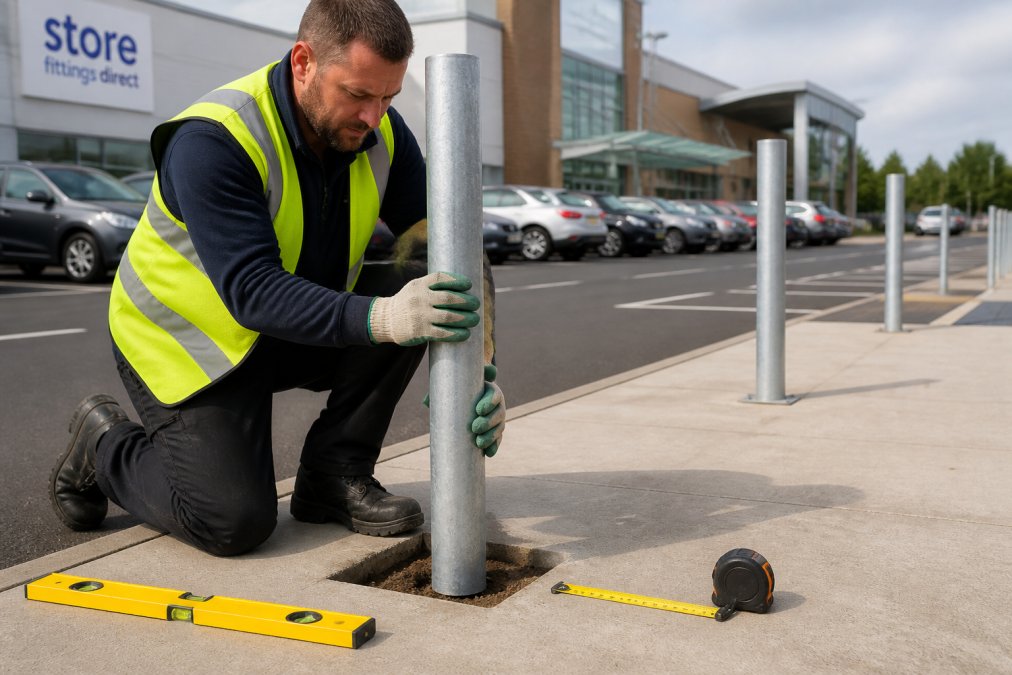
Step 1: Mark Out and Check for Underground Services
Mark the centre of each post with paint or pegs, then run a string line along the row. Check the line against your service plans and use a cable detector across the whole run. If anything is unclear, stop and confirm before you dig.
Step 2: Excavate, Position and Set the Bollard
Dig each hole to your calculated depth and width. Lower the post in, then check it is plumb with a spirit level on two sides. Brace it so it cannot move while the concrete sets.
Step 3: Concrete, Cure and Finish
Pour concrete around the post to form the collar, working it down to remove air pockets. Leave the concrete proud of the ground so water runs off. Let it cure fully before the post takes any load, then fit caps and reflective bands.
Common Mistakes to Avoid
Most failed installations come down to a handful of avoidable errors. Each one is quick to prevent at the start and expensive to fix later.
- Digging too shallow. Posts set less than three times their height in the ground loosen under load.
- Skipping the service check. Hitting a buried line is dangerous and costly.
- No concrete collar. A tight hole with no collar gives the post nothing to grip.
- Loading too soon. Concrete needs time to cure before the post takes weight.
- Ignoring the slab on surface mounts. Thin or cracked concrete will not hold base plates.
For a run that mixes fixed and removable posts, Store Fittings Direct supplies galvanised mild steel bollards made for casting into concrete with extended legs or flange plates, so you can match the fixing to each spot on site.
Perimeter security is a long-term decision, and weak groundworks undermine even the best posts. Store Fittings Direct has spent over 30 years supplying durable bollards and site protection to retailers, schools and warehouses, with fast nationwide delivery and trade accounts offering 30 days' interest-free credit. Our galvanised and stainless steel bollards come with free delivery and can be made to your exact height, finish and diameter. Get started with Store Fittings Direct and fit perimeter protection that holds up for years, not months.

Frequently Asked Questions
What is the standard depth for a steel bollard foundation?
As a general rule, the foundation depth should be at least equal to the above-ground height of the bollard, so a 1000mm bollard needs roughly a 1000mm deep hole. For softer ground or locations exposed to vehicle impact, increase this to 1.2 to 1.5 times the height. The hole diameter should be at least three times the bollard's diameter to give enough concrete around the post for stability.
Do I need planning permission to install security bollards?
In most cases, bollards installed on private land, such as a retail park or car dealership forecourt, do not need planning permission. However, if the site is in a conservation area, is a listed building, or the bollards sit on or near a public highway, you should check with your local planning authority first. Free-standing permitted development rights usually cover small-scale security measures, but it is always worth confirming before you dig.
What is the difference between surface-mounted and root-fixed bollards?
Surface-mounted bollards bolt directly onto an existing concrete or paved surface using a flange plate, making them quick to fit and easy to relocate. Root-fixed bollards are cast into a concrete foundation below ground, which gives far greater resistance to vehicle impact and is the preferred choice for ram raid deterrence. Surface-mounted suits light pedestrian control; root-fixed is better for car park perimeters and high-risk entrances.
Can steel bollards be installed on existing concrete surfaces?
Yes, provided the concrete is at least 100mm thick and in good condition. You will need a hammer drill and suitable anchor bolts, such as M12 or M16 through-bolts, to secure the flange plate. If the slab is thinner or cracked, it is safer to cut out a section and pour a new concrete foundation rather than rely on the existing surface, especially where vehicle impact is a real risk.


