

Table of Contents
- What Makes Night Owl Keep Left Bollards Different
- Passive Safety Bollard Requirements Explained
- Illuminated vs Non-Illuminated Bollards: Which Suits Your Site
- Self-Righting Bollard Installation: What to Expect
- Comparing the Night Owl Range: Which Model Fits Your Site
- Common Mistakes When Specifying Keep Left Bollards
- Conclusion
- Frequently Asked Questions
Last Updated: September 30, 2026
What Makes Night Owl Keep Left Bollards Different
Keep left bollards are the small, unglamorous pieces of street furniture that quietly stop drivers from drifting onto the wrong side of a traffic island. Night Owl variants are the ones built for unlit junctions, where there is no street lighting to make a standard sign visible. This guide from Store Fittings Direct covers what separates the Night Owl range from ordinary flexible bollards, which standards apply, and how to choose the right model for your site.

The key difference is construction. A conventional flexible bollard is moulded from a single polymer, so the whole post bends on impact and the reflective graphic bends with it. That repeated flexing is what cracks and blisters the sign face over time.
Night Owl bollards solve this by fusing two materials into one unit. A flexible base absorbs the impact while a rigid sign carrier holds the graphic flat. The result is a bollard that folds over, springs back, and keeps its reflective face intact.
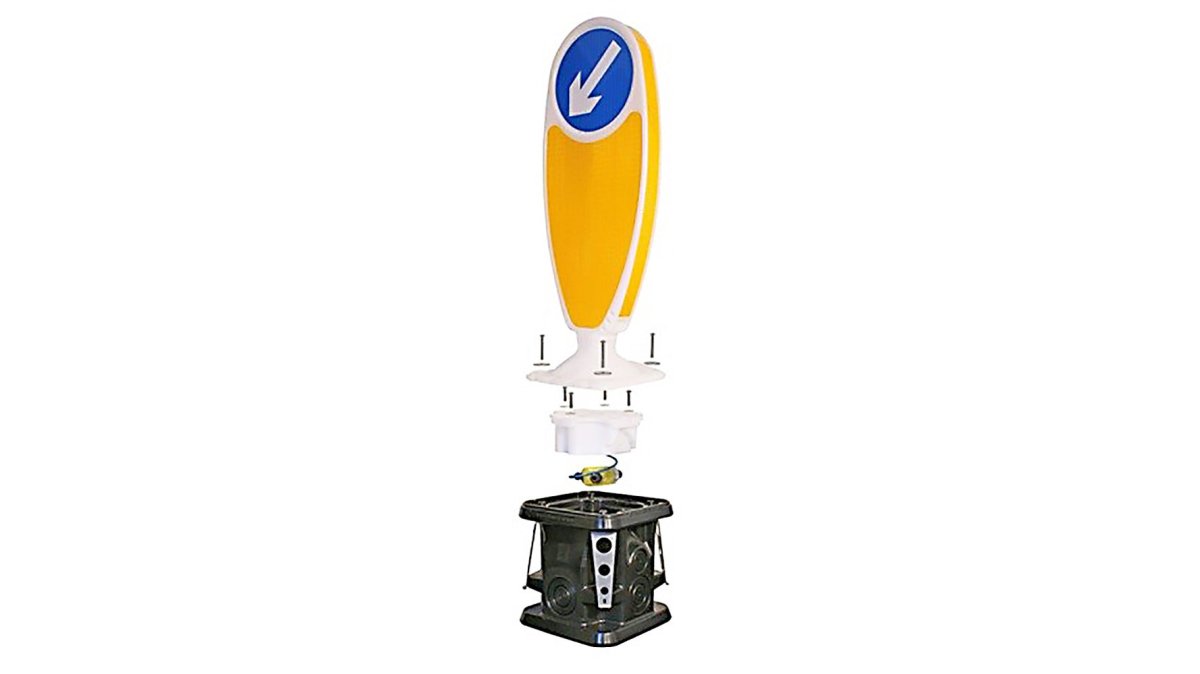
The composite base and rigid sign carrier
The manufacturing technique bonds a flexible polymer base to a rigid MDPE sign face during moulding. Because the two materials behave differently under load, the base collapses on impact while the sign carrier barely flexes.
That matters for longevity. The double-skin sign carrier reduces flexing to a minimum, which is what stops retro-reflective graphics from cracking, splitting, and eventually peeling off. The reflectors are also recessed, so a scraping vehicle hits the post before it hits the graphic.
Passive Safety Bollard Requirements Explained
A passive safety bollard is a post designed to yield or collapse on impact rather than transmit force into the vehicle and its occupants. It is the opposite of a rigid barrier, which is intended to stop a vehicle outright.
Two British and European standards govern this. BS EN 12767 sets performance classes for passively safe support structures, covering the impact speed and energy absorption level a product achieves. BS 8442 covers miscellaneous road traffic signs and, in Part 14, the requirements for self-righting and flexible bollards, including minimum retro-reflective surface area.
BSI guidance on BS EN 12767 passive safety standards sets out how the performance classes are structured, and the Department for Transport traffic sign regulations and guidance explains where keep left signs are required on the highway.

BS EN 12767 and BS 8442 in plain terms
BS EN 12767 tells you how a bollard behaves when struck: at what speed it was tested, and whether it absorbs, transfers, or sheds the impact energy. A rating such as 100 NE4 means the product was tested at 100 km/h and classified as non-energy-absorbing, which is the typical profile for a flexible sign that folds flat and returns upright.
Illuminated Night Owl | Flexible Keep →
BS 8442 Part 14 is the product standard for the bollard itself. It specifies the reflective surface area a sign must present. The Night Owl range exceeds the minimum, with 53 mm wide side and top reflectors giving a projected surface area of 0.045 m² against the 0.02 m² the standard requires.
Illuminated vs Non-Illuminated Bollards: Which Suits Your Site
Choose illuminated bollards where there is no ambient lighting and the sign must be seen at distance. Choose non-illuminated bollards where street lighting already exists, or where power cannot reasonably be run to the island.
The trade-off is running cost and maintenance against visibility. An illuminated unit needs a power supply and a light source that will eventually need attention. A non-illuminated unit relies entirely on retro-reflective material and vehicle headlights.
The Illuminated Night Owl uses a Cree LED light source mounted completely below ground level, which protects it from impact damage and from being driven over directly. It is rated Class L1 for light output and delivers up to 75% energy efficiency gains over traditional fluorescent alternatives, which matters if you are maintaining a large estate of bollards.

Non-illuminated models such as the EVO N use reflex material on the base combined with rigid polyethylene on the sign, so the bollard can take repeated impacts and return upright without damaging the reflective surfaces.
| Site condition | Recommended type | Why |
|---|---|---|
| Unlit junction or island | Illuminated | Sign must be visible without headlights close by |
| Lit carriageway, urban centre | Non-illuminated | Ambient light plus retro-reflectives are sufficient |
| Remote site, no power supply | Non-illuminated | Avoids trenching and cable installation |
| High-traffic municipal estate | Illuminated | Lower maintenance and energy cost over lifecycle |
Self-Righting Bollard Installation: What to Expect
Self-righting bollard installation is a bolt-down job in most cases, not a civils project. The base plate or ground socket is fixed to a prepared surface, and the bollard is then fitted to it. A single post typically takes under an hour with basic hand tools.
The practical steps are:
- Confirm the surface is sound and can take anchor bolts, or prepare a concrete pad if not
- Mark the fixing positions from the base plate template
- Drill and set the anchors, checking the post is plumb with a spirit level
- Bolt the base down and torque to the fixing specification
- Fit the bollard to the base and check it returns upright cleanly
What most guides miss is the surface itself. A flexible bollard is only as good as what it is bolted to.
Adapter plates and retrofit options
Adapter plates let a one-piece Night Owl bollard replace a different manufacturer's failed unit without re-drilling the ground. If you are refreshing an estate of mixed bollards, this avoids new fixing holes and keeps the existing base plate pattern.
Illuminated Night Owl | Flexible Keep →
Comparing the Night Owl Range: Which Model Fits Your Site
Pick the model by whether you need illumination and how much impact the site sees. The four options below cover most installations.
| Model | Price | Illuminated | Best for |
|---|---|---|---|
| Illuminated Night Owl | £445.00 | Yes | Unlit junctions, municipal estates |
| EVO N Flexible Keep Left | £187.36 | No | Highways and non-highway applications |
| Flexible Keep Left Night Owl | £175.00 | No | Retrofit onto failed bollards |
| Flexbrite Impact Recovery | £129.00 | No | Industrial estates, HGV traffic |
- Illuminated Night Owl (£445.00): the choice where visibility is the priority and power is available. Withstands impacts up to 100 km/h and returns upright with no mechanical parts to fail.
- EVO N Flexible Keep Left (£187.36): a passively safe, independently tested unit for highway and non-highway use. The two-component design separates the bounce-back base from the sign, so a damaged sign can be replaced on its own.
- Flexible Keep Left Night Owl (£175.00): the one-piece moulded version, returning to 97.9% of vertical within 55 seconds and folding to just 130 mm. Adapter plates make it a direct replacement for failed units.
- Flexbrite Impact Recovery (£129.00): a recycled rubber post that withstands 40-tonne traffic and bolts down in minutes. Best where HGV and delivery vehicles are the main risk.
Common Mistakes When Specifying Keep Left Bollards
Specifying on price alone is the mistake that costs the most. A cheaper bollard that cracks its graphic within two years costs more than a composite unit that lasts, once you count the replacement visit and the labour.
Three others come up repeatedly:
- Ignoring the reflective surface area. A sign below the BS 8442 minimum is not compliant, however good it looks in daylight.
- Fitting an illuminated unit where no power exists. Trenching and supply work will dwarf the cost of the bollard itself.
- Skipping the surface check. A flexible post on a failing base is a false economy.
Conclusion
Getting keep left bollards right comes down to matching the unit to the site: illumination where there is no light, a rigid sign carrier where graphics keep failing, and a base that suits the surface it bolts to. Specifying on headline price alone is how replacement programmes end up repeating themselves every couple of years.
Frequently Asked Questions
What is a Night Owl bollard?
A Night Owl is a flexible keep left bollard designed to stay visible and upright after vehicle impact. The range includes illuminated and non-illuminated versions. The illuminated model uses a Cree LED light source mounted below ground level to protect it from damage, while non-illuminated versions rely on retroreflective graphics for visibility in areas without street lighting. Both are built for highways and non-highway applications.
Are Night Owl bollards self-righting?
Yes. The flexible base is designed to absorb impact and return the bollard to an upright position. One-piece models return to 97.9% of vertical within 55 seconds, and the EVO N has a folding height of 130mm. There are no mechanical parts to fail, so the bollard keeps marking the hazard after side scrapes, side swipes or front-on impacts.
Do Night Owl bollards meet highway safety standards?
The illuminated Night Owl is BS 8442 Pt 14 compliant and tested to BS EN 12767:2007 at 100 NE4, meaning it withstands impacts up to 100km/h. The non-illuminated range is designed and independently tested for UK highway use. The one-piece model offers 0.045 sq m of projected reflective area, more than double the 0.02 sq m required by BS 8442:2006.
How does self-righting bollard installation work?
Most Night Owl models bolt down using pre-drilled holes in the base plate. Adapter plates are available so a one-piece Night Owl can replace other popular bollards that have failed, avoiding new groundworks. Once fixed, the flexible base absorbs impact while the rigid sign carrier holds the reflective graphics in place, so installation is usually a same-day job for a competent contractor.


