

Table of Contents
- What Are Queue Management Systems?
- Types of Queue Management Systems
- Queue Barrier Systems for Crowd Control
- Retail Checkout Layout Design Principles
- Reducing Perceived Wait Times
- Key Benefits and Implementation Challenges
- How to Choose the Right Queue Management System
- Frequently Asked Questions
Last updated: September 3, 2026
What Are Queue Management Systems?
A queue management system is a structured approach to organising customer flow and reducing congestion in retail, hospitality, and service environments. It combines physical barriers, digital signage, layout design, and operational procedures to guide customers through waiting areas efficiently whilst maintaining a professional appearance.
Queue management systems serve a dual purpose: they improve the customer experience by making waits feel shorter and more organised, and they increase operational efficiency by reducing bottlenecks at checkout, service counters, or entry points. At Store Fittings Direct, we've worked with retailers for over 30 years to understand that an effective queue management system isn't just about controlling crowds, it's about turning idle time into an opportunity to engage customers and drive additional sales.
The core principle is simple: a well-designed queue management system keeps customers moving, reduces frustration, and creates space for merchandising or promotional messaging. Without one, checkout areas become chaotic, staff stress increases, and customers leave with a poor impression of your business.
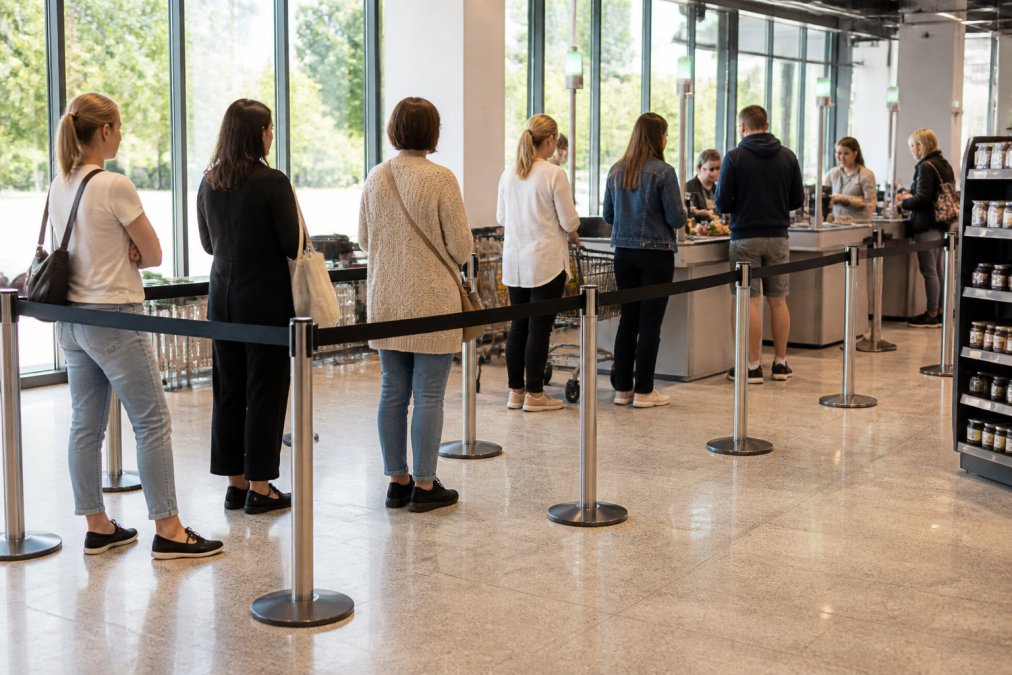
Types of Queue Management Systems
Queue management systems fall into three primary categories, each suited to different retail environments and operational needs.
Physical Queue Barriers
Physical barriers form the foundation of most queue management systems. Retractable belt barriers with sturdy posts create visible, psychological boundaries that guide customers naturally into orderly lines. These barriers are portable, adjustable, and require no power or maintenance beyond occasional cleaning.
The Retractable Belt Queue Barrier (Black Post) from Store Fittings Direct costs £99.00 and delivers professional crowd control with extra-long belts customisable for your specific layout. For environments requiring a more premium appearance, the Retractable Queue Barrier (Stainless Steel) at £129.00 offers durability and aesthetic appeal suitable for upmarket retail settings. Both models include free delivery and can be deployed quickly when queue volumes spike.

Physical barriers work best in high-traffic retail environments where you need immediate, visual guidance. They're cost-effective, require no training, and communicate expectations to customers without signage.
Virtual and Digital Solutions
Digital queue management systems use technology to manage flow virtually. Customers take a ticket or check in via an app, receive real-time wait time estimates, and are notified when their position approaches. Digital systems reduce physical crowding and allow customers to browse whilst waiting.
These solutions suit service-heavy environments like banks, healthcare facilities, or government offices where customers may wait extended periods. However, they require investment in software, hardware, and staff training. For independent boutiques or small retail operations, digital systems often introduce unnecessary complexity.
Hybrid Approaches
Many retailers combine physical barriers with digital elements, retractable queues paired with digital signage displaying wait times, or merchandising displays positioned within queue lines. This hybrid approach maximises space efficiency whilst maintaining the psychological comfort of physical boundaries.
Hybrid systems work particularly well in mixed-use spaces where queue volumes fluctuate throughout the day. You can deploy barriers during peak hours and remove them during quieter periods, adapting your queue management system to actual demand.
Queue Barrier Systems for Crowd Control
Effective crowd control through queue barrier systems requires more than simply placing posts at checkout. The barrier system must guide customers naturally, prevent queue jumping, and maintain sightlines for staff supervision.
The Traffic-Line Economy Belt Barrier at £206.57 offers versatility beyond traditional checkout queuing. Designed for diverse scenarios, queue guidance, industrial sites, warehouses, parking facilities, and public spaces, it features a self-tensioning belt that deploys smoothly and retracts securely. This flexibility makes it ideal for retailers who need to reconfigure their space seasonally or for special events.
Effective queue barrier systems follow three design principles. First, barriers should create a clear, linear path with minimal decision points. Second, the barrier height should be high enough to prevent queues from dispersing sideways, typically 900-1000mm (bsigroup.com). Third, spacing between barrier posts should allow comfortable passage for customers with pushchairs, wheelchairs, or mobility aids.
Common mistakes include spacing barriers too far apart (allowing queue jumping), placing them too close together (creating bottlenecks), or using barriers that look cheap or unstable (damaging brand perception). Professional-grade barriers from Store Fittings Direct signal that you take customer experience seriously.
Retail Checkout Layout Design Principles
Your queue management system's effectiveness depends entirely on the underlying checkout layout. Poor layout design undermines even the best barriers and signage.
Effective checkout layout follows these principles. Position your primary queue line where customers naturally enter the checkout area, typically along the side wall rather than down the centre. This keeps the main sales floor visible and accessible. Create a single, unified queue that feeds multiple tills rather than separate queues per till, which reduces perceived wait times and prevents customers feeling they've chosen the "wrong" queue.
Ensure adequate space behind the queue for customers to stand comfortably without blocking other shoppers. A minimum of 1.5 metres depth is recommended. Use visual cues, floor markings, barriers, or signage, to communicate the queue direction clearly, particularly at the entry point.
The Standard Shelf Bay Merchandising Queuing System at £327.07 and the Hook Bay Merchandising Queuing System at £312.63 from Store Fittings Direct transform queue lines into revenue opportunities. Positioned within queue areas, these systems display impulse-purchase items, promotional information, or advertising whilst customers wait. This turns perceived wait time into productive engagement.

Avoid cluttering the queue area with too many displays, one focal point per 2-3 metres of queue length is optimal. The display should be at eye level and easily accessible without customers leaving the queue. managing event queues.
Reducing Perceived Wait Times
Customers' perception of wait time often exceeds the actual duration. A well-designed queue management system reduces perceived wait through environmental and psychological strategies.
Provide visual confirmation of progress. When customers can see the queue moving, even slowly, they perceive the wait as shorter. Barriers that allow sightlines to the checkout area help customers gauge how many people are ahead. Digital signage displaying average wait times also reduces uncertainty, which is often more frustrating than the wait itself.
Occupy customers' minds during the queue. Retail displays, promotional posters, or entertainment (in hospitality settings) distract from time passing. This is why the merchandising queue systems from Store Fittings Direct are so effective, they engage customers and often generate additional sales from impulse purchases.
Reduce queue visibility from the sales floor. Long, obvious queues discourage new customers from entering. Where possible, position queues in alcoves or behind partial walls to minimise the visual impact on the overall shopping experience.
Ensure staff are visible and attentive. When customers see staff monitoring the queue and opening additional checkouts when needed, they feel the business is actively managing their experience. This perception significantly reduces frustration.
Key Benefits and Implementation Challenges
Implementing a queue management system delivers measurable operational benefits. Improved customer flow reduces checkout times, which increases transaction capacity during peak hours. Better organisation reduces staff stress and improves service quality. Professional barriers and signage enhance brand perception, customers associate organised queues with well-managed businesses.
Queue systems also reduce theft and loss. Orderly queues with clear sightlines make unauthorised behaviour more difficult. Barriers create natural checkpoints where staff can monitor activity.
Implementation challenges typically centre on space constraints and upfront investment. Small retailers worry that barriers will make limited space feel cramped. The solution is modular, scalable systems that adapt to your footprint. Store Fittings Direct's range of barrier heights and configurations allows you to optimise even tight spaces.
Another common concern is aesthetic integration. Barriers shouldn't look institutional or temporary. Professional-grade barriers in stainless steel or powder-coated finishes complement modern retail environments. Budget-conscious retailers often underestimate how much a cheap, wobbly barrier damages customer perception, investing in quality systems pays back through improved brand image.
Staff training represents a smaller but real challenge. Teams must understand how to deploy and adjust barriers, maintain clear sightlines, and monitor queue flow. Most systems require minimal training, typically 15-30 minutes of instruction (shrm.org).
How to Choose the Right Queue Management System
Selecting the right queue management system depends on three core factors: your physical space, customer volume patterns, and budget.
Assess Your Space and Volume
Measure your checkout area length and width. Calculate how many customers typically queue during peak hours and how long the average transaction takes. These figures determine barrier quantity and spacing.
High-volume, fast-turnover environments (supermarkets, quick-service restaurants) benefit from physical barriers that guide high customer throughput. Lower-volume, service-heavy environments (boutiques, specialist retailers) may prioritise aesthetic appeal over maximum throughput capacity.
Consider future growth. If you're expanding or adding checkouts, choose modular systems you can reconfigure rather than fixed installations.
Budget and Scalability
Retractable barriers represent the most cost-effective entry point, starting at £99.00 per unit. Stainless steel variants cost slightly more but last significantly longer in high-traffic environments.
Merchandising systems add functionality and revenue potential. A Standard Bay system at £327.07 or Hook Bay system at £312.63 transforms queue space into a sales tool. For independent boutiques concerned about space, these systems integrate naturally into checkout areas.

Consider total cost of ownership. Cheaper barriers often require replacement within 2-3 years due to wear (peer-reviewed research). Professional-grade systems from Store Fittings Direct deliver durability that justifies the initial investment through longevity.
Integration with Existing Systems
Your queue management system should complement your existing checkout infrastructure, POS systems, payment terminals, and security systems. Ensure barrier placement doesn't obstruct sightlines to security cameras or restrict access for staff during emergencies.
If you're using digital queue management software, verify that physical barriers integrate logically with the customer flow the software expects. Misalignment between digital and physical systems creates confusion rather than clarity.
Store Fittings Direct's experience across retail, education, and warehouse sectors means our solutions integrate seamlessly with diverse operational environments. We've helped independent boutiques optimise tight spaces and large retailers manage high-volume checkout areas.
Effective queue management is about more than reducing congestion, it's about creating a professional, customer-focused experience that reflects your brand values. Whether you're a small independent retailer managing limited space or a larger operation handling high volumes, the right queue management system transforms checkout areas from necessary evils into controlled, efficient, and even revenue-generating zones. Store Fittings Direct's range of retractable barriers, merchandising systems, and design expertise helps you implement solutions that work for your specific space and budget. Explore our queue barrier systems and merchandising displays to discover how professional crowd control can enhance your customer experience and operational efficiency.
Frequently Asked Questions
What are the benefits of using a queue management system?
Queue management systems improve customer experience by reducing perceived wait times and creating an organised flow. They enhance staff efficiency, prevent bottlenecks at checkouts, and can increase sales by keeping customers engaged during queues. Physical barriers and merchandising displays also protect assets and guide customers through your space more effectively.
What is the difference between virtual and physical queue management?
Physical queue management uses barriers, signage, and merchandising displays to direct customer flow, like retractable belt barriers or shelf bays. Virtual systems employ digital ticketing or mobile apps to manage wait times without physical barriers. Many retailers combine both approaches for maximum effectiveness, using barriers for flow control and digital tools for estimated wait times.
How can queue management improve customer satisfaction?
Customers feel less frustrated when queues are clearly organised and move predictably. Reducing perceived wait times through visual distractions, merchandising opportunities, and transparent queue systems keeps customers engaged. Well-designed queue management also prevents overcrowding, improves safety, and demonstrates that your business respects their time.
Are there queue management solutions suitable for small businesses?
Yes. Small independent retailers benefit from affordable physical solutions like retractable barriers (from £99) and merchandising shelf bays that cost less than digital systems but still improve flow significantly. These modular options work in tight spaces and require no technical setup, making them ideal for boutiques and smaller shops with limited budgets.
How do I choose between retractable barriers and merchandising displays for my checkout?
Retractable barriers are best for directing flow and creating clear queue lines, particularly in high-traffic areas. Merchandising shelf bays serve dual purposes: they guide queues whilst displaying products for impulse purchases. Many retailers use both together, barriers create the queue structure, whilst displays occupy customer attention and boost sales during wait times.
What makes a queue management system durable enough for daily heavy use?
Look for systems with reinforced posts, quality materials like stainless steel, and robust belt mechanisms. Products designed for retail environments should withstand constant movement, adjustments, and customer contact. Stainless steel barriers resist corrosion and maintain a professional appearance longer than cheaper alternatives, ensuring your investment lasts years of daily operation.


