

Table of Contents
- What Are Retail Digital Screens?
- Digital Menu Boards: Transform Customer Ordering
- Digital Menu Board Design Best Practices
- Digital Window Displays: Attract Customers at Street Level
- Retail Display Brightness Requirements for Maximum Visibility
- Digital Signage Content Management Software: Running Your Displays
- Choosing the Right Retail Digital Screen for Your Business
- Conclusion
- Frequently Asked Questions
Last Updated: September 1, 2026
What Are Retail Digital Screens?
Retail digital screens are dynamic display systems that present content electronically, powered by digital signage software enabling real-time updates. They range from menu boards in hospitality venues to window displays that attract foot traffic. At Store Fittings Direct, we've helped thousands of retailers modernise customer communication with solutions designed for durability and impact in demanding retail environments.
A printed menu becomes outdated the moment you need to adjust pricing or highlight a promotion. A digital display updates instantly across all locations. This flexibility transforms how retailers interact with customers, whether they're ordering from a menu board or browsing window displays that change throughout the day.
Retail digital screens serve distinct purposes: digital menu boards simplify ordering in food service and enable dynamic pricing; window displays capture street-level attention; in-store displays guide customers through product categories and highlight promotions. Each application demands different specifications, brightness for outdoor visibility, refresh rates for smooth video playback, content management systems that scale across multiple locations.

Businesses report improved operational efficiency when staff no longer manually update physical signage. Customer experience improves when menus are legible and promotions are prominent. Retailers gain the ability to test messaging quickly, adjusting content based on real-time performance rather than waiting weeks for new printed materials.
Digital Menu Boards: Transform Customer Ordering
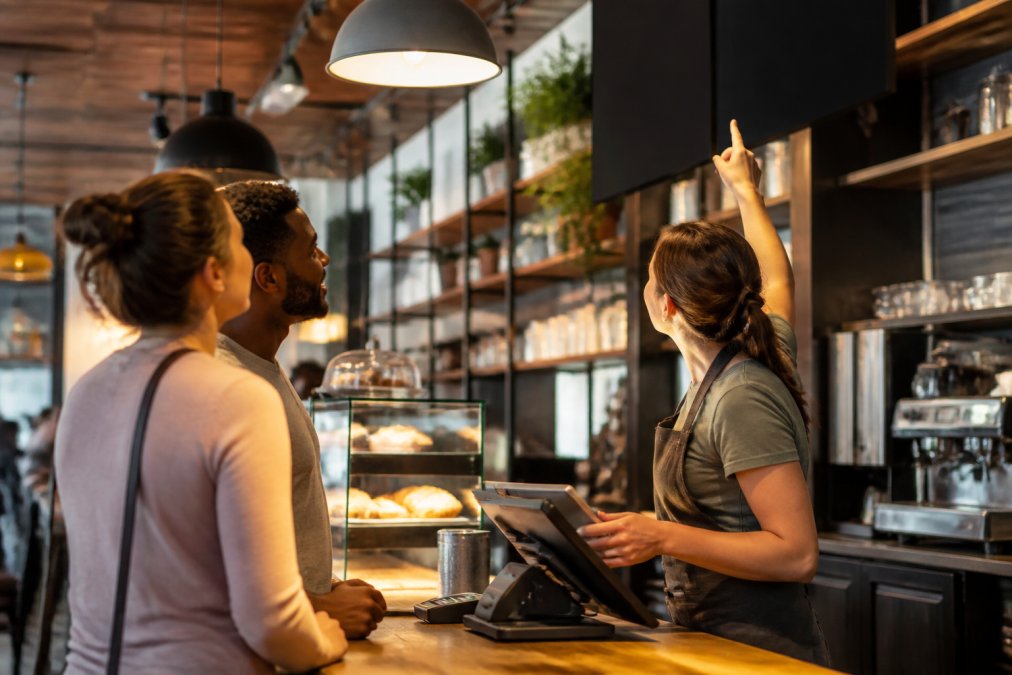
Digital menu boards eliminate friction between customer desire and ordering clarity. When customers see exactly what's available, read detailed descriptions, and understand pricing without asking staff, transactions accelerate.
The best digital menu boards integrate with your point-of-sale system, syncing pricing and availability automatically. When you adjust a price in your POS, it updates on the display within seconds. This prevents costly pricing mismatches and reduces staff time answering availability questions.
Visual hierarchy matters significantly. A well-designed menu board groups items logically, highlights high-margin products, and uses colour strategically to draw attention to promotions. Poor design creates confusion and slows ordering.
Store Fittings Direct offers the Network Digital Menu Boards, a cloud-based solution that lets you manage content from anywhere. Multiple locations sync instantly, ensuring consistency across your business. You update once; every screen reflects the change immediately.
Installation flexibility matters too. Menu boards mount above counters, hang from ceilings, or stand freely depending on your space. Hardware must be strong enough to handle daily use; cheap displays fade, flicker, or fail within months, damaging customer perception.
Digital Menu Board Design Best Practices
Menu board design directly influences how quickly customers decide and how accurately they order.
Start with legibility. Text must be readable from at least 2 metres away. A 20-point font that looks adequate on your computer becomes illegible on a large screen viewed from distance. Test your design from the actual viewing distance before finalising layout.
Contrast is critical. Dark text on light backgrounds or light text on dark backgrounds both work; avoid mid-tone combinations that create eye strain. Colour should serve a purpose, highlighting promotions, grouping categories, or drawing attention to high-margin items.
Hierarchy guides the eye naturally. Feature bestsellers prominently, position premium items where customers' eyes naturally focus, and make add-ons visible without overwhelming the main menu. A customer should grasp core offerings within seconds.
Update frequency affects design. If you change content daily, use templates allowing quick text swaps. If content changes monthly, you have more flexibility for creative layouts. Mismatching design flexibility to your update cadence creates bottlenecks.
Animation should enhance, not distract. Subtle fades between menu sections work well. Constant flashing or rapid transitions exhaust viewers and reduce comprehension.
Test with real customers if possible. Watch how people interact with your menu board. Do they hesitate at certain items? Do they miss promotions? Does the layout guide their eyes logically? Real-world observation beats assumptions.
Digital Window Displays: Attract Customers at Street Level
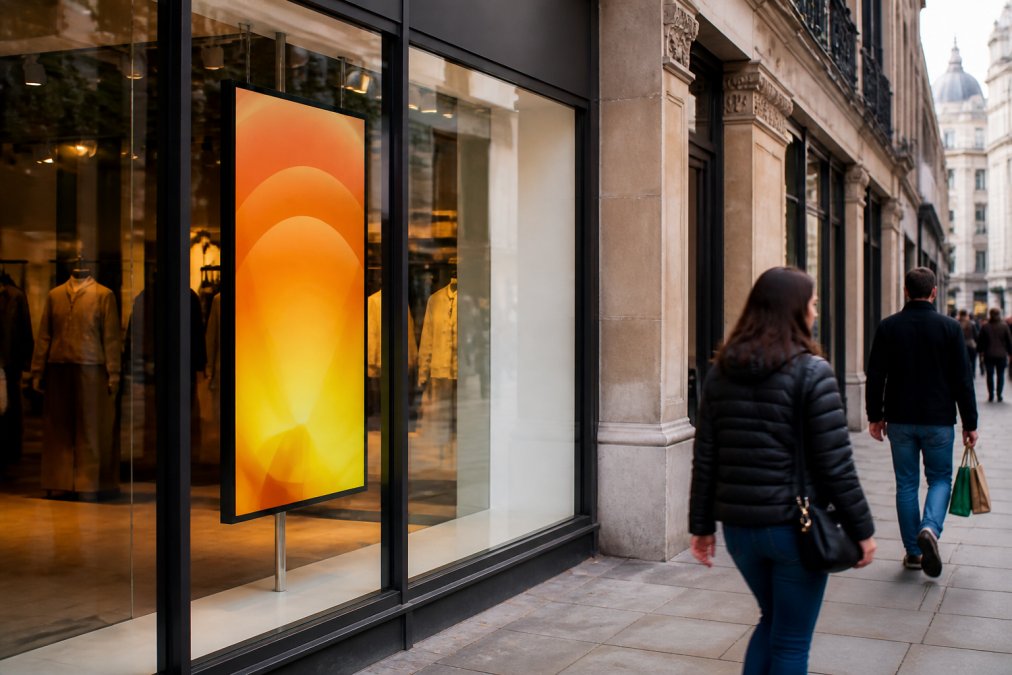
Window displays compete for attention against countless distractions. A static printed poster holds attention for perhaps three seconds (peer-reviewed research). A digital display that changes every 10-15 seconds keeps people looking longer, creating opportunity to communicate multiple messages.
The strategic advantage lies in dynamic content. A fashion retailer shows new arrivals in the morning, switches to sale items at lunchtime, and highlights evening wear before closing. A café promotes breakfast specials at 7 a.m., lunch options at noon, and pastries with afternoon coffee at 3 p.m. Each message reaches the right audience at the right time without requiring manual changes. digital menu boards.
Brightness determines visibility in direct sunlight. A standard office monitor becomes nearly invisible in bright daylight (peer-reviewed research). Professional window displays use high-brightness panels engineered for outdoor visibility. The specification is "cd/m²" (candelas per square metre), measuring light output. Standard monitors operate around 300 cd/m². Professional window displays range from 700 to 3,500 cd/m² depending on sunlight exposure (cie.co.at).
Store Fittings Direct supplies the Double Sided Hanging Window Display at 700 cd/m², ideal for most retail windows, and the Ultra High Brightness Hanging Double Sided Digital Window Displays at 3,500 cd/m² for exceptionally bright locations.

Double-sided displays maximise impact. A single display facing the street reaches pedestrians outside. A double-sided display adds an in-store audience, turning window space into a communication channel for both external and internal messaging.
Weather resistance matters significantly. Window displays face temperature swings, humidity, and UV exposure that indoor screens never encounter. Professional displays use sealed enclosures, temperature management, and UV-resistant components designed for years of outdoor service.
Retail Display Brightness Requirements for Maximum Visibility
Brightness specifications confuse many retailers because the numbers seem abstract. Understanding what they mean practically helps you choose correctly.
A display's brightness is measured in cd/m² (candelas per square metre). Here's what different levels mean in practice:
Standard office monitors (250-300 cd/m²) work well indoors under controlled lighting. Place one in direct sunlight and it becomes nearly invisible. These are unsuitable for window displays.
Mid-range professional displays (700 cd/m²) handle typical retail window environments. Most shops have some roof overhang or awning providing partial shade. A 700 cd/m² display remains visible throughout the day in these conditions.
High-brightness displays (1,200-1,500 cd/m²) work in brightly lit windows with minimal shade protection or intense afternoon sun exposure.
Ultra-high brightness displays (3,000-3,500 cd/m²) are engineered for the most demanding conditions: corner shop windows with unobstructed sun exposure, or locations where maximum street impact is critical.

The practical choice depends on three factors: your window's shade protection, the time of day when visibility matters most, and how much impact you need.
Power consumption increases with brightness, so over-specifying wastes energy and money. Choose the minimum brightness that delivers visibility in your specific location.
Colour accuracy matters alongside brightness. A bright display that renders colours poorly looks cheap. Professional displays maintain colour accuracy even at high brightness levels.
Digital Signage Content Management Software: Running Your Displays
The display hardware is only half the equation. Content management software determines whether your displays improve operations or become frustrating obstacles.
Effective software lets you update content remotely without visiting each location. Cloud-based systems let you update all displays simultaneously from your office, or schedule content changes to occur automatically at specific times.
Template-based systems accelerate content creation. Rather than designing layouts from scratch each time, you build templates that preserve your brand identity while allowing quick text and image updates. This matters for high-frequency updates.
Scheduling capability enables strategic content timing. Set promotions to display during specific hours, days, or seasons without manual intervention. A restaurant can schedule breakfast content 6-11 a.m., lunch content 11 a.m.-2 p.m., and dinner content 5-10 p.m., all automatically.
Analytics show what content performs. Some systems track how long customers view different content and how content changes affect sales. This data guides future content decisions.
Integration with your POS system prevents pricing mismatches. When your menu board price differs from what the till charges, customers become frustrated. Integrated systems sync automatically.
Reliability matters more than feature richness. Choose software from providers known for stability and support. The cheapest option often becomes expensive when you factor in downtime.
Choosing the Right Retail Digital Screen for Your Business
The correct choice depends on your specific application, space constraints, and budget.
Start by defining your primary use case. Are you replacing a static menu board? Attracting window traffic? Guiding customers through your store? Each application demands different specifications.
Space constraints shape your options. A small café might fit a single menu board of a suitable size above the counter. A large restaurant might need multiple displays. Window displays range from compact units to expansive wall-mounted arrays. Measure your actual space and test display sizes before committing.
Budget considerations include hardware cost, installation, software licensing, and ongoing content creation. The display itself is often the smallest expense. Professional installation, reliable software, and quality content creation add significantly to total cost.
Store Fittings Direct provides solutions across different budgets and applications. The Network Digital Menu Boards start at £536.29 and offer cloud-based management for multi-location consistency. The Double Sided Hanging Window Display at £1,911.11 delivers professional brightness and dual-audience visibility. The Ultra High Brightness Hanging Double Sided Digital Window Displays at £3,195.00 handle the most demanding visibility requirements.
Consider your team's technical capability. Choose tools your staff can actually use without constant support calls. Over-complicated systems create resentment and underutilisation.
Scalability matters if you plan to expand. Software and hardware that work for one location should handle growth to five or ten locations without major changes.
Durability affects long-term value. Professional-grade displays cost more upfront but last years longer than consumer equipment. In retail environments with high-traffic, temperature swings, and constant use, durability directly impacts your return on investment.
Conclusion
Retail digital screens transform how you communicate with customers, from the moment they notice your window display to the moment they place an order. The technology has matured to the point where quality displays are affordable and software is genuinely user-friendly.
Store Fittings Direct has spent over 30 years helping retailers optimise their spaces with solutions that actually work in real-world conditions. Our digital displays combine professional brightness, reliable hardware, and straightforward content management software. Whether you need menu boards that sync across multiple locations or window displays that capture attention in bright sunlight, we have solutions designed for durability and impact. Explore our range of Network Digital Menu Boards and professional window displays to find the right fit for your business.
Store Fittings Direct eliminates the uncertainty most retailers face when choosing digital screens. With over 30 years of experience and over 1.3 million products delivered, we understand what actually works in retail environments. Our displays feature professional-grade brightness, reliable cloud-based content management, and fast nationwide delivery. Start with a single display or scale across multiple locations. Get started with Store Fittings Direct and transform how your customers see your business.
Frequently Asked Questions
What are the main benefits of installing retail digital screens in a shop?
Retail digital screens allow you to update promotions instantly without printing new materials, reducing waste and labour. They draw customer attention with dynamic content, improving footfall and dwell time. Menu boards speed up ordering and reduce errors, whilst window displays maximise visibility in direct sunlight. Most retailers see improved customer engagement and faster transaction times after installation.
How bright should a digital window display be for outdoor visibility?
Outdoor-facing digital screens need a minimum of 700 cd/m² brightness to remain readable in daylight. For high-traffic areas with direct sunlight, 3,500 cd/m² ultra-high brightness displays ensure your content stays vivid throughout the day. The brightness requirement depends on your location's ambient light levels and whether the display faces north or south. Undersized brightness results in washed-out content that fails to engage passing customers.
What software do I need to manage digital signage content?
Most modern retail digital screens use cloud-based content management systems (CMS) that let you update displays remotely from any device. These platforms allow scheduling of content, real-time menu changes, and multi-location management if you operate multiple sites. Look for software that integrates with your existing systems and offers user-friendly templates so staff can make updates without technical training. Many suppliers, including Store Fittings Direct, include CMS access with their digital signage products.
Are digital screens cost-effective for small independent retailers?
Yes, digital screens are increasingly affordable for independent retailers. A quality digital menu board starts from £536.29, whilst window displays range from £1,826.67 to £3,195.00 depending on brightness and size. The return comes from reduced printing costs, faster staff training, fewer ordering errors, and increased impulse purchases driven by dynamic content. Many small retailers recover their investment within 12–18 months through operational savings and improved sales.


