

Table of Contents
- The Core Types of Retail Shelving Explained
- What Are the Different Types of Retail Shelving?
- Gondola Shelving Units: The Workhorse of the Shop Floor
- Modular Shop Shelving Systems: Flexibility for Any Layout
- Retail Store Layout Best Practices for Shelving
- Specialist Shelving: Corner, Magazine and Wine Displays
- How to Choose the Right Shelving for Your Shop
- Frequently Asked Questions
Last Updated: September 13, 2026
The Core Types of Retail Shelving Explained
Retail shelving is the range of freestanding and wall-mounted display systems used to hold, present and organise stock on a shop floor, and most stores rely on a small number of core types: gondola units, wall and perimeter bays, modular systems, and specialist fixtures for corners, magazines and wine. This guide from Store Fittings Direct breaks down each type, where it belongs in a layout, and how to choose between them.

The choice matters more than most shop owners expect. Get it wrong and you either waste floor space or block sightlines that drive impulse purchases. Get it right and the same square metreage sells noticeably more.
Below, we'll show you exactly how each shelving type works, which layouts suit independent shops, and the specification details that separate durable units from ones that wobble within a year.
What Are the Different Types of Retail Shelving?
The four main types of retail shelving are gondola units, wall and perimeter bays, modular shop shelving systems, and specialist display fixtures. Each serves a distinct function: gondolas create aisles, wall bays maximise vertical space, modular systems adapt to changing layouts, and specialist units handle awkward corners or particular product categories.

The British Standards Institution guidance on retail furniture safety sets out structural expectations that reputable suppliers design to, which is worth checking before any fit-out.
Gondola and Island Units
Gondola units are freestanding, double-sided shelving runs that form the aisles of a shop. An island unit is a shorter gondola placed away from the walls, creating a walk-around display. Both let customers browse from two sides, which roughly doubles the display frontage per unit of floor space.
Wall and Perimeter Bays
Wall bays fix to the perimeter of a shop and use the full height of the room. Because they sit against a wall, they free up the centre of the floor for gondolas and customer movement. A typical wall shelving bay stands around 2.4m high with a 470mm base shelf and 370mm upper shelves, giving a deep base for bulk stock and shallower shelves above for lighter items (bsigroup.com).
Gondola Shelving Units: The Workhorse of the Shop Floor
Gondola shelving units are the double-sided, freestanding bays that form the backbone of most shop floors. They define aisles, carry the bulk of general merchandise, and can be reconfigured as ranges change.
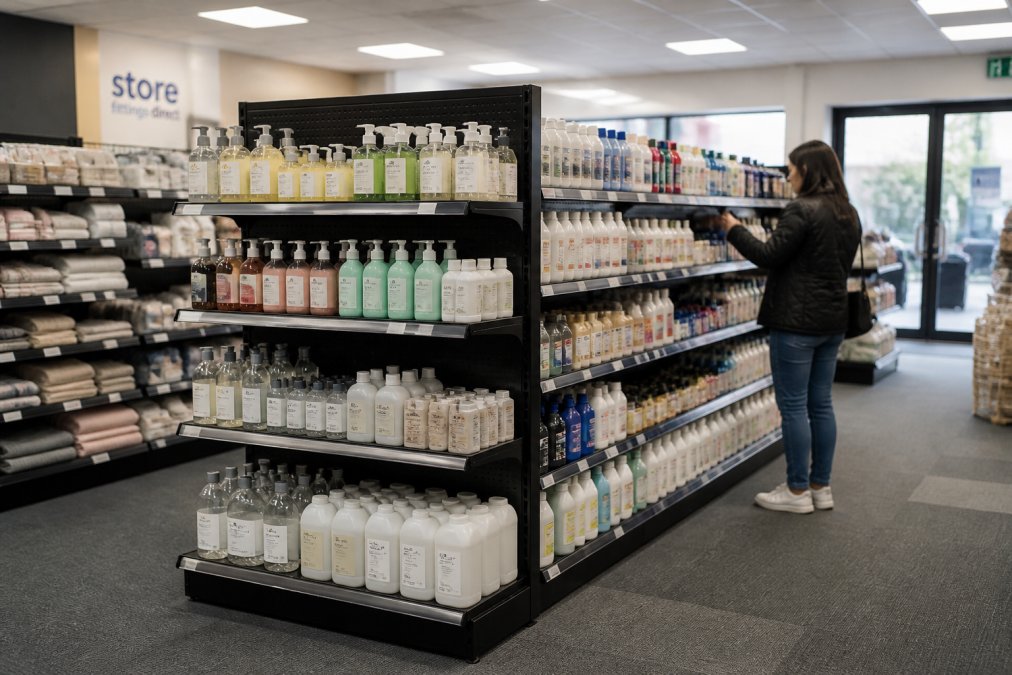
A standard gondola bay comes with a deep base shelf and shallower upper shelves, an upright frame, back panels and adjustable shelves. Base depths of 470mm with 370mm uppers suit most convenience and general retail ranges, while bay widths of 500mm through to 1250mm let you build continuous runs without awkward gaps.
What most guides miss is the base shelf depth. A 470mm base holds bulky multipacks and larger boxes that would look lost on a 370mm upper. Pair the two and you get a practical mix of volume and visibility in one bay.
Modular Shop Shelving Systems: Flexibility for Any Layout
Modular shop shelving systems are bays built from standard interchangeable components, so shelves, uprights and feet can be added, removed or repositioned without replacing the whole unit. That flexibility is what makes them suitable for independent boutiques with tight or irregular floor plans, not just large chains.
The practical benefit is straightforward: you buy a bay width and shelf depth that fits today, then adjust shelf heights as your range changes. A shop that switches from folded clothing to boxed gifts, for example, can raise shelf pitch rather than buy new units.
Independent retailers often assume modular systems are designed for bigger chains. In practice, the opposite is true. A small shop with an awkward footprint benefits most from being able to build a run bay by bay and stop exactly where the wall juts out.
Retail Store Layout Best Practices for Shelving
Retail store layout best practices for shelving come down to three rules: keep sightlines open, group bays into coherent runs, and place high-margin stock at eye level. Layout decisions affect how customers move through the shop, and shelving is the main tool for directing that movement.
Start with the perimeter. Wall bays carry the heaviest and bulkiest stock because they can take the load without obstructing the centre of the floor. Then place gondola runs parallel to the entrance, so customers walking in see the full length of an aisle rather than the end panel of a bay.
A useful rule for shelf height allocation:
| Shelf Position | Height from Floor | Best Stock |
|---|---|---|
| Base shelf | 0-470mm | Bulk, multipacks, heavy items |
| Lower mid | 470-900mm | Value ranges, larger boxes |
| Eye level | 900-1500mm | High-margin, impulse lines |
| Top shelf | 1500mm+ | Light stock, back-up, signage |
Leave at least 1.2m between facing gondola runs so two shoppers with baskets can pass without turning sideways. Tighter than that and customers avoid the aisle entirely, which kills the impulse purchases the bay was meant to drive.
Health and Safety Executive guidance on workplace safety is worth reviewing before finalising aisle widths and fixing methods, particularly for any area the public accesses.
Specialist Shelving: Corner, Magazine and Wine Displays
Specialist shelving handles the product categories that standard bays serve badly: corners, periodicals and bottled goods. A corner shelving bay turns dead space into selling space, magazine units present covers face-out, and wine displays combine tiered presentation with the strength to carry glass.

Corner bays are add-on units that join two wall runs at a right angle. One practical detail: a corner bay needs additional wall space on both sides, typically around 730mm on each joining wall, so measure before you commit to a run length.
Magazine shelving uses multiple shallow tiers rather than a few deep shelves, so covers face the customer instead of stacking flat. Eight tiers on a 2.4m unit is a common configuration for newsagents and convenience stores.
For beers, wines and spirits, a tiered display unit presents bottles at an angle that shows the label. These units are built to carry glass safely and often include free delivery as standard.
How to Choose the Right Shelving for Your Shop
Choosing shelving starts with measurement, not product browsing. Work out your usable wall run, your centre-floor dimensions and your heaviest product weight, then match bay heights, base depths and shelf counts to those numbers.
A simple decision sequence:
- Measure total wall run and centre-floor space in metres
- Identify your heaviest single product and its packaging size
- Choose base shelf depth to suit that product (470mm covers most general retail)
- Pick bay widths that divide evenly into your wall run
- Set bay height to your ceiling clearance, allowing for signage
- Count shelf tiers needed at your chosen shelf pitch
- Confirm wall-fixing and end-finisher requirements before ordering
Store Fittings Direct supplies gondola bays, wall shelving bays, corner units and specialist displays built for exactly this kind of fit-out. With over 30 years of experience and more than 1.3 million products sold, the range covers independent boutiques through to multi-site chains, and trade accounts come with 30 days interest-free credit plus bulk discounts.
Frequently Asked Questions
What is the most common type of retail shelving?
Gondola shelving is the most common type found in retail stores. These freestanding units are double-sided and create aisles, making them ideal for supermarkets, convenience stores and pharmacies. They maximise floor space and product density. Wall shelving is the second most common, used around the perimeter to display products and draw customers into the store.
How do I choose the right shelving for my retail shop?
Start by measuring your floor space and identifying key zones for customer flow. Consider the weight and size of your products, then select a shelving type that matches. For flexibility, modular shop shelving systems allow you to reconfigure bays as your stock changes. Always check the load capacity per shelf and ensure the finish suits your brand.
What are the benefits of modular shelving systems?
Modular shop shelving systems offer unmatched flexibility. You can add, remove or rearrange bays without replacing the entire unit. This makes them ideal for seasonal changes, refits or expanding product ranges. They also simplify maintenance because individual parts can be replaced. For independent boutiques with tight layouts, modular systems let you build a custom configuration that fits your exact space.
What materials are best for retail display shelving?
Steel with a powder-coated finish is the most durable and common material for retail shelving. It resists scratches, corrosion and heavy daily use. For a more premium look, wood or wood-effect finishes are popular in boutiques. Ensure any shelving you buy is easy to clean and can handle the weight of your products without bowing.
How can retail shelving improve customer flow?
Well-planned shelving guides shoppers through your store naturally. Using retail store layout best practices, place gondola units to create clear aisles and use wall bays to define zones. This prevents bottlenecks and encourages customers to explore more of your range. Adjustable shelves also let you create sightlines that draw people deeper into the shop.
Getting the shelving specification right is the difference between a shop that flows and one that fights its own layout. Store Fittings Direct offers modular bays, wall runs, corner units and specialist displays with fast nationwide delivery, a Price Match Promise, and trade accounts with 30 days interest-free credit. Get started with Store Fittings Direct and build a shop floor that sells the way you designed it to.


