

Last Updated: 26 October 2026
Quick Summary
Products for the NHS that protect healthcare buildings are wall buffers and bump rails, corner guards, high impact bumper rails, and covered shelters and canopies. We supply these to healthcare sites so corridors, ward entrances and external waiting areas survive daily cleaning and bed impacts.
- Damage clusters at corners, door frames and the last metre before a turn, so specification should follow the damage.
- Stainless steel bump rails suit rigorous cleaning regimes and heavy traffic in clinical corridors.
- Shelters need wind loading rated for local conditions, accessible routes and drainage that sheds water away from walkways.
- Survey and photograph every scuff, dent and crushed corner to build your evidence base before shortlisting.
- Ignore vague compliance claims and ask for the standard, the certificate and the test instead.
Table of Contents
- Why Healthcare Buildings Need Their Own Product Specification
- Products for the NHS: What Facilities Teams Actually Buy
- Healthcare Wall Protection That Survives Daily Cleaning
- Impact Protection for Healthcare Facilities: Where Damage Starts
- Shelters for Healthcare Sites: Covered Walkways and Waiting Areas
- A Step-by-Step Guide to Selecting and Procuring
- Choosing Products for the NHS: What to Ignore
- Request a Quote and Specification Check for Your Site
- Frequently Asked Questions
Why Healthcare Buildings Need Their Own Product Specification
Products for the NHS have to survive beds pushed against walls, cleaning chemicals applied several times a day, and equipment moved by staff who are focused on a patient, not on the paintwork. That is why healthcare buildings need their own specification rather than a generic commercial one.
At Store Fittings Direct, we supply shelters, impact protection and wall buffers to healthcare sites, schools and public buildings. We have seen what happens when a standard fitting meets a hospital environment: it fails within months.
The difference comes down to three things:
- Cleaning regimes. Healthcare surfaces are cleaned far more often than retail ones.
- Impact frequency. Beds and cages hit walls daily.
- Compliance. NHS estates teams answer to NHS England's estates and facilities guidance and to the Health and Safety Executive on safe premises.
Below, we break down what facilities teams actually buy, which product types suit which problem, and how to run a procurement process that stands up to scrutiny.
Products for the NHS: What Facilities Teams Actually Buy
Products for the NHS fall into a small number of practical categories. Estates and facilities teams buy wall protection, impact protection, covered shelters, and external site furniture. Each one solves a specific, recurring problem on a healthcare site. Maintaining the longevity of interior assets often requires protecting furniture legs from the constant friction of high-traffic clinical environments.
Here is the shortlist we see most often:
| Product type | Solves | Typical location |
|---|---|---|
| Wall buffers and bump rails | Scuffs and plaster damage from beds | Corridors, ward entrances |
| Corner guards | Crushed corners at tight turns | Doorways, junctions |
| High impact bumper rails | Repeated heavy knocks | Loading bays, treatment rooms |
| Shelters and canopies | Waiting outside in the rain | Entrances, smoking areas, cycle stores |
The pattern is consistent. Damage clusters at the same few points on every site, and the products that fix it are the ones that address those points directly.
Healthcare Wall Protection That Survives Daily Cleaning
Healthcare wall protection is the layer of physical defence fitted to walls in corridors, wards and treatment areas to absorb knocks and resist repeated cleaning. It works when the material, the fixing method and the position are all chosen for a clinical setting.
A common mistake is buying on appearance alone. A wall buffer that looks right but uses weak fixings will pull away from the wall once a bed frame catches it.
What matters in practice:
- Material choice. Stainless steel bump rails suit rigorous cleaning regimes and heavy traffic.
- Fixing depth. Buffers need fixings that suit plasterboard, blockwork or concrete.
- Height and coverage. Protection must sit at the height where equipment actually strikes.
We stock a wall buffer and bump rail range for corridors and general impact damage, plus a stainless steel bump rail option built for frequent washing down. Both are specified by facilities teams who need protection that lasts, not just protection that looks tidy on day one.
Impact Protection for Healthcare Facilities: Where Damage Starts
Impact protection for healthcare facilities works best when it is fitted at the points where damage actually begins, not spread evenly along a wall. Walk any hospital corridor and the pattern is obvious: corners, door frames and the last metre before a turn take almost all the punishment.
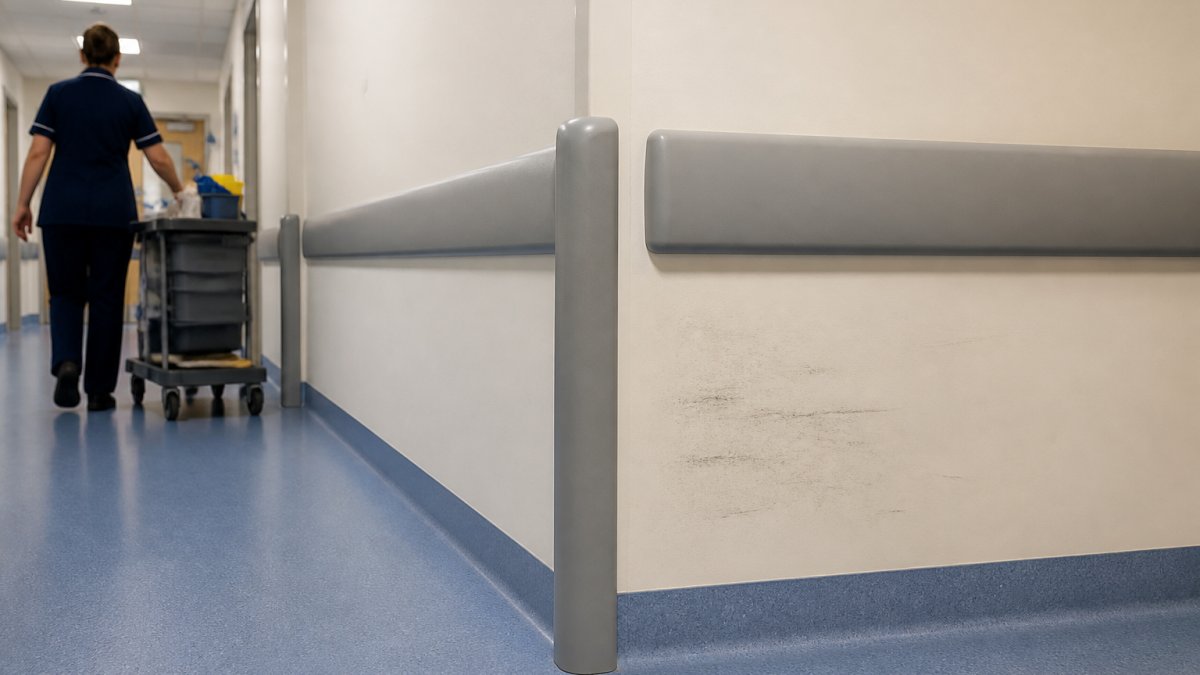
So the specification should follow the damage, not the floor plan.
Three places to prioritise:
- Corners on bed routes. The tightest turns between wards and lifts.
- Doorway edges. Where trolleys clip the frame on the way through.
- Loading and service areas. Where cages and equipment meet the wall hard.
For those high-impact spots, a high impact bumper rail and bump strip gives a specifier a product rated for repeated knocks rather than occasional contact. Watch out: fitting light-duty protection in a heavy-traffic zone costs more over time, because it gets replaced while the wall behind it still fails.
Shelters for Healthcare Sites: Covered Walkways and Waiting Areas
Shelters for healthcare sites solve a problem that is easy to underestimate. Patients, visitors and staff wait outside in all weathers, and an uncovered entrance turns a five-minute wait into a soaking.
The practical uses on a healthcare site include:
- Covered walkways between buildings and car parks
- Waiting areas outside main entrances
- Cycle and scooter stores for staff
- Smoking shelters positioned away from entrances
Specification points that matter:
- Wind loading. Shelters on exposed sites need a structure rated for local conditions.
- Accessibility. Routes under a canopy must stay wide enough for wheelchairs and hospital beds.
- Drainage. Roof design should shed water away from walkways, not onto them.
You can browse the school and site shelter range to see the styles that suit covered walkways and waiting areas. The same structures are used across healthcare, education and public sector sites.
A Step-by-Step Guide to Selecting and Procuring
Procurement for an NHS site follows a predictable path. Get the sequence right and the process moves quickly. Skip a step and it stalls at the point where you can least afford it.
Step 1: Survey the damage. Photograph every scuff, dent and crushed corner. This becomes your evidence base.
Step 2: Group by product type. Sort findings into wall protection, impact protection and shelters. One survey often covers all three.
Step 3: Check the specification. Confirm material, fixings and finish suit the cleaning regime and the substrate.
Step 4: Confirm compliance. Check the product against the relevant British Standard and against NHS England's estates guidance before you shortlist.
Step 5: Get a quote in writing. Ask for delivery times and lead times alongside the price.
Step 6: Plan installation around clinical activity. Corridor closures need ward coordination.
If you also buy for a council or public body, our public sector buyer's guide walks through the same process for local authority purchasing.
Choosing Products for the NHS: What to Ignore
A lot of the noise around NHS products is not useful. Here is what we would ignore, and why.
Ignore the cheapest quote on its own. A bumper rail that fails in a year costs more than one that lasts a decade. Price per year of service is the number that matters.
Ignore appearance-led decisions. A finish chosen for looks will not survive a ward corridor. Choose for durability first.
Ignore vague compliance claims. Ask for the standard, the certificate and the test. "Healthcare grade" is not a standard.
Ignore one-size-fits-all packages. Damage patterns differ between a ward corridor and a loading bay. The specification should reflect that.
What most guides miss is that the specification document is the real product. Get that right and the purchase takes care of itself.
Request a Quote and Specification Check for Your Site
The hardest part of buying products for the NHS is not choosing a bumper rail. It is proving, on paper, that the choice was right. Estates teams need a clear trail from survey to specification to purchase, and that trail has to hold up when a corridor is being repaired again two years later.
At Store Fittings Direct, we help facilities and procurement teams build that trail. We offer over 30 years of experience supplying site protection, shelters and fixtures, a Price Match Promise, and trade accounts with 30 days interest-free credit. Bulk discounts are available on larger orders, and we deliver nationwide.
Get started with Store Fittings Direct and specify wall buffers, impact protection and shelters that still look right after years of daily cleaning.
Frequently Asked Questions
What products does the NHS use to protect its buildings?
NHS estates teams typically fit wall buffers, corner guards, crash rails and hygienic wall cladding in corridors and treatment areas, plus covered walkway shelters at entrances and ambulance bays. The choice depends on traffic volume, cleaning regime and how easily each item can be wiped down. Products for the NHS also need to tolerate frequent disinfection without discolouring, cracking or lifting at the edges, which is why smooth, sealed surfaces are preferred over textured finishes.
What is impact protection in a healthcare setting?
Impact protection for healthcare facilities covers the physical barriers that absorb contact from wheelchairs, beds and cleaning equipment before it reaches the wall. Typical items include corner guards, wall buffers, crash rails and door frame protectors. The aim is twofold: keep the building fabric intact and reduce the disruption and cost of repeated patch repairs. In busy wards, a single unprotected corner can be damaged several times a year, so protection is usually fitted at the points where traffic turns or queues.
What should be considered when selecting a shelter for an NHS site?
Shelters for healthcare sites need to handle high footfall, withstand wind loading and stay easy to clean. Check the frame finish for corrosion resistance, confirm the roof drainage works with the existing surface, and make sure the structure leaves enough clear width for wheelchairs and hospital beds. Consider whether the shelter needs side panels for weather protection, and whether it will sit on an entrance, a smoking area or a cycle store. Ask for delivery lead times before committing to an installation date.
How do wall buffers help protect corridors and walls?
Wall buffers sit proud of the wall surface at equipment and bed height, so moving equipment strikes the buffer rather than the plaster or plasterboard. That keeps corridors looking presentable and cuts the maintenance backlog caused by scuffed and dented walls. Healthcare wall protection works best when buffers, corner guards and rails are specified together, because damage tends to migrate to whichever surface is left exposed. Choose a profile depth that matches the equipment used on the site.


