

Table of Contents
- Why Storefront Bollards Matter for Retail Protection
- Types of Security Bollards for Shops and Commercial Entrances
- Fixed vs Removable Bollards: Which Suits Your Premises?
- Bollard Spacing and Placement Outside Your Shop
- Bollard Installation Requirements and Common Pitfalls
- Quick Comparison: Timber Bollard Options at a Glance
- Conclusion: Matching the Right Bollard to Your Storefront
- Frequently Asked Questions
Last Updated: 12 October 2026
Why Storefront Bollards Matter for Retail Protection
Storefront bollards are short, sturdy posts installed at the edge of your pavement to keep vehicles away from your shop front, pedestrians and glazing. This guide from Store Fittings Direct covers how to choose the right ones for your premises. Getting this decision wrong is expensive: a single vehicle strike can put a shop out of action for weeks, and glass replacement alone can run into thousands.
Most shop owners think about bollards only after an incident. That is backwards. The right posts, spaced correctly and installed properly, cost a fraction of a repair bill and quietly do their job for decades.
Below, we break down materials, fixed versus removable options, spacing and installation so you can specify with confidence. The common mistake is buying on looks alone. A bollard that suits a country park rarely suits a busy high street.
Types of Security Bollards for Shops and Commercial Entrances
The main types of security bollards for shops are timber, steel and concrete posts, each offering a different balance of impact resistance, cost and appearance.
Your choice comes down to three questions:
- What vehicle risk are you guarding against?
- How visible should the posts be?
- What look suits the building?
For most independent shops, timber is a practical starting point. It blends in and installs quickly.
Steel, Timber and Concrete: How Material Affects Performance and Appearance
Timber bollards offer a softer, natural appearance that suits garden centres, parks and period shopfronts. Solid oak is the traditional choice because it weathers well outdoors.

For a full range of solid European Oak bollards, our Timber Bollards | Solid oak with pyramid top come in widths from 100mm to 200mm and lengths from 900mm to 3000mm.
Fixed vs Removable Bollards: Which Suits Your Premises?
Fixed bollards are permanently set into the ground and offer protection. Removable bollards can be lifted out to allow access, which suits shops that need occasional vehicle entry but want the pavement protected the rest of the time. Properly installing steel bollards ensures that these structural barriers remain firmly anchored against impact while maintaining the necessary flexibility for your specific site requirements.
Timber Bollards | Solid oak with pyramid top →
Choose fixed posts when:
- You never need vehicles past the point
For most shopfronts, fixed timber is a simpler answer.
Bollard Spacing and Placement Outside Your Shop
Correct bollard spacing balances protection with access. A common approach is to leave a gap of around 1.2 to 1.5 metres between posts, which allows pedestrians, wheelchairs and pushchairs through while blocking most vehicles.
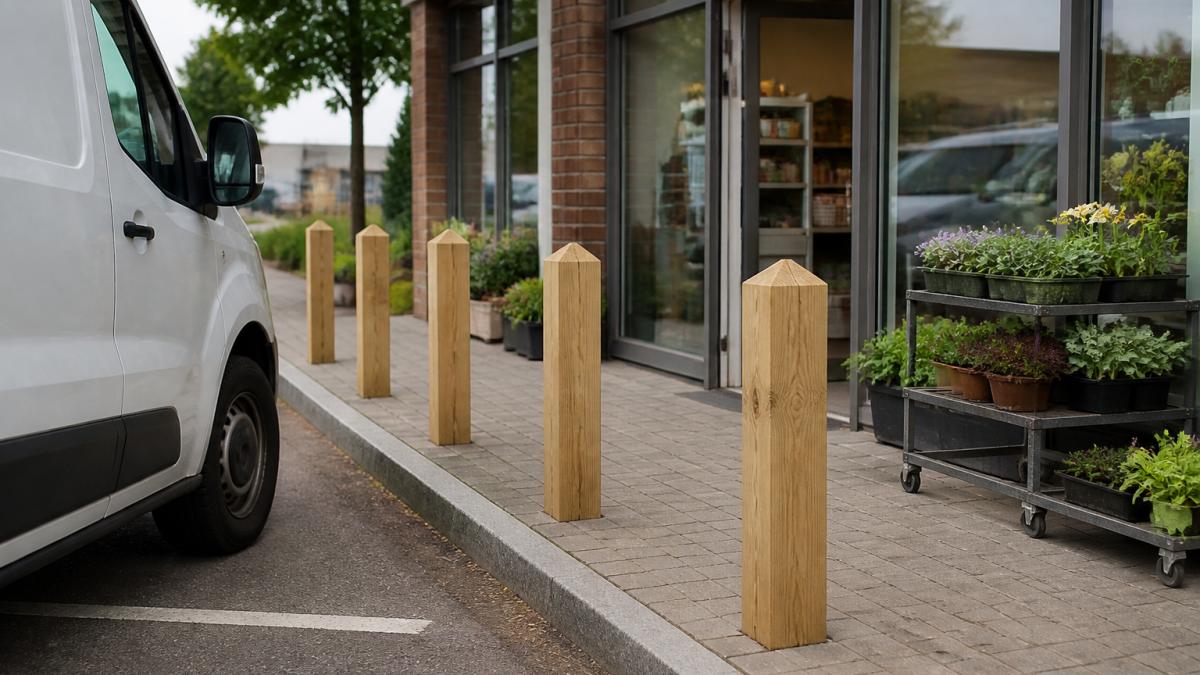
Placement matters as much as spacing:
- Set posts back from the kerb so they do not catch passing traffic
- Line them up with the edge of the pedestrian zone
- Leave a clear route to your entrance
- Check they do not block emergency access
A common mistake is spacing posts so tightly that shoppers cannot pass comfortably. That pushes footfall away from your door. Measure the gaps before you order, not after.
Bollard Installation Requirements and Common Pitfalls
Bollard installation requirements start with depth: posts need to be set well into the ground to resist impact, and the sub-base must be firm. Loose or shallow footings are the single biggest cause of failure.
Before you dig, check for buried services (Excavation and underground services). Water, gas, electricity and telecoms cables run under many pavements, and striking one is dangerous and costly. On public highways you may also need permission from the local authority before installing anything on the footway.
Common pitfalls to avoid:
- Setting posts too shallow, so they lean after a knock
- Forgetting drainage, which lets water pool around timber
- Storing oak bollards indoors before fitting, which causes them to dry and split
- Ignoring the need for approval on public land
Quick Comparison: Timber Bollard Options at a Glance
Timber bollards differ mainly by top finish, which affects both look and price. Here is how our solid oak options compare.
Timber Bollards | Solid oak with pyramid top →
| Bollard | Top Finish | Price | Best For |
|---|---|---|---|
| Solid oak, flat top | Flat | £14.37 | Simple, clean demarcation |
| Solid oak, half pyramid | Half pyramid | £17.97 | Traditional frontages |
| Solid oak, backweather | Backweather | £17.97 | Sheltered, decorative settings |
| Solid oak, pyramid top | Pyramid | £18.68 | Classic shopfront protection |
All four are manufactured from solid oak, with widths from 100mm to 200mm and lengths from 900mm to 3000mm. Each is hand-picked and available with a range of finishes, including rough sawn or planed all round.
Conclusion: Matching the Right Bollard to Your Storefront
Choosing storefront bollards comes down to matching material, fixing type and spacing to your actual risk and setting. Get those three right and the posts will quietly protect your shop for years.
At Store Fittings Direct, we have over 30 years of experience supplying shop fixtures and site protection. Our solid oak timber bollards come with fast nationwide delivery, a Price Match Promise and trade accounts with 30 days interest-free credit.
Get started with Store Fittings Direct and protect your frontage with durable, professional bollards built to last.
Frequently Asked Questions
What type of bollard is best for protecting a storefront?
It depends on the risk and the look you want. Timber bollards such as solid oak with a pyramid or flat top are a good fit for demarcation, protecting grass verges and guiding pedestrians away from traffic, and they blend into landscaped settings. For most shopfronts, start by identifying what you are separating pedestrians from, then match the material and height to that job.
What is the difference between fixed and removable bollards?
Fixed bollards are set permanently into the ground and cannot be moved, so they give consistent, permanent protection and clear pedestrian boundaries.
How far apart should bollards be placed outside a shop?
Spacing depends on what you are keeping out and who needs to pass through. A common approach is to leave a gap of roughly 1 to 1.5 metres between posts so pedestrians, wheelchairs and pushchairs can pass while cars cannot. Where you need to block vehicles entirely, tighten the gaps. Check your local authority's guidance before you fix anything, as some high streets have specific requirements.
Can bollards be installed on existing paving?
They can, but the paving type and sub-base matter. Timber bollards are usually set into a concrete footing below the surface, which means lifting the paving around each post and reinstating it afterwards. Check for services, drainage and cables before you dig, and confirm whether the surface is privately owned or adopted highway. If it is public highway, you will need permission from the relevant local authority first.


